Best IVR Service Provider in India: What to Look For Before You Sign Up (2026 Guide)
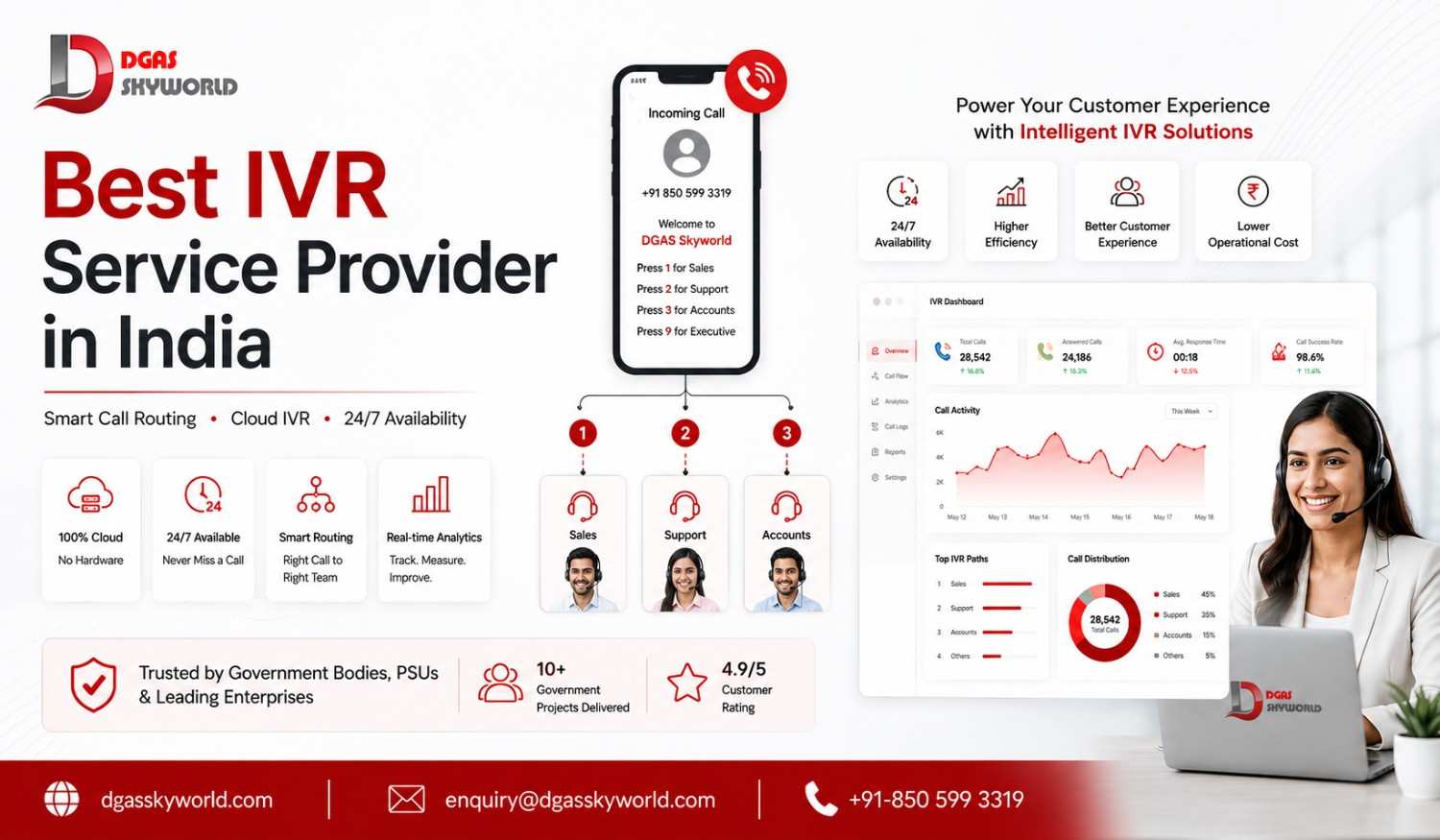
If you run a business in India and your phone keeps ringing off the hook, you already know the problem. One agent can only take one call at a time. Two missed calls during lunch hour and you’ve probably lost a lead who’s already calling your competitor. This is exactly the gap an IVR service is built to close, and it’s why “best IVR service provider in India” is one of the most searched phrases among business owners right now.
The tricky part is that almost every provider on page one calls itself “the best.” So instead of adding one more unverifiable claim to that list, this guide walks through what an IVR service actually is, how it works day to day, what separates a genuinely good provider from a flashy landing page, and where DGAS Skyworld fits into that picture — including the government and enterprise clients we’ve actually delivered projects for, not just logos we’d like to have.
What Is an IVR Service?
An IVR (Interactive Voice Response) service is an automated phone system that greets your callers, plays a set of menu options, and routes them to the right place — a department, an agent, a recorded answer, or a callback queue — based on what they press or say. You’ve heard it a thousand times: “Press 1 for Sales, Press 2 for Support, Press 9 to speak to an executive.”
That’s the simple version. Behind the scenes, what is IVR service really doing for a business? It’s handling three jobs at once:
- Answering every call instantly, even if all your agents are busy or it’s 11 PM.
- Collecting information before the call even reaches a human — account number, language preference, reason for calling.
- Routing calls correctly so a billing query doesn’t land with your sales team and waste everyone’s time.
For a caller, it feels like a two-second decision tree. For the business, it’s the difference between an organised support desk and a chaotic one where every call is a coin flip.
Why Every Growing Business in India Needs a Cloud IVR System
Ten years ago, IVR meant buying an EPABX box, running physical phone lines, and hiring an IT person to keep it alive. That’s gone. Cloud IVR runs entirely on the internet — no hardware in your office, no annual maintenance contract for a machine sitting in a server room.
A few reasons this shift matters right now:
Call volumes in India are only going up. UPI transaction volumes have crossed 10 billion a month, e-commerce order confirmations, EMI reminders, appointment bookings — nearly every transaction today generates a phone touchpoint somewhere. Industry research on India’s cloud communication market puts the country’s CPaaS sector at roughly USD 1.12 billion in 2025, projected to nearly triple to around USD 3.27 billion by 2030. That growth isn’t theoretical — it’s businesses replacing manual call handling with automated systems because the call volume has simply outgrown what a front desk can manage.
Banking and BFSI are leading the shift toward automated self-service. RBI’s push for round-the-clock digital customer access has made cloud IVR close to mandatory for tier-1 banks and NBFCs, and that pressure is trickling down to smaller financial businesses too — loan applicants and EMI customers now expect a call to be answered by a system, not a busy tone.
Remote and hybrid teams need cloud-first tools. If your support team is spread across two cities, a physical EPABX box makes zero sense. Cloud IVR lets an agent in Noida and an agent in Bangalore log into the same call queue from a laptop.
Customers genuinely prefer self-service for routine questions. Nobody wants to wait on hold to ask “what’s my order status” when a keypad press or a recorded response can answer it in five seconds.
Types of IVR Services in India — Which One Does Your Business Actually Need?
Not every business needs the same kind of IVR. Here’s the breakdown, in plain terms:
| Type | What it does | Best suited for |
|---|---|---|
| Single-level IVR | One layer of menu options — “Press 1 for Sales, Press 2 for Support” | Small businesses, single-department setups |
| Multi-level IVR | Nested menus that branch further based on the first choice | Businesses with multiple departments or locations |
| Self-service IVR | Lets callers check balances, order status, or account details without an agent | BFSI, e-commerce, logistics |
| Agent-assisted IVR | Automation handles the greeting and routing, then hands off to a live agent with full context | Support-heavy businesses, healthcare, real estate |
| Outbound / bulk voice IVR | Sends automated calls out to a contact list, sometimes capturing a press-1 response | EMI reminders, appointment confirmations, election and citizen outreach, exam alerts |
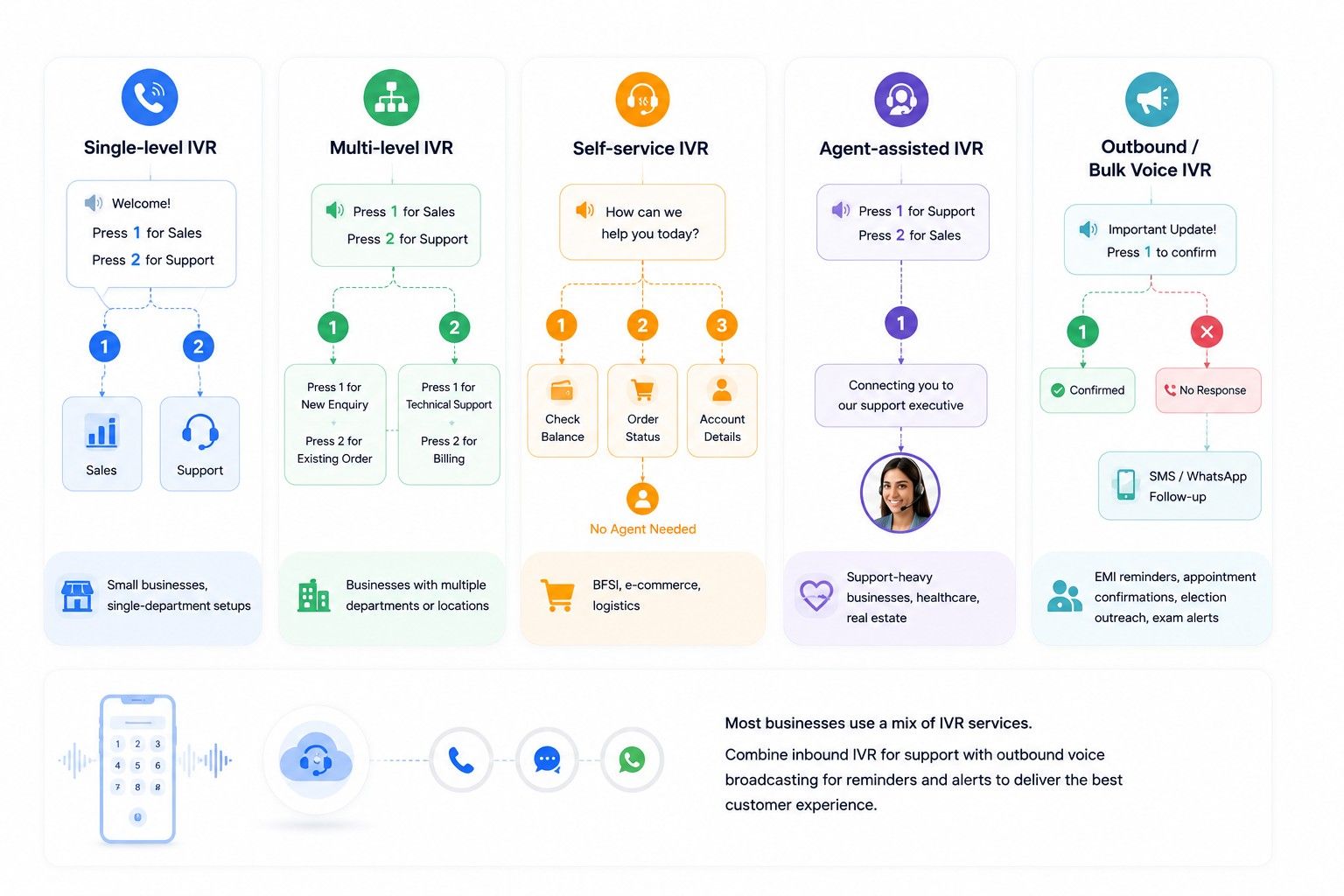
Most businesses actually end up using a mix — an inbound multi-level IVR for support calls, and outbound bulk voice broadcasting for reminders and alerts. That combination is where a CPaaS provider (more on this below) genuinely earns its place over a single-purpose IVR vendor.
How to Choose the Best IVR Service Provider in India: A Practical Checklist
If you’re comparing vendors right now, here’s what actually matters once you get past the sales pitch:
1. Can it handle your real call volume, not just your average one? Ask what happens during a spike — a festival sale, an election, a product launch. Some cheap plans cap simultaneous calls at 20 or 50, and that’s exactly when you’ll need more.
2. Does the menu logic match how your business actually works? Sketch your ideal call flow before you sign anything. If you need time-based routing (different flow after office hours) or language selection as step one, confirm the builder actually supports that without a developer.
3. Is it TRAI and DND compliant by default? In India, this isn’t optional. Outbound campaigns need automatic DND scrubbing, and every call needs proper CLI (Calling Line Identification) display. A provider that treats this as a manual checklist item on your end, rather than something built into the platform, is a red flag.
4. Does it support Hindi and regional languages properly? A robotic-sounding Hindi prompt does more harm than good. Test the actual audio before committing — don’t take “multilingual support” as a checkbox claim.
5. Can it talk to your CRM? Screen-pops, automatic call logging, lead capture — if your IVR and your CRM live in separate worlds, someone on your team is manually copying data every day.
6. Is support actually based in India, in IST hours? When a campaign breaks at 6 PM on a Friday, you want someone who picks up the phone, not a ticket that gets a response the next business day.
7. Is the pricing transparent in INR, with no surprise per-minute or per-DID charges? Ask for the full breakdown — platform fee, inbound minutes, outbound minutes, DID rental, recording storage, GST. Add it up before comparing headline prices across vendors.
If a provider is confident about your business, they’ll walk you through all seven points on a call without hesitation. That’s a decent litmus test on its own.
DGAS Skyworld: A CPaaS Company Built for India, Not Retrofitted for It
We’ve been building communication infrastructure for Indian businesses since 2017 — before “CPaaS” was even a common term here. DGAS Skyworld isn’t a company that started overseas and later added India compliance as an afterthought. Every product we’ve built — SMS API, Enterprise Voice Solutions and IVR, RCS Messaging, WhatsApp Business API, Truecaller Messaging, AI Chatbot, and Email API — was designed for how Indian businesses actually operate, and we serve customers exclusively within India. No overseas routing, no split product roadmap between markets.
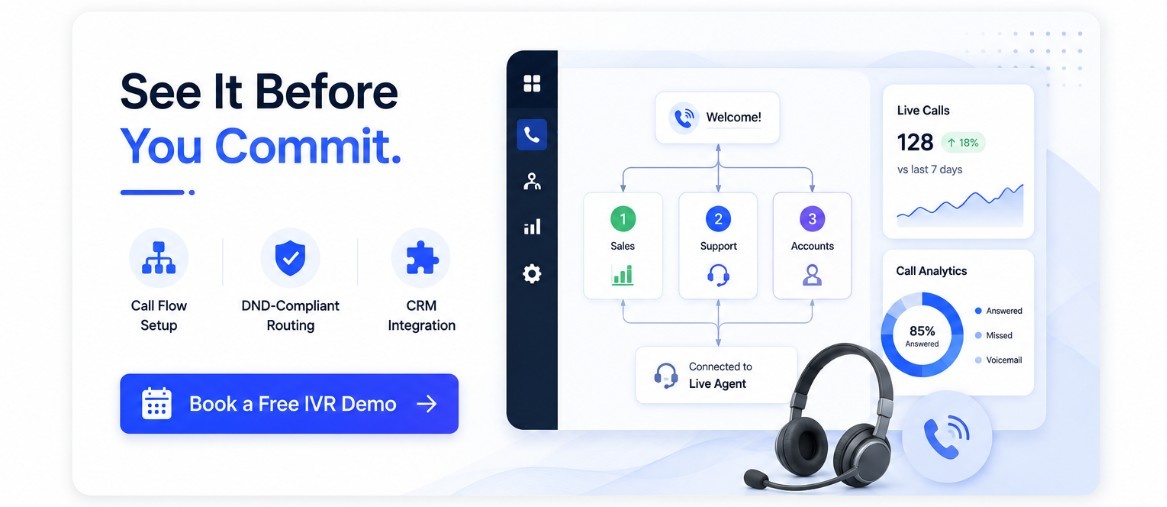
When you set up IVR through DGAS Skyworld, here’s roughly what that looks like in practice: our team maps your call flow first — how many departments, what languages, what happens after hours — before a single line is configured. The multi-level menu, DTMF and voice-based routing, call recording, and real-time call analytics are all managed from one dashboard, and it connects into the same account you’d use for SMS, WhatsApp, or Voice broadcasting, so a missed IVR call can trigger a follow-up SMS automatically instead of just disappearing into a call log nobody checks.
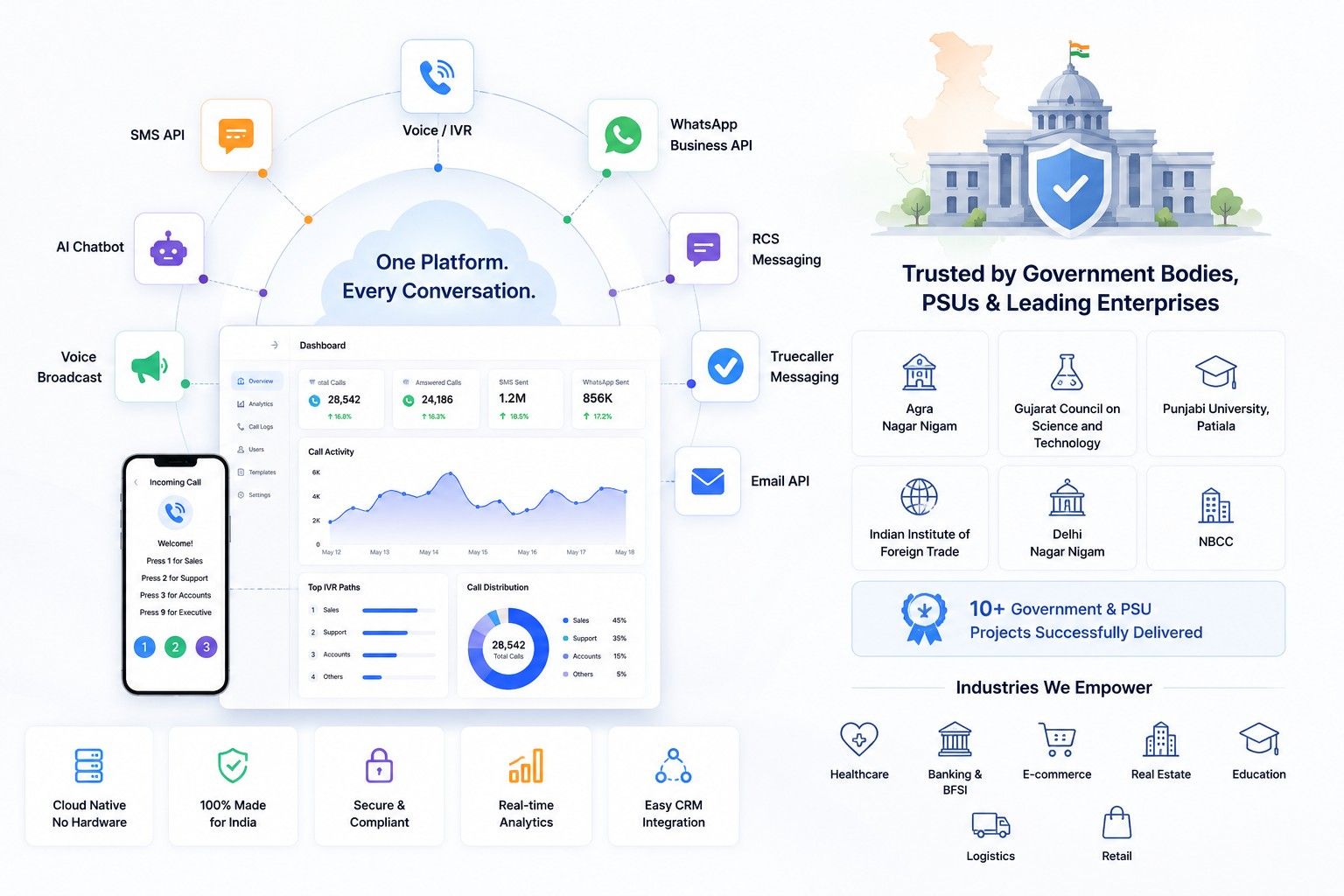
Trusted by Government Bodies, PSUs & Leading Enterprises
This is the part most IVR providers can’t back up with names, so we’ll just list ours:
- Agra Nagar Nigam
- Gujarat Council on Science and Technology
- Punjabi University, Patiala
- Indian Institute of Foreign Trade
- Delhi Nagar Nigam
- NBCC
…and more government organisations, PSUs, and private enterprises across India, with 10+ government and PSU projects successfully delivered. Government and municipal bodies don’t sign off on vendors casually — there’s a compliance and reliability bar most private-sector deals don’t require. Clearing that bar repeatedly is a better trust signal than any five-star badge on a landing page.
On the private side, we work across Healthcare, Banking, E-commerce, Real Estate, Education, Logistics, and Retail — industries with very different call patterns, and each one has shaped how our IVR and voice systems handle edge cases like high concurrent call volume during a sale, or after-hours routing for a hospital helpline.
Explore what else sits under this stack: Enterprise Voice Solutions, WhatsApp Business API, Promotional Bulk SMS, Transactional SMS, Truecaller Messaging, AI Chatbot and Email API.
Why Bulk Voice Broadcasting Works Better Through a CPaaS Provider
This is the one part almost nobody explains properly, so let’s actually go through it.
Bulk voice broadcasting is the outbound cousin of IVR — instead of waiting for a customer to call you, you send a pre-recorded or text-to-speech voice message out to a list of numbers. EMI due reminders, appointment confirmations, election outreach, exam result alerts, delivery updates — anywhere you’d otherwise need thousands of manual phone calls, a voice broadcast does it in minutes, often with a press-1 response captured to gauge interest or confirm action.
Now here’s the part that matters: you could buy this from a standalone voice broadcasting vendor. Or you could get it through a CPaaS provider that also runs your SMS, WhatsApp, and IVR. The second option has real, practical advantages:
- One integration instead of four. A single API connects your CRM to voice, SMS, WhatsApp, and RCS. You’re not maintaining four separate vendor integrations, four sets of documentation, and four support contacts.
- Automatic channel fallback. If a voice call isn’t answered, the same platform can trigger a follow-up SMS or WhatsApp message to the same contact — without you writing that logic yourself. A standalone voice vendor has no idea your SMS provider even exists.
- Compliance handled once, not per-channel. DND scrubbing and consent tracking apply across every channel from a single compliance layer, instead of you manually cross-checking DND lists separately for your voice vendor and your SMS vendor.
- One dashboard for cross-channel numbers. Delivery rate, answer rate, press-1 response rate — visible together, so you can actually compare which channel is working better for a given campaign instead of exporting data from four different portals.
- Easier scaling during high-volume periods. Festival sales, election season, exam result day — call volumes spike hard and fast. A CPaaS provider that already handles your other channels can scale voice capacity without you negotiating a new contract mid-campaign.
- One vendor relationship, one bill. For finance teams, this alone is worth something — one invoice, one account manager, one renewal date, instead of reconciling four.
Where this shows up in real use: a hospital chain using appointment-reminder voice calls alongside SMS confirmations for patients who don’t answer; a real estate developer running IVR-based lead qualification on inbound calls while pushing outbound voice broadcasts to a purchased list, then routing anyone who presses 1 straight into a WhatsApp follow-up; an NBFC sending EMI due voice reminders that automatically fall back to SMS if the call goes unanswered. None of that needs four separate logins if you’re on one CPaaS stack.
IVR Service Provider in Delhi and Noida — Local Support, Not Just a Local Number
If you’ve specifically searched for an ivr service provider in Delhi or an ivr service provider in Noida, the reason is usually simple: you want a team that understands the local business environment and is reachable without a time-zone gap or an overseas support queue.
DGAS Skyworld operates out of the NCR region, and a meaningful chunk of our government and enterprise client base — including municipal bodies and PSUs — is based right here in Delhi NCR. That means when a campaign needs adjusting, or a call flow needs a same-day tweak, you’re talking to a team that’s a phone call away, not a support ticket in a different time zone.
Frequently Asked Questions
What is an IVR service?
An IVR service is an automated phone system that greets callers, presents menu options via voice or keypad, and routes the call to the right department, agent, or self-service answer — without a human needing to pick up first.
Who is the best IVR service provider in India?
There’s no single universal answer — it depends on your call volume, industry, and compliance needs. What matters is checking a provider’s real track record: TRAI/DND compliance, CRM integration, regional language support, and verifiable client history. DGAS Skyworld’s 10+ delivered government and PSU projects are one way to judge that track record directly.
What’s the difference between single-level and multi-level IVR?
Single-level IVR offers one set of menu options (Press 1, Press 2). Multi-level IVR branches further after the first choice — for example, Press 1 for Sales, then Press 1 for New Enquiry or Press 2 for Existing Order. Multi-level suits businesses with more than one or two departments.
Is IVR service available in Delhi and Noida?
Yes. DGAS Skyworld is based in the NCR region and serves businesses and government bodies across Delhi and Noida directly, with local, India-based support.
How does bulk voice broadcasting work with a CPaaS provider?
Voice broadcasting sends automated calls to a contact list from the same platform that runs your SMS, WhatsApp, and IVR — so a missed call can trigger an automatic SMS follow-up, and compliance (DND scrubbing, consent) is handled once across every channel instead of separately per vendor.
Is DGAS Skyworld TRAI and DND compliant?
Yes. All outbound campaigns run through DND scrubbing and TRAI-compliant routing, and DGAS Skyworld operates exclusively within India, keeping data residency and regulatory compliance straightforward.
Can IVR integrate with my CRM?
Yes — DGAS Skyworld’s IVR and voice platform is built to connect with CRM and business systems via API, so call data, lead capture, and recordings sync without manual data entry.
How much does an IVR service cost in India?
Pricing depends on call volume, number of DIDs, and features required (multi-level routing, recording storage, analytics). Rather than quoting a generic figure that may not apply to your setup, it’s worth getting a call-volume-based quote directly — reach out to DGAS Skyworld’s sales team for a plan matched to your actual usage.
Does DGAS Skyworld serve government organizations?
Yes. DGAS Skyworld has delivered 10+ projects for government bodies and PSUs, including Agra Nagar Nigam, Gujarat Council on Science and Technology, Punjabi University Patiala, Indian Institute of Foreign Trade, Delhi Nagar Nigam, and NBCC.
Why choose DGAS Skyworld over other IVR service providers in India?
Because IVR isn’t a standalone product for us — it sits inside a full CPaaS stack (SMS, WhatsApp, RCS, Voice/IVR, Truecaller, Email, AI Chatbot) built exclusively for the Indian market since 2017, backed by a verifiable government and enterprise client history rather than unverified “best in India” claims.
Choosing the Right IVR Partner Comes Down to Proof, Not Promises
Every provider on the internet says “best IVR service provider in India” somewhere on their homepage. The way to actually tell them apart is to ask for proof — real client names, real compliance depth, a real walkthrough of how the call flow gets built for your specific business, not a generic template. Government bodies and PSUs don’t sign multi-year contracts with vendors who can’t deliver, and that’s exactly the bar DGAS Skyworld has been clearing since 2017.
If you’re currently comparing IVR services in India, the fastest way to know if a provider fits is to see the dashboard and call flow builder yourself, on your own use case.
Talk to our Sales Team: +91-850 599 3319
Have a question first? Reach out to DGAS Skyworld
Sources referenced for market data: Persistence Market Research (Cloud Telephony Service Market, 2026–2033), EnableX (India CPaaS Market Insights, 2025–2030), MarkWide Research (IVR System Market Forecast, 2026–2035). Figures should be re-verified against the original reports at time of publishing, as market estimates are updated periodically.


![Automated Voice Messaging System: What It Is, Benefits, Use Cases & How to Use It [2026 Guide]](https://dgasskyworld.com/wp-content/uploads/2026/09/automated-voice-messaging-system.jpeg)