What is CPaaS Platform? Best CPaaS Platform in India (2026 Guide)
If you have ever received an SMS confirming your Swiggy order, a WhatsApp update about your bank transaction, or an OTP while logging into your favourite app, you have already experienced CPaaS in action — even if you never knew the term existed.
For businesses in India, understanding what is CPaaS platform – and knowing how to pick the best CPaaS platform in India — has become a critical decision. Whether you run an e-commerce store, a hospital, a real estate firm, or a school, the way you communicate with your customers directly affects trust, retention, and revenue.
In this guide, we’ll break down CPaaS in plain language, explain how it actually works, compare it with other cloud communication models, and walk you through the best CPaaS platforms in India — along with the exact factors you should evaluate before signing up with any provider.
What is CPaaS? (CPaaS Meaning Explained Simply)
CPaaS stands for Communications Platform as a Service. It is a cloud-based platform that allows businesses to add real-time communication features — like SMS, WhatsApp messaging, voice calls, RCS, and email — directly into their own applications and workflows, without building the underlying telecom infrastructure themselves.
In simpler words: instead of spending months (and lakhs of rupees) building your own SMS gateway or call routing system, a CPaaS platform gives you ready-to-use APIs that let your app “talk” to your customers instantly.
Breaking Down the Term
- Communications — SMS, voice, video, WhatsApp, RCS, email
- Platform — a single cloud-based system that houses all these channels
- As-a-Service — you pay for what you use, without owning or maintaining hardware
A Simple Analogy
Think of a CPaaS platform like the electricity connection in your office. You don’t build your own power plant to run your lights and computers — you simply plug into the grid and pay for what you consume. A CPaaS platform works the same way for communication: you plug your app into the platform’s APIs, and instantly you can send SMS, make voice calls, or trigger WhatsApp messages — without owning any telecom infrastructure.
This is exactly why CPaaS platforms in India have become the backbone of customer communication for e-commerce, BFSI, healthcare, real estate, and D2C brands over the last few years.
How Does CPaaS Work? (The Technology Behind It)
At the core of every CPaaS platform is an API (Application Programming Interface) — a technical bridge that allows your application to send a request (like “send this OTP”) to the CPaaS provider’s servers, which then deliver it through the right channel (SMS, WhatsApp, voice, etc.).
The Role of APIs and SDKs
A CPaaS provider gives developers:
- APIs to trigger messages, calls, or notifications programmatically
- SDKs (Software Development Kits) to integrate faster into web and mobile apps
- Webhooks to receive delivery reports and customer replies in real time
- Documentation and technical support to make integration smoother
A Real India Example
Imagine a real estate company running a property launch campaign. A prospective buyer fills a lead form on their website. Within seconds:
- The SMS API sends an instant acknowledgment SMS
- The WhatsApp Business API sends a brochure and site-visit link
- A voice call is triggered to connect the lead to a sales executive
- All of this is logged and DLT-compliant, because it’s routed through a registered CPaaS platform in India
This entire sequence happens through a single integration — this is the real power of a CPaaS platform.
(For a deeper dive into how one of these channels works, see our detailed guide on what is WhatsApp API and how it powers business messaging.)
CPaaS vs UCaaS vs SaaS — What’s the Difference?
Many businesses confuse CPaaS with UCaaS (Unified Communications as a Service) or think of it as “just another SaaS tool.” Here’s a clear comparison:
| Factor | CPaaS | UCaaS |
|---|---|---|
| Purpose | Embed communication into your own app/workflow | Ready-made internal team communication suite |
| Customization | High — build exactly what you need | Limited — fixed feature set |
| Technical effort | Requires API integration | Plug-and-play, no coding |
| Best for | Customer-facing communication (SMS, WhatsApp, voice alerts) | Internal team calls, video meetings |
| Pricing model | Pay-as-you-go (per message/call) | Subscription-based (per user) |
When to Choose CPaaS Over UCaaS
If your goal is to talk to your customers — sending order updates, appointment reminders, OTPs, or marketing messages — a CPaaS platform is the right fit. If your goal is internal team collaboration (like video meetings between employees), UCaaS tools serve that purpose better. Many growing Indian businesses actually use both — UCaaS internally, CPaaS externally.
Key Benefits of Using a CPaaS Platform for Indian Businesses
1. Cost Efficiency — No Heavy Infrastructure Investment
You don’t need to invest in servers, telecom licenses, or a large in-house development team. You only pay for the messages, calls, or API calls you actually use.
2. Faster Time-to-Market
Instead of building communication features from scratch, businesses can integrate a CPaaS API in days, not months, and launch customer engagement campaigns much faster.
3. Scalability for Seasonal and Festive Traffic
Indian businesses deal with massive traffic spikes — Diwali sales for e-commerce, exam-result notifications for edtech, or festive booking surges for travel. A good CPaaS platform in India scales instantly to handle this volume without any manual intervention.
4. Better Customer Engagement Across Channels
Customers today expect to be reached on the channel they prefer — SMS, WhatsApp, RCS, or voice. CPaaS platforms let you run all these channels from a single dashboard or API layer.
5. Built-In DLT & TRAI Compliance
This is where India-focused CPaaS platforms have a real edge over global providers. Every SMS and promotional message sent in India must comply with TRAI’s DLT (Distributed Ledger Technology) regulations. A CPaaS platform that deeply understands Indian telecom compliance — rather than treating it as an afterthought — protects your business from message blocking, penalties, and delivery failures.
(We’ve covered this compliance requirement in detail in our post on Benefits of Bulk SMS Marketing and how DLT registration protects your campaigns.)
Core Features & Communication Channels Offered by CPaaS Platforms
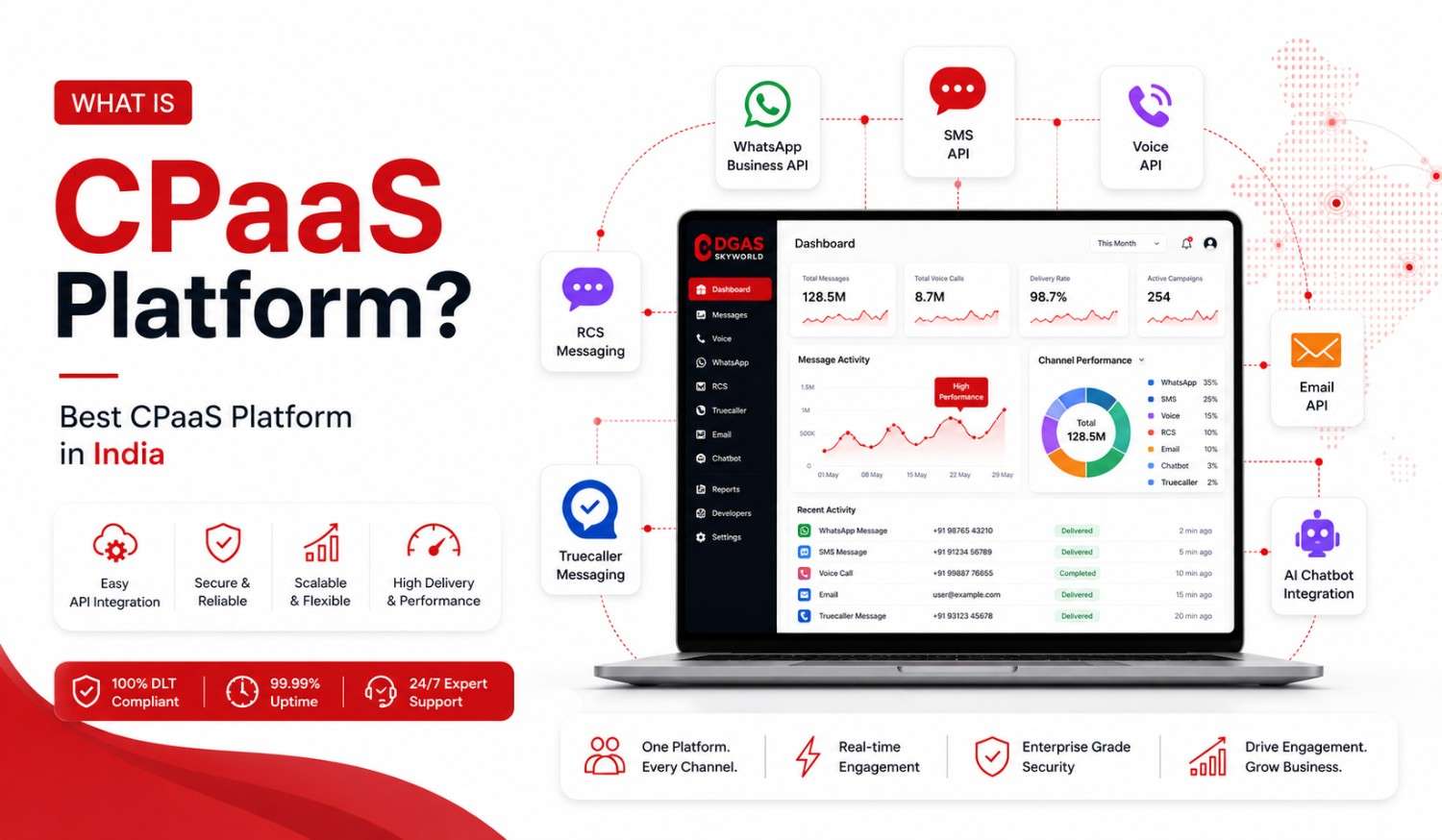
A strong CPaaS platform typically bundles the following channels under one roof:
- SMS API — for OTPs, alerts, transactional and promotional messages (learn more about SMS API)
- WhatsApp Business API — for rich, two-way conversational messaging, catalogs, and automated replies (see our WhatsApp automation guide)
- RCS Messaging — the next generation of SMS with rich media, branding, and interactive buttons
- Enterprise Voice Solutions — automated IVR, voice OTPs, and click-to-call for sales and support
- Email API — for transactional and marketing emails with deliverability tracking
- AI Chatbots — for automated, always-on customer support across web and WhatsApp
- Truecaller Messaging — a channel most global CPaaS providers don’t even offer, but increasingly valuable for Indian businesses wanting verified, spam-free outreach directly through Truecaller’s business messaging network
This full-stack channel coverage — SMS, WhatsApp, RCS, Voice, Email, AI Chatbot, and Truecaller Messaging under a single India-focused platform — is exactly the kind of comprehensive setup that has made DGAS Skyworld one of the more complete CPaaS platforms available to Indian businesses today, compared to providers that only specialize in one or two channels.
Real-World Use Cases of CPaaS in India
E-commerce — Order & Delivery Alerts
Automated SMS and WhatsApp updates for order confirmation, shipping, and delivery — reducing “Where is my order?” support tickets.
Healthcare — Appointment Reminders
Clinics and hospitals use voice and SMS reminders to cut down missed appointments and improve patient follow-through.
BFSI — OTP & Fraud Prevention
Banks and NBFCs rely on SMS and voice OTPs for secure logins, transaction verification, and two-factor authentication.
Real Estate — Lead Notifications & WhatsApp Follow-ups
Property developers use CPaaS to instantly respond to website leads with WhatsApp brochures, site-visit scheduling, and voice callbacks — a workflow we’ve helped structure for luxury residential campaigns in the NCR corridor.
Education — Admission Alerts & Fee Reminders
Schools and colleges automate admission confirmations, fee due reminders, and exam notifications via SMS and WhatsApp at scale.
How to Choose the Best CPaaS Platform in India — Key Factors to Consider
Before picking any provider, evaluate them against this checklist:
- DLT & TRAI Registration Compliance — Is the provider fully registered and does it guide you through DLT template approval?
- Channel Coverage — Does it support SMS, WhatsApp, RCS, Voice, and Email under one roof, or will you need multiple vendors?
- API Documentation & Ease of Integration — Are the APIs well-documented with clear SDKs and sandbox testing?
- Pricing Transparency — Is pricing per-message/per-call clearly stated, with no hidden charges?
- Local Support & Uptime Reliability — Does the provider offer India-based support that understands local carrier issues and compliance nuances?
- Official API Provider Status — Is the provider an official, direct API partner (e.g., an official WhatsApp Business API provider), or are you buying through a reseller layer that adds cost and reduces accountability?
- Data Security & Privacy Standards — Does the platform follow strong encryption and data-handling practices for sensitive customer data?
Best CPaaS Platforms in India in 2026 (Comparison)
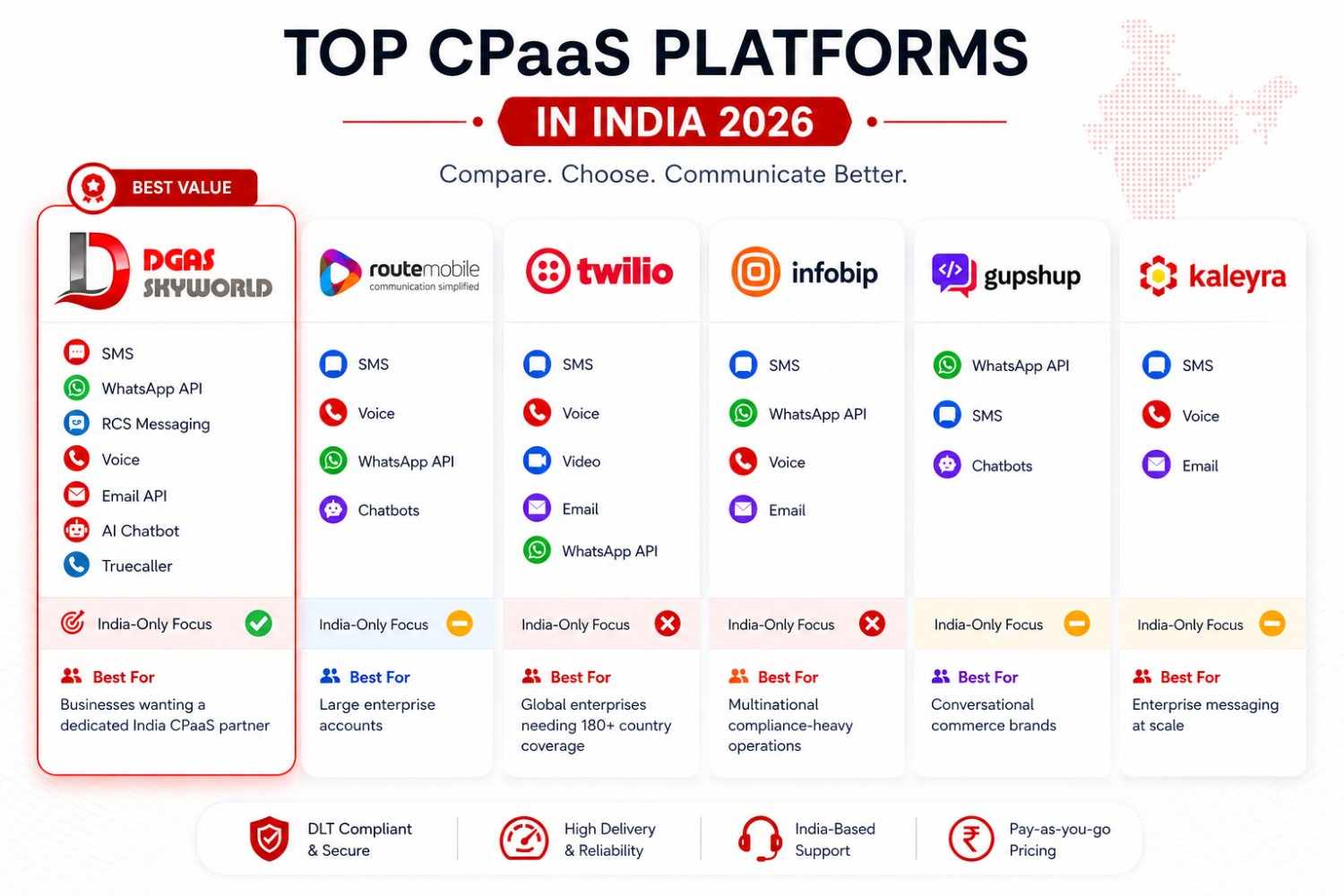
India’s CPaaS market includes both India-focused specialists and global players with an India presence. Here’s an honest look at the leading options:
1. DGAS Skyworld
DGAS Skyworld has been operating exclusively in the Indian CPaaS space since 2017, and this India-only focus is precisely what sets it apart from global providers who treat India as just one of 180+ markets.
What makes it stand out:
- Full channel stack in one platform — SMS API, WhatsApp Business API, RCS Messaging, Enterprise Voice Solutions, Truecaller Messaging, AI Chatbot, and Email API
- Official WhatsApp Business API provider — not a reseller or a layer on top of a BSP, which means direct accountability, faster support resolution, and no unnecessary markup
- Deep DLT/TRAI compliance expertise — because DGAS Skyworld only operates within India, compliance isn’t a side feature; it’s built into the core of how the platform is run
- India-first support — support teams that understand Indian carrier networks, regional language nuances, and local business workflows in a way that global providers structurally cannot match
- Best suited for: Indian businesses — from real estate and healthcare to D2C and BFSI — that want a communication partner solely focused on the Indian market rather than a global platform where India is a secondary priority
This singular India focus, combined with genuine ownership of the WhatsApp Business API relationship (rather than reselling through a BSP), is why DGAS Skyworld has positioned itself as a serious contender for the title of best CPaaS platform in India — particularly for businesses that don’t need (and don’t want to pay for) global coverage they’ll never use.
See it in action: Want to test SMS, WhatsApp, RCS, Voice, and AI Chatbot working together on a single dashboard? Book a Free Omnichannel CPaaS Demo with DGAS Skyworld and see how a single India-focused platform can replace your current multi-vendor setup.
2. Route Mobile
An established Indian CPaaS player with strong omnichannel workflows and Meta Business Partner status, primarily serving large enterprise accounts.
3. Twilio
A global CPaaS leader with massive scale (2.5 trillion+ communications annually), but pricing and support structures are built around global enterprises, not India-specific SMB needs.
4. Infobip
A globally recognized CPaaS provider with strong compliance tooling, though — like Twilio — its India offering is one piece of a much larger global operation.
5. Gupshup
Known primarily for conversational messaging and WhatsApp API access, with a strong presence among Indian D2C brands.
6. Kaleyra
An India-origin CPaaS provider (now part of a larger global group) offering SMS, voice, and email APIs to enterprise clients.
Comparison at a Glance
| Platform | Key Channels | India-Only Focus | Best For |
|---|---|---|---|
| DGAS Skyworld | SMS, WhatsApp API, RCS, Voice, Email, AI Chatbot, Truecaller | ✅ Yes (since 2017) | Businesses wanting a dedicated India CPaaS partner |
| Route Mobile | SMS, Voice, WhatsApp, Chatbots | Partial (global expansion) | Large enterprise accounts |
| Twilio | SMS, Voice, Video, Email, WhatsApp | ❌ Global platform | Global enterprises needing 180+ country coverage |
| Infobip | SMS, WhatsApp, Voice, Email | ❌ Global platform | Multinational compliance-heavy operations |
| Gupshup | WhatsApp, SMS, Chatbots | Partial | Conversational commerce brands |
| Kaleyra | SMS, Voice, Email | Partial (global group) | Enterprise messaging at scale |
CPaaS Pricing in India – What to Expect
Most CPaaS platforms in India follow a pay-as-you-go model, where you’re billed per SMS, per WhatsApp conversation, per voice minute, or per API call. Some providers also offer volume-based slabs or monthly subscription tiers for high-volume businesses. When comparing pricing, always check whether DLT/template setup costs, API access fees, and support charges are included — many providers quote a low per-message rate but add these separately.
Common Mistakes Businesses Make When Choosing a CPaaS Provider
- Ignoring DLT registration until it’s too late — leading to blocked messages right when a campaign needs to go live
- Choosing a reseller instead of an official API provider — resellers add cost layers and slow down issue resolution since they don’t own the direct relationship with WhatsApp or telecom carriers
- Not checking uptime/SLA guarantees — a few hours of downtime during a sale or campaign can cost real revenue
- Overlooking local support — a global support ticketing system is far less useful than a team that understands Indian carrier and compliance issues directly
Frequently Asked Questions
What is a CPaaS platform in simple words?
A CPaaS platform is a cloud-based service that lets businesses add communication features like SMS, WhatsApp, voice calls, and email into their own apps or systems using ready-made APIs, instead of building this infrastructure from scratch.
What is the difference between CPaaS and UCaaS?
CPaaS is used to embed communication into your own business applications for customer-facing use (like SMS alerts or WhatsApp messages), while UCaaS is a ready-made internal communication suite mainly used for team collaboration, such as video meetings and calls.
Which is the best CPaaS platform in India?
Among India-focused providers, DGAS Skyworld stands out for offering a complete channel stack — SMS, WhatsApp Business API, RCS, Voice, Email, AI Chatbot, and Truecaller Messaging — combined with deep DLT/TRAI compliance expertise and official WhatsApp API provider status, since it has operated exclusively in the Indian market since 2017.
Is DLT registration mandatory for SMS/WhatsApp API in India?
Yes. TRAI mandates DLT registration for all businesses sending promotional and transactional SMS in India. A reliable CPaaS provider will guide you through this registration and template approval process.
How much does a CPaaS platform cost in India?
Most providers use a pay-as-you-go pricing model, charging per SMS, per WhatsApp conversation, or per voice minute, with some offering volume-based discounts for high-usage businesses.
Can small businesses use CPaaS, or is it only for enterprises?
CPaaS platforms are built to scale, which means small businesses can start with low usage and pay only for what they consume, while enterprises can scale up to millions of messages without changing platforms.
Is WhatsApp Business API part of CPaaS?
Yes. WhatsApp Business API is one of the core channels offered by most CPaaS platforms, alongside SMS, voice, RCS, and email.
Conclusion — Choosing the Right CPaaS Partner for Your Business
CPaaS has moved from being a “nice-to-have” to a core part of how Indian businesses communicate with their customers — whether it’s an OTP, an order update, or a WhatsApp follow-up on a real estate lead. The right platform should offer the channels you actually need, transparent pricing, and — most importantly for Indian businesses — genuine DLT/TRAI compliance expertise rather than a bolted-on afterthought.
For businesses looking for a CPaaS partner that has built its entire focus around the Indian market since 2017 — offering SMS API, WhatsApp Business API, RCS Messaging, Enterprise Voice Solutions, Truecaller Messaging, AI Chatbot, and Email API as an official provider rather than a reseller — DGAS Skyworld is worth evaluating as your communication backbone.
Ready to See It Work for Your Business?
Talk to our team and get a hands-on walkthrough of every channel — SMS, WhatsApp Business API, RCS, Voice, Email, AI Chatbot, and Truecaller Messaging — tailored to your industry.
Explore our related guides: What is WhatsApp API · WhatsApp Blue Tick Verification · A2P Messaging Explained · Benefits of Bulk SMS Marketing