2 Way SMS Messaging: How It Works, Benefits & Business Uses
Businesses need more than a way to send messages. They need a reliable way to receive customer responses, answer questions and take action. This is where 2 way SMS messaging makes a difference.
Unlike traditional one-way SMS campaigns, two-way messaging allows businesses and customers to communicate through text messages. Customers can reply to promotions, confirm appointments, request information, share feedback or connect with support teams.
With a suitable SMS gateway and automation setup, businesses can manage these conversations at scale. In this guide, we explain how two-way SMS works, its benefits, practical applications and how businesses can use it effectively.
What Is 2 Way SMS Messaging?
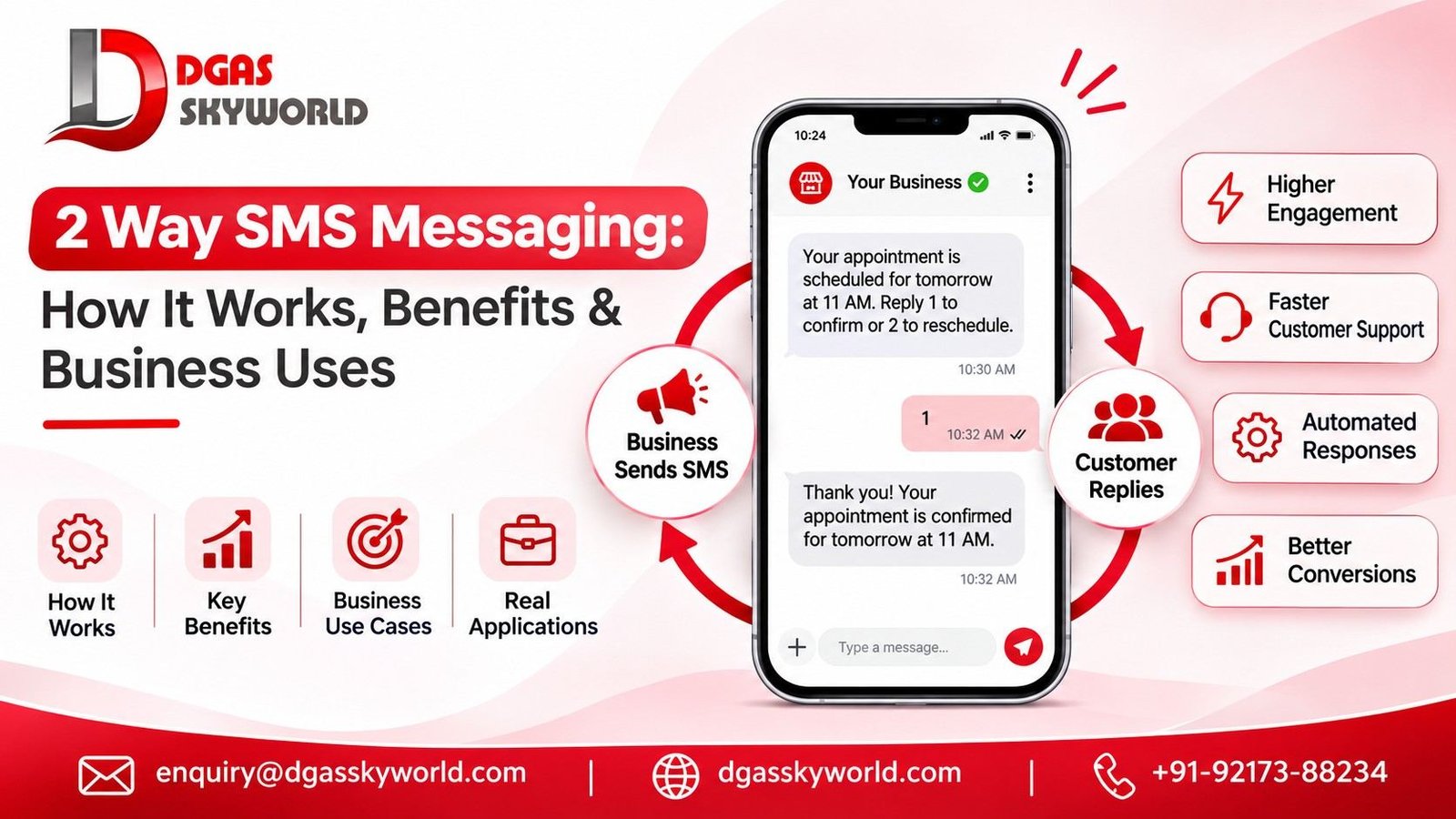
2 way SMS messaging is a communication method that allows businesses to send SMS messages and receive replies from customers using the same messaging channel.
For example, a business sends:
Your appointment is scheduled for tomorrow at 11 AM. Reply 1 to confirm or 2 to reschedule.
The customer replies with 1 or 2, and the system processes the response accordingly.
This creates a two-way communication channel instead of simply delivering information.
A two-way SMS messaging service typically uses an SMS gateway, a reply-enabled number or shortcode, and an application or inbox to receive and manage incoming messages.
How Does Two-Way SMS Messaging Work?
Two-way SMS communication involves two types of messages:
- MT (Mobile Terminated): Messages sent by a business to a customer’s mobile phone.
- MO (Mobile Originated): Messages sent by a customer back to the business.
Here is how the process works:
- Business sends an SMS: The company sends a notification, offer, reminder or question through an SMS gateway.
- Customer receives the message: The message reaches the recipient through the mobile network.
- Customer replies: The recipient responds using a keyword, number or free-text message.
- SMS gateway receives the reply: The incoming message is routed to the business platform.
- System takes action: An automated response is triggered, or the message is forwarded to an agent or CRM.
For example, a customer replying YES to a payment reminder can trigger an automated confirmation or update in the connected system.
One-Way SMS vs Two-Way SMS
The main difference is whether customers can respond to the messages they receive.
| Feature | One-Way SMS | Two-Way SMS |
|---|---|---|
| Communication | Business to customer | Business and customer |
| Customer replies | Not supported on the route | Supported |
| Interaction | Limited | Interactive |
| Automation | Alerts and notifications | Replies and automated workflows |
| Common use cases | OTPs, alerts, updates | Surveys, confirmations, support |
One-way SMS works well for delivering information. 2 way SMS messaging is more suitable when a business needs customer responses or wants to manage conversations.
Key Features of a Two-Way SMS Messaging Service
A business-ready two-way SMS solution should offer the following capabilities:
1. Inbound and Outbound SMS: Send messages and receive customer replies through a centralized platform.
2. Keyword-Based Responses: Use keywords such as YES, NO, STOP, HELP or BOOK to trigger specific actions.
3. Automated SMS Replies: Send instant responses based on customer keywords, selections or predefined rules.
4. SMS API Integration: Connect messaging workflows with websites, mobile applications, CRM systems and business software.
5. Shared Inbox and Reply Management: Allow support or sales teams to view incoming messages, assign conversations and respond.
6. Delivery Reports and Analytics: Monitor message delivery, inbound replies, response rates and campaign performance.
7. Workflow Automation: Trigger actions such as appointment updates, lead allocation, feedback requests and payment confirmations.
Business Use Cases of 2 Way SMS Messaging
Two-way SMS can support customer engagement across multiple industries.
| Industry | Practical Application |
|---|---|
| Banking and Finance | Payment confirmations, service requests and customer feedback |
| Healthcare | Appointment confirmations, reminders and patient feedback |
| Education | Fee confirmations, parent responses and admission enquiries |
| Retail and E-commerce | Order updates, product enquiries and promotional responses |
| Real Estate | Site visit confirmations, property enquiries and lead qualification |
| Travel and Hospitality | Booking confirmations, cancellations and customer support |
| Government | Citizen feedback, service updates and information requests |
For example, an educational institution can send fee reminders and ask parents to reply with a confirmation. A healthcare provider can allow patients to confirm or reschedule appointments through SMS.
Why Are Businesses Using Two-Way SMS?
Two-way messaging helps businesses turn routine notifications into measurable customer interactions.
According to the 2024 Consumer Texting Report by EZ Texting, 84% of surveyed consumers said they read new text messages within 15 minutes. The report also found that 42% expected a business response within 15 minutes.
These findings highlight why timely messaging and reply management matter. However, businesses should measure actual campaign performance rather than assume every message is read.
Key benefits include:
- Faster customer responses: Customers can reply directly instead of visiting another channel.
- Better engagement: Interactive messages encourage customers to take action.
- Reduced manual work: Automated replies handle common questions and confirmations.
- Improved customer experience: Customers can respond through a familiar communication channel.
- Lead qualification: Businesses can identify interested prospects through keyword-based replies.
- Measurable performance: Reply rates, delivery reports and conversions help evaluate campaigns.
Important Considerations Before Choosing a 2 Way SMS Messaging Service
Not every SMS route or sender ID supports incoming replies. Before choosing a provider, check these important requirements:
- Reply-enabled numbers: Confirm whether the provider offers a suitable two-way number or shortcode.
- Operator support: Inbound SMS availability can vary by country, telecom operator and messaging route.
- API and integration support: Check whether incoming replies can be connected to your CRM, application or helpdesk.
- Automation capabilities: Confirm support for keywords, auto-replies and custom workflows.
- Reporting: Look for delivery reports, inbound message logs and campaign analytics.
- Compliance: Ensure the provider follows applicable messaging regulations.
DLT Compliance for Two-Way SMS in India
Businesses sending commercial SMS in India must follow applicable TRAI and Distributed Ledger Technology (DLT) requirements.
Depending on the communication category, businesses may need to complete Principal Entity registration, register sender headers and content templates, and obtain consent where required.
It is also important to confirm the inbound reply mechanism with your telecom provider. A registered sender header does not automatically mean that customers can reply to it.
Refer to the TRAI guidelines for senders and telemarketers for compliance requirements.
Why Choose DGAS Skyworld for Business Messaging?
DGAS Skyworld provides cloud-based communication solutions that help businesses manage customer communication through multiple channels.
Its CPaaS ecosystem includes:
- Bulk SMS and SMS API
- WhatsApp Business API
- RCS Business Messaging
- Voice Solutions
- Email API
- AI Chatbots
Businesses can integrate communication APIs with their existing applications, CRM platforms and business workflows.
DGAS Skyworld’s published platform figures include:
- 12,000+ active users
- 4.3+ user rating
- 500+ trusted partners and government organisations
These are published platform-level figures, not a specific two-way SMS delivery or uptime guarantee. Businesses evaluating a provider should request the latest SLA, operator-wise delivery reports, inbound routing performance and API reliability metrics.
Explore DGAS Skyworld and its API integration capabilities to understand how its communication solutions can support business workflows.
The Future of Business Messaging Is Interactive
Customer communication is moving beyond isolated notifications towards connected, conversational experiences. SMS continues to play an important role, while channels such as RCS, WhatsApp and AI-powered chatbots offer additional ways to engage customers.
Infobip’s 2026 Messaging Trends Report recorded 628 billion mobile-channel interactions on its platform during 2025, highlighting the growing scale of business messaging. These are Infobip platform figures, not a measurement of the entire messaging industry.
For businesses, the opportunity is to use the right channel for each interaction. 2 way SMS messaging can handle simple confirmations, replies and customer feedback, while richer conversations can move to WhatsApp, RCS or other supported channels.
With the right gateway, automation and integration, businesses can make customer communication more responsive and efficient.
FAQ: 2 way SMS Messaging
1. What is 2 way SMS messaging?
It is a messaging method that allows businesses to send SMS messages and receive customer replies through a reply-enabled number or shortcode.
2. What is the difference between inbound and outbound SMS?
Outbound SMS is sent by a business to a customer (MT), while inbound SMS is sent by a customer to a business (MO).
3. Can two-way SMS messages be automated?
Yes. Businesses can configure keyword-based replies, automated responses and API-triggered workflows to process incoming messages.
4. Does two-way SMS work in India?
Yes, where the selected provider, telecom operator and messaging route support inbound replies. Businesses must also follow applicable TRAI and DLT requirements.
5. What is the difference between a two-way SMS gateway and an SMS API?
A two-way SMS gateway handles the sending and receiving of messages. An SMS API allows applications and software to connect with that gateway programmatically.
6. Can two-way SMS integrate with CRM software?
Yes. With API integration, incoming replies can be recorded in CRM systems, assigned to teams or used to trigger automated business actions.
Start Building Better Customer Conversations with 2 way SMS Messaging
Move beyond one-way notifications. Explore 2 way SMS messaging solutions that help you send updates, receive responses and manage customer interactions through connected communication channels.
Contact DGAS Skyworld to discuss your business messaging requirements.