WhatsApp OTP Verification Service: Features, Pricing & Benefits (2026)
Somewhere between the third failed SMS OTP and the customer abandoning the checkout page, most Indian businesses have the same realization: their authentication flow is losing them money. The code was sent. It just never arrived — or it arrived four minutes late, right after the user gave up and closed the app.
This is the exact gap that WhatsApp OTP verification was built to close. Instead of pushing a one-time password through a congested SMS route, businesses now deliver it straight into an app that’s already open on almost every Indian smartphone. If you’re evaluating otp verification on WhatsApp for your login, signup, or payment flow, this guide walks through what it actually is, how a WhatsApp OTP verification service provider should be evaluated, and why the businesses getting the best results aren’t using WhatsApp alone – they’re running it inside a wider omnichannel CPaaS setup.
What Is WhatsApp OTP Verification?
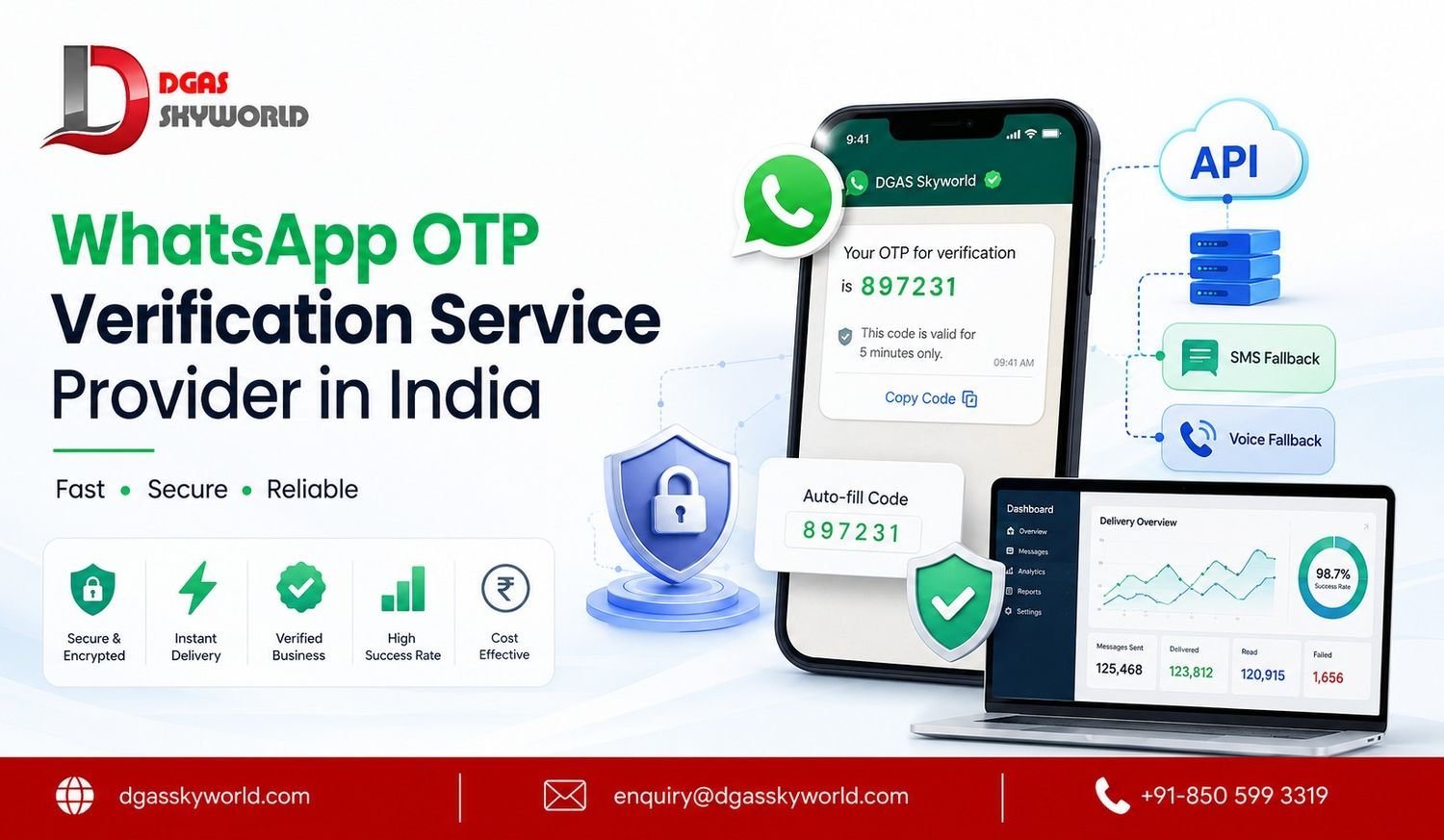
WhatsApp OTP verification is a method of authenticating a user by sending a one-time password through a Meta-approved WhatsApp Authentication template instead of a text message. The code is generated the same way an SMS OTP is — a short-lived, randomly generated string — but it’s delivered inside an encrypted WhatsApp chat from a verified business sender, rather than from an unfamiliar ten-digit number or SMS header.
Functionally, otp verification on WhatsApp looks almost identical to SMS OTP from the user’s side: they get a message, they enter the code, they’re verified. What changes is the delivery layer. WhatsApp Authentication templates travel over Meta’s infrastructure, arrive with your business name and logo attached, and — on supported Android devices — can even be auto-filled without the user typing anything. Businesses typically set a short validity window (commonly 3–5 minutes) so a code can’t be reused or intercepted later.
It’s worth being precise about the category, too. Meta treats OTPs as “Authentication” template messages — a separate bucket from Marketing or Utility messages — with its own approval process and, unlike some other template types, billing that applies even inside a customer-initiated conversation window. That distinction matters when you’re comparing pricing across a whatsapp otp service provider india shortlist, because a provider quoting a low headline rate may not be quoting the authentication-specific rate you’ll actually pay.
Why Indian Businesses Are Shifting to OTP Verification on WhatsApp
The shift toward WhatsApp OTP verification service isn’t a trend chasing novelty — it’s a response to two things happening at once: SMS reliability is under pressure, and WhatsApp usage in India has become close to universal.
India is WhatsApp’s single largest market in the world, with hundreds of millions of monthly active users — a scale no other messaging app in the country comes close to matching. Business messages sent through WhatsApp are opened at dramatically higher rates than email, and a large majority of Indian small and mid-sized businesses already use WhatsApp in some form for customer communication. When almost every one of your users already has the app installed and open, routing your OTP there instead of through an SMS gateway simply meets people where they already are.
On the SMS side, the picture is more strained. DLT-registered SMS routes in India have grown more expensive over the past few years, and template mismatches, sender ID issues, or telecom-level filtering can delay or drop transactional messages at exactly the moment a user is waiting to log in. A whatsapp otp verification service provider sidesteps a lot of that friction because the message travels over Meta’s own delivery network rather than through multiple telecom hops.
There’s also a trust dimension that’s easy to underrate. A WhatsApp Authentication message arrives with your verified business name and, once your account clears Meta’s review, a green checkmark next to it. For a user who’s grown wary of SMS-based OTP scams and spoofed sender IDs, seeing a message land inside a known WhatsApp thread — instead of from an unfamiliar alphanumeric sender — is a small but real trust signal that improves completion rates.
None of this means SMS OTP is obsolete. It means WhatsApp has become the stronger primary channel for a large share of Indian users, with SMS best used as the safety net underneath it — which is exactly the model covered in the next section.
How WhatsApp OTP Verification Works
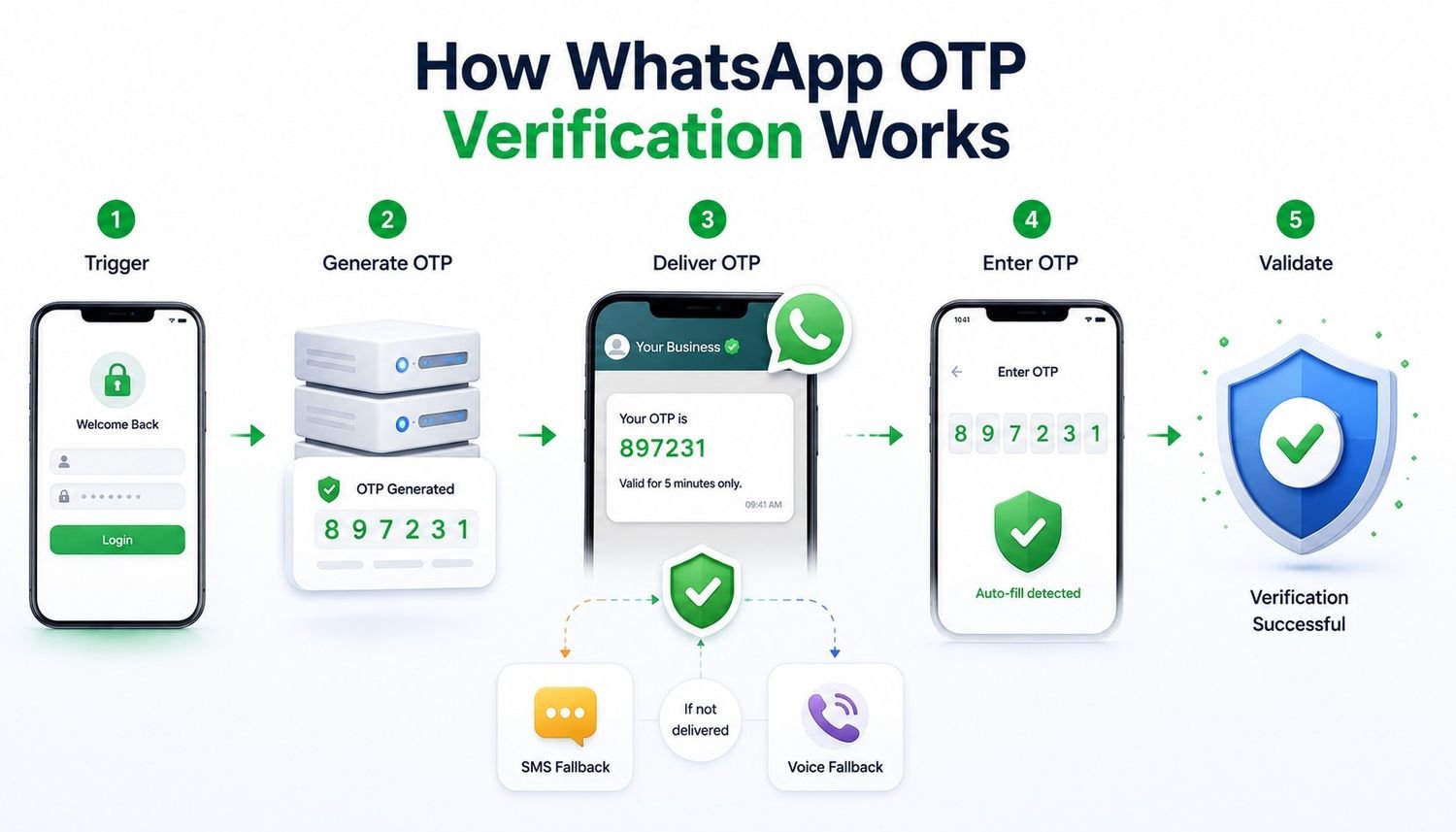
Underneath the simple user experience, a WhatsApp OTP verification service typically runs through five steps:
- Trigger — The user initiates a login, signup, password reset, or transaction on your app or website.
- Generation — Your backend (or your provider’s API) generates a random, time-bound OTP and logs an expiry window against it.
- Delivery — The OTP is sent using a pre-approved WhatsApp Authentication template from your verified business number. If the message isn’t delivered or read within a set time, a well-built system automatically retries over SMS or voice.
- Entry — The user reads the code (or taps to auto-fill it, on supported devices) and submits it in your interface.
- Validation — Your system checks the code against what was generated, respects rate limits to block brute-force attempts, and returns a success or failure result.
This flow is exactly why fallback logic matters so much in practice. WhatsApp connectivity in India is high, but it isn’t 100% — some users are logged out, some are on a device without the app, some have poor connectivity at that exact moment. A provider that only speaks WhatsApp has no answer for that last mile. A provider built around omnichannel CPaaS simply reroutes the same OTP through SMS or a voice call without the user having to do anything differently.
Key Benefits of a WhatsApp OTP Verification Service
For businesses weighing whether to add or shift to otp verification on WhatsApp, the practical benefits stack up quickly:
- Higher completion rates — Messages inside WhatsApp are read and acted on faster than most SMS, which directly reduces drop-off during signup and checkout.
- Encrypted, verified delivery — Authentication templates travel through WhatsApp’s end-to-end encrypted infrastructure from a Meta-verified sender, not an anonymous number.
- Branded trust — Your business name, logo, and (once approved) green tick appear on every OTP message, reducing the chance a user mistakes it for spam or a phishing attempt.
- Zero-tap and autofill support — On many Android devices, users don’t need to switch apps or manually retype the code.
- No charge for undelivered messages — Unlike some SMS routes where you pay regardless of delivery outcome, WhatsApp authentication billing is tied to successful delivery.
- Works over Wi-Fi — In areas with weak cellular signal but available Wi-Fi, WhatsApp OTPs can reach users when SMS might lag.
Common Use Cases for OTP Verification on WhatsApp
WhatsApp OTP verification shows up anywhere a business needs to confirm that the person on the other end is who they claim to be:
Login and signup verification — Confirming a new account or a returning login attempt, especially for apps and platforms where fake sign-ups dilute lead quality.
Password reset authentication — Verifying that a password reset request genuinely came from the account owner, not an attacker who guessed an email address.
Transaction and payment confirmation — Adding a verification step before a payment, wallet top-up, or high-value order is finalized.
Two-factor authentication (2FA) — Layering WhatsApp OTP on top of a password as a second authentication factor for sensitive accounts.
Booking and appointment confirmation — Verifying identity before finalizing a reservation, consultation, or property site-visit slot, which cuts down on no-shows and fake bookings.
Real estate is a particularly good example of where this compounds. A builder running WhatsApp-based lead capture — the kind of flow we’ve covered in our guide on WhatsApp marketing for real estate in India — can use the same WhatsApp number to verify a genuine site-visit request before a sales executive spends time on a call. Similarly, businesses running automated WhatsApp flows for lead engagement or support benefit from routing account verification through the same channel end to end.
Is WhatsApp OTP Verification Cheaper Than the Alternatives?
Cost is usually the question that decides whether a business actually switches, so it’s worth breaking down where WhatsApp OTP verification sits on price — both against SMS OTP and against WhatsApp’s own other message types.
Against SMS OTP: SMS routes in India that are compliant with DLT registration typically run in the range of ₹0.12–₹0.20 per message, and that cost applies whether or not the message is actually delivered on time — a filtered or delayed OTP still gets billed. WhatsApp Authentication messages, by contrast, are priced under Meta’s own India rate card at a level that’s broadly comparable to or lower than DLT SMS rates, and — importantly — you’re only billed when the message is actually delivered. Over high volumes, that delivery-based billing alone can meaningfully reduce wasted spend on OTPs that never reach the user.
Against WhatsApp’s other message categories, this is where the real gap shows up. WhatsApp Authentication and Utility messages are priced in the same low tier, while Marketing messages in India are priced several times higher per message — commonly somewhere around 6–8x the authentication rate under Meta’s current India rate card. In other words, an OTP is one of the cheapest things you can send on WhatsApp; a promotional broadcast to the same number is not.
There’s one more cost lever worth knowing: service (session) messages sent as free-form replies within a customer-initiated 24-hour window are free. That window only applies once the customer has messaged you first, and it can’t be used to send Authentication templates — but it’s a useful detail if you’re also running support or engagement on the same number.
A rough way to think about the hierarchy, cheapest to most expensive per message in India:
- Service/session replies within a 24-hour window — free
- Authentication (OTP) and Utility templates — lowest paid tier
- DLT-routed SMS OTP — comparable to slightly higher than WhatsApp Authentication, billed regardless of delivery outcome
- Marketing templates — several times higher than Authentication or Utility
Note: Meta revises its India rate card periodically (most recently at the start of 2026), and 18% GST applies on top of these charges. Treat the figures above as indicative of the relative gap between categories, not a fixed quote — always confirm current per-message rates with your provider’s live rate card before budgeting.
For a business sending both OTPs and marketing campaigns from the same WhatsApp number, this pricing structure is also a practical argument for working with one omnichannel CPaaS partner rather than juggling separate vendors — a single dashboard makes it far easier to see exactly which message category is driving your monthly spend.
What to Look for in a WhatsApp OTP Verification Service Provider in India
Not every whatsapp otp verification service provider is built the same way, and the differences matter once you’re sending real volume. Before signing with any provider, check for:
Direct WhatsApp Business API access — Is the provider an official WhatsApp Business API provider, or are you going through a reseller layered on top of one? Every extra layer between you and Meta adds latency to template approvals and support escalations.
Fallback channel support — Can the same API automatically retry a failed or unread WhatsApp OTP over SMS or voice, or will you need to build and maintain that logic yourself across separate vendors?
India-specific compliance understanding — Does the provider understand DLT registration for your SMS fallback, sender ID rules, and how authentication billing works specifically for the Indian market?
Delivery transparency — Real-time delivery and read-receipt reporting, so you can actually see where a verification attempt failed instead of guessing.
Support that can escalate to Meta — When a WhatsApp number has an approval delay or a delivery issue during a launch, you need a support team that can push the issue forward, not just log a ticket.
Transparent, India-only pricing — Clear per-message authentication rates without hidden markups stacked on top of Meta’s own fees.
Why Omnichannel CPaaS Is the Smarter Way to Run WhatsApp OTP Verification
This is the part most WhatsApp-only providers can’t offer, and it’s the single biggest factor separating a good whatsapp otp verification service from a great one: running OTP delivery through an omnichannel CPaaS platform rather than a single-channel WhatsApp tool.
Here’s what that actually changes:
One API, every channel — Instead of integrating a WhatsApp BSP for authentication, a separate SMS gateway for fallback, and a third vendor for voice OTP, an omnichannel CPaaS platform gives you all three under one API and one dashboard.
Automatic failover, not manual patchwork — If a WhatsApp OTP isn’t delivered or read within your set window, the system retries the same code over SMS or a voice call automatically, without the user restarting the process or your engineering team writing custom retry logic.
Near-complete delivery coverage — WhatsApp handles the large majority of Indian users efficiently, SMS and voice cover the rest — the users without the app open, without a stable connection, or without WhatsApp installed at all.
Unified analytics — One dashboard showing delivery, read, and failure rates across WhatsApp, SMS, and voice, instead of stitching together reports from three different vendor portals.
Smarter cost control — Routing decisions can prioritize the most cost-effective reliable channel per user or region, rather than defaulting every single OTP to the most expensive path.
Consistent fraud monitoring — Rate limiting and anomaly detection applied across every channel uniformly, instead of one policy on WhatsApp and a different (or missing) one on SMS.
For a deeper look at how this model works beyond just OTP delivery, our guide on what CPaaS is and how the best CPaaS platforms in India operate breaks down the full omnichannel picture.
DGAS Skyworld: A Trusted Omnichannel CPaaS Partner for WhatsApp OTP Verification in India
If reliable otp verification on WhatsApp is what you’re building toward, it helps to work with a provider that has actually been tested at scale — by government bodies as much as by private enterprises.
DGAS Skyworld has been operating in India’s CPaaS space since 2017, and functions as an official WhatsApp Business API provider — not a BSP layered on top of one, and not a reseller. That distinction matters for OTP flows specifically: template approvals, Meta business verification, and support escalations run directly through us, without an extra vendor sitting between your account and Meta.
Unlike many international CPaaS players, DGAS Skyworld’s services — SMS API, Enterprise Voice Solutions, RCS Messaging, WhatsApp Business API, Truecaller Business Messaging, AI Chatbot, and Email API — are built and delivered exclusively for the Indian market. We don’t offer out-of-India service, and that focus is deliberate: it means every integration, every compliance detail, and every support conversation is built around how Indian businesses and Indian users actually behave, not adapted from a global default.
Trusted by Government Bodies, PSUs & Leading Enterprises
DGAS Skyworld has been the preferred WhatsApp Business API and CPaaS partner for major government and public sector organizations across India — a distinction that speaks louder than any claim we could make ourselves. Our government and PSU client list includes:
- Agra Nagar Nigam
- Gujarat Council on Science and Technology
- Punjabi University Patiala
- Indian Institute of Foreign Trade
- Delhi Nagar Nigam
- NBCC
and 10+ government and PSU projects successfully delivered, alongside 500+ trusted partners and organizations relying on the platform, an active user base of 12,000+, and a 4.3+ average user rating.
Built for Private Enterprises Across Every Major Sector
While the government and PSU track record establishes credibility, the day-to-day work of a whatsapp otp verification service provider india businesses actually choose happens in the private sector — and this is where DGAS Skyworld is used most heavily:
- Healthcare — verifying patients before confirming appointments or releasing sensitive reports
- Banking and fintech — securing logins, transaction confirmations, and two-factor authentication for high-value actions
- E-commerce — verifying checkout, COD orders, and account changes to cut fraud and cart abandonment
- Real estate — confirming genuine site-visit and booking requests before sales teams follow up
- Education — verifying student and parent logins for portals and exam systems
- Logistics — authenticating delivery confirmations and pickup requests
- Retail — securing loyalty program logins and in-store digital transactions
Because DGAS Skyworld runs OTP delivery through an omnichannel CPaaS platform rather than a WhatsApp-only tool, businesses in these sectors get the fallback protection — SMS and voice retries via our transactional SMS service — built in from day one, instead of bolted on later. If you’re also sending WhatsApp campaigns beyond OTPs, it’s worth pairing this with the practices in our guide on how to send bulk WhatsApp messages without getting banned, since authentication and marketing traffic on the same number can affect each other’s delivery health if not managed carefully.
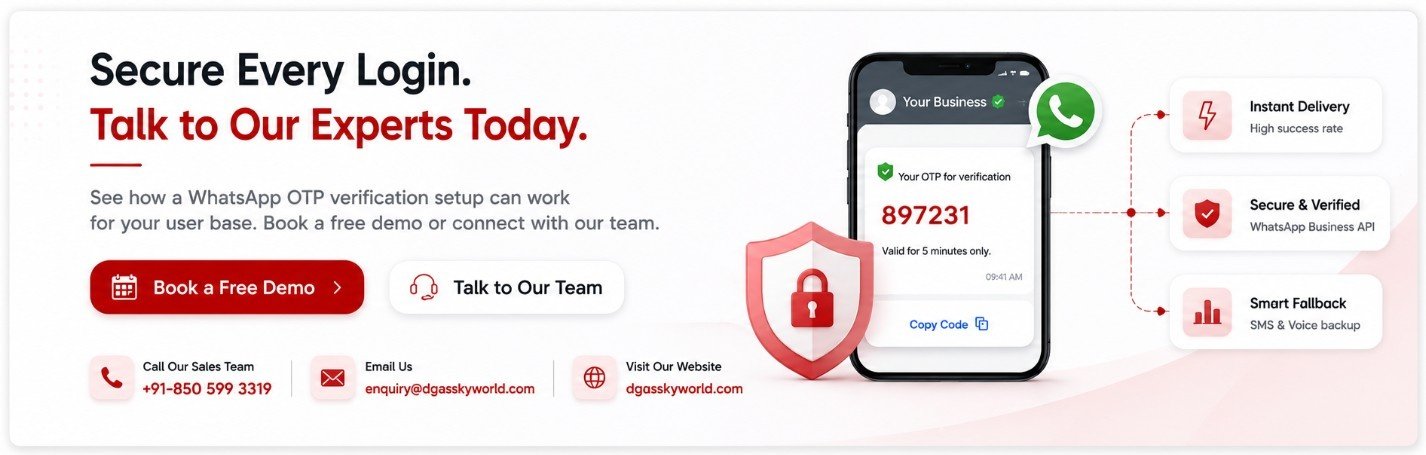
Ready to see it in action? Book a free demo or call our sales team at +91-850 599 3319 to discuss a WhatsApp OTP verification setup built around your existing user base.
WhatsApp OTP vs SMS OTP: A Quick Comparison
| Factor | WhatsApp OTP | SMS OTP |
|---|---|---|
| Delivery speed | Seconds, over Meta’s IP-based network | Seconds, but subject to telecom-level routing delays |
| Open/read rate | Very high — messages land in an app users already check constantly | Lower, and increasingly caught by spam filters |
| Sender identity | Branded, Meta-verified business profile | Numeric or alphanumeric sender ID only |
| Billing model | Charged only on successful delivery | Often charged regardless of delivery outcome |
| Device dependency | Requires WhatsApp installed and connectivity | Works on any mobile phone, no app needed |
| Best role | Primary verification channel | Essential fallback for full coverage |
The takeaway most experienced CPaaS users arrive at is the same one this table implies: it isn’t WhatsApp or SMS — it’s WhatsApp first, with SMS as the channel that catches everyone else.
Best Practices for Implementing WhatsApp OTP Verification
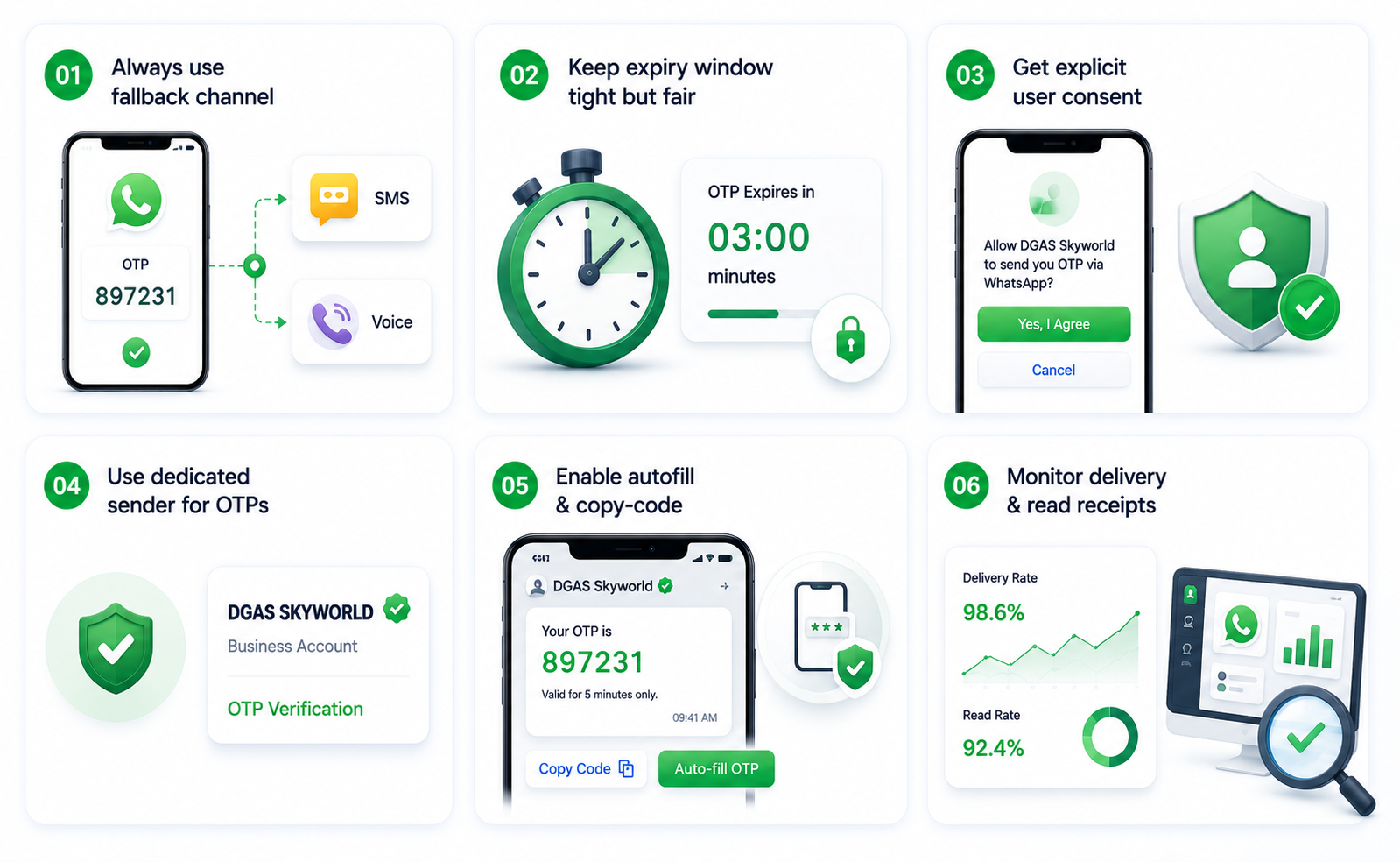
A few implementation habits consistently separate high-converting OTP flows from leaky ones:
- Always pair WhatsApp with a fallback channel. Don’t launch WhatsApp-only; build in SMS or voice retry from day one.
- Keep the expiry window tight but fair. Three to five minutes is a common sweet spot — long enough for a user to switch apps, short enough to limit misuse.
- Get explicit consent before the first message. This keeps your sender reputation clean and your delivery rates high.
- Use a dedicated sender for OTPs. Mixing authentication messages with marketing sends on the same number can affect deliverability for both.
- Enable autofill and copy-code buttons wherever supported. Every tap you remove from the user improves completion.
- Monitor delivery and read receipts continuously. A sudden drop in read rates is often the earliest signal of a template or sender issue.
Talk to our team to see how a WhatsApp OTP verification setup would work for your user base, or book a free demo directly. You can also reach our sales team at +91-850 599 3319 or through our contact page.
Frequently Asked Questions
What is WhatsApp OTP verification?
WhatsApp OTP verification is the process of sending a one-time password through an approved WhatsApp Authentication template to confirm a user’s identity during login, signup, or a transaction, instead of sending that code by SMS.
Is WhatsApp OTP verification safe for businesses in India?
Yes. Messages travel through WhatsApp’s encrypted infrastructure from a Meta-verified business sender, and providers apply rate limiting and expiry windows to prevent misuse — the same security principles used in SMS OTP, with added sender verification.
How is WhatsApp OTP verification different from SMS OTP?
The code and validation logic are the same; what differs is the delivery channel. WhatsApp OTP arrives inside an encrypted app chat from a branded, verified sender, while SMS OTP arrives as a plain text message from a numeric or alphanumeric ID.
Do I need a fallback channel for OTP verification on WhatsApp?
Yes. Not every user will have WhatsApp open or installed at every moment, so a fallback to SMS or voice ensures your verification flow doesn’t lose users who can’t receive the WhatsApp message.
How do I choose the best WhatsApp OTP verification service provider in India?
Look for direct WhatsApp Business API access (not a reseller layer), built-in SMS/voice fallback, transparent India-specific pricing, real-time delivery reporting, and support that can escalate issues to Meta directly.
Does DGAS Skyworld provide WhatsApp OTP verification service across India?
Yes. DGAS Skyworld provides WhatsApp OTP verification and broader CPaaS services exclusively within India, serving government bodies, PSUs, and private enterprises across healthcare, banking, e-commerce, real estate, education, logistics, and retail.
Can WhatsApp OTP verification work with SMS and Voice together?
Yes — this is the core idea behind omnichannel CPaaS. A single API triggers the OTP through WhatsApp first and automatically falls back to SMS or a voice call if the WhatsApp message isn’t delivered or read in time.
Conclusion
WhatsApp is fast becoming the default authentication channel for Indian users — but the businesses seeing the best results aren’t treating it as a standalone tool. They’re running WhatsApp OTP verification as one channel inside a broader omnichannel CPaaS setup, with SMS and voice quietly catching everyone WhatsApp doesn’t reach.
That’s the model DGAS Skyworld has built since 2017: an official WhatsApp Business API provider trusted by government bodies, PSUs, and private enterprises across India, with SMS and voice fallback built into the same platform from the start.