Voice Call API in India: Features, Pricing & How to Choose the Right Provider (2026 Guide)
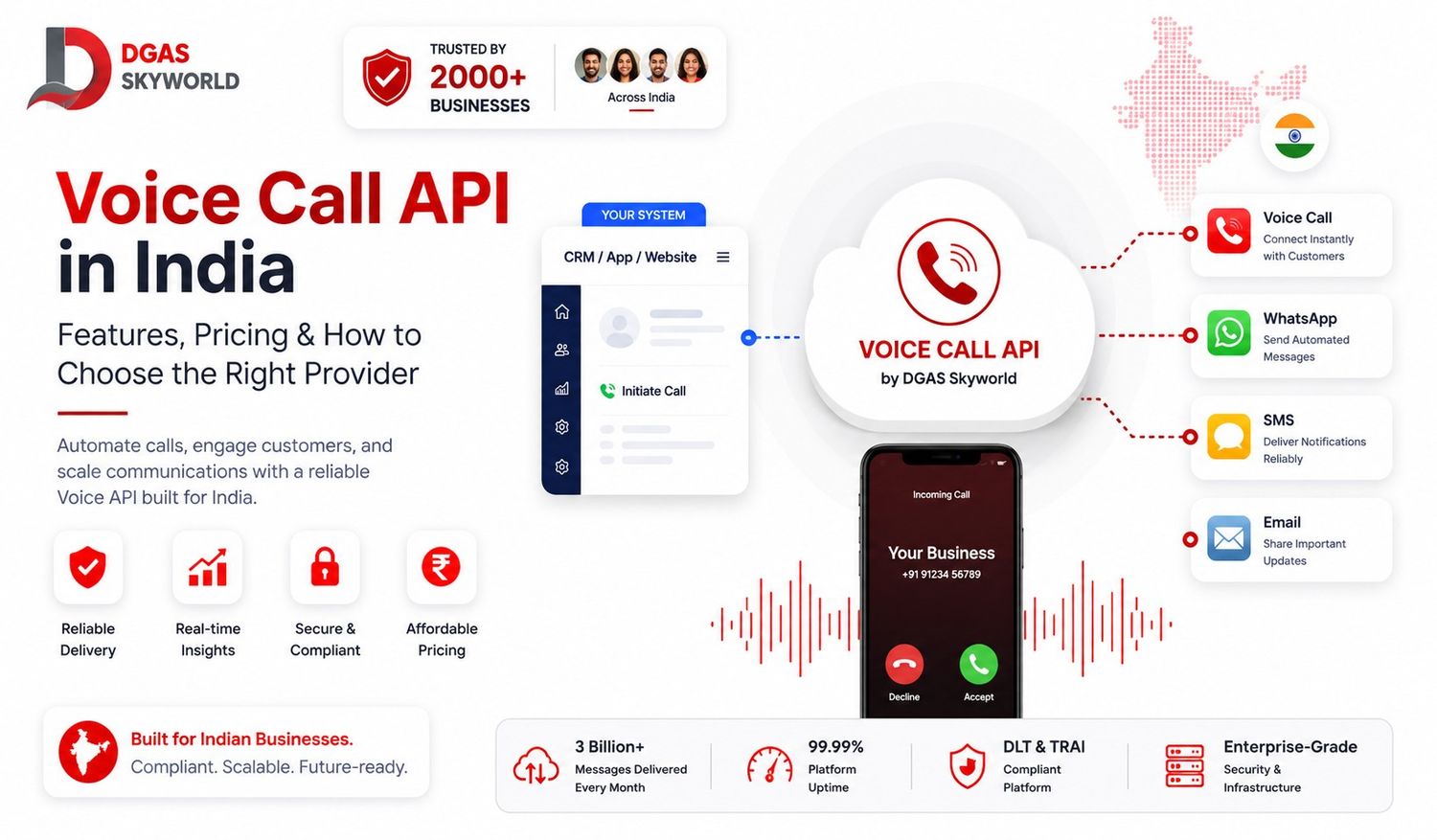
If you run a business in India, chances are a phone call has already saved you a sale, a support escalation, or a payment reminder that SMS quietly failed to deliver. Voice remains the one channel Indian customers still trust when something actually matters — a delayed order, an OTP that needs urgent confirmation, or a doctor’s appointment that’s about to be missed.
That’s exactly why the voice call API market in India has grown so fast. Businesses no longer want a call centre with rows of headsets and a AMC contract for EPABX hardware. They want a way to plug voice calling straight into their app, CRM, or website — and let their own systems decide when to ring a customer, what to say, and what happens next.
This guide breaks down what a voice call API actually does, how pricing works in India, which features genuinely matter, how compliance has changed under TRAI’s latest rules, and how to evaluate a provider before you sign anything. Wherever it’s useful, we’ve linked out to related reads on WhatsApp API, SMS API, and CPaaS so you can go deeper on any channel.
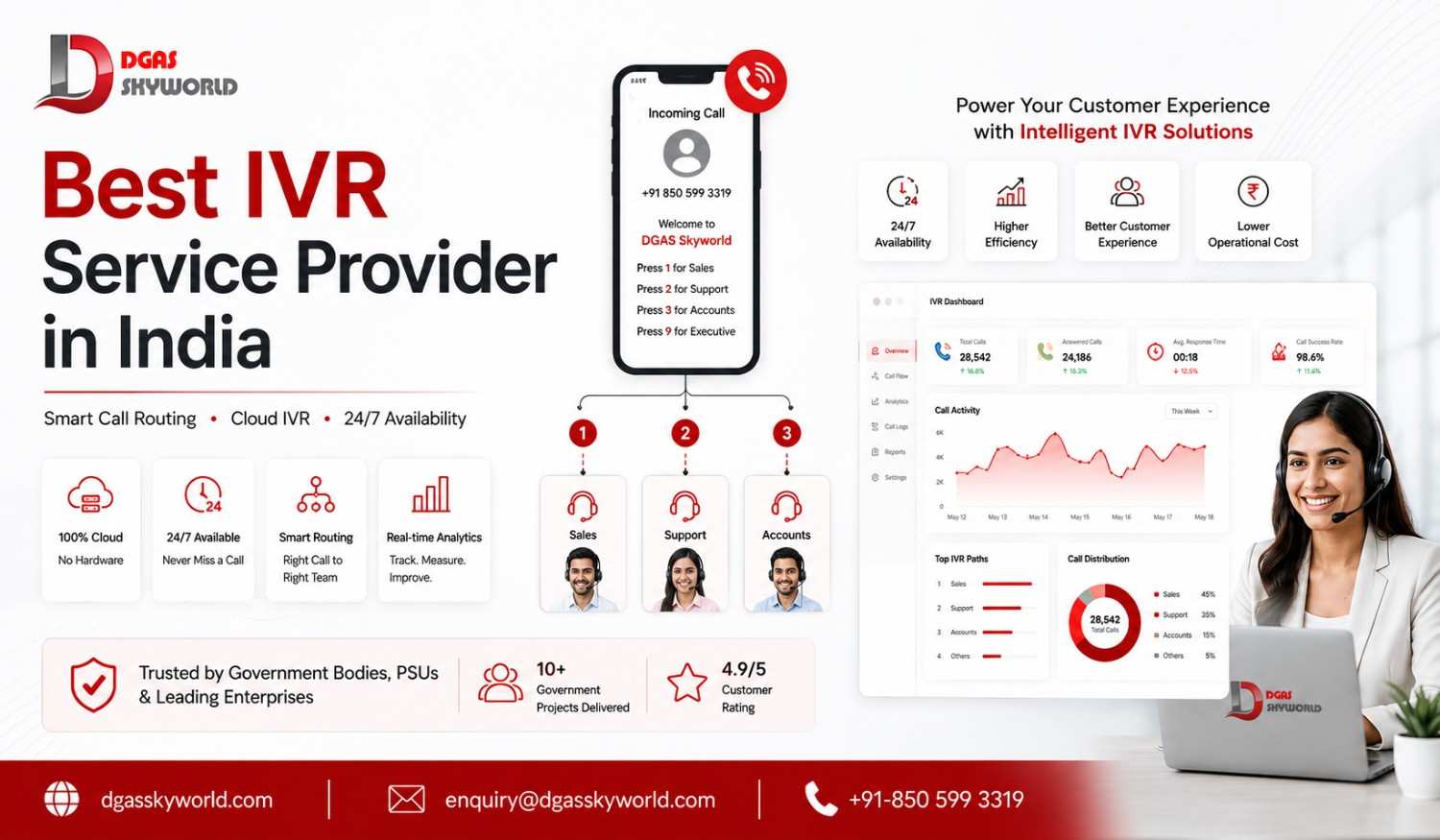
What Is a Voice Call API?
A voice call API is a set of cloud-based tools that let your application make, receive, and manage phone calls programmatically — without you owning telecom hardware, leasing PRI lines, or signing a contract with a local carrier.
In plain terms: your backend sends a request (usually a simple HTTP call) with a destination number and instructions — play a text-to-speech message, run an IVR menu, or connect the caller to an agent. The API provider’s infrastructure handles the actual dialling, call routing, and delivery, and sends your system a status update once the call is complete.
This is different from a legacy IVR box sitting in a server room. With a programmable voice API, the call logic lives inside your own application. You can personalise every call using live data — a customer’s name, an order number, a due amount — and change the flow instantly without raising a ticket with your vendor.
If you’re also exploring other channels, it’s worth reading our breakdown of what a CPaaS platform actually is — voice calling is just one piece of that larger communication stack.
How Does a Voice Calling API Work?
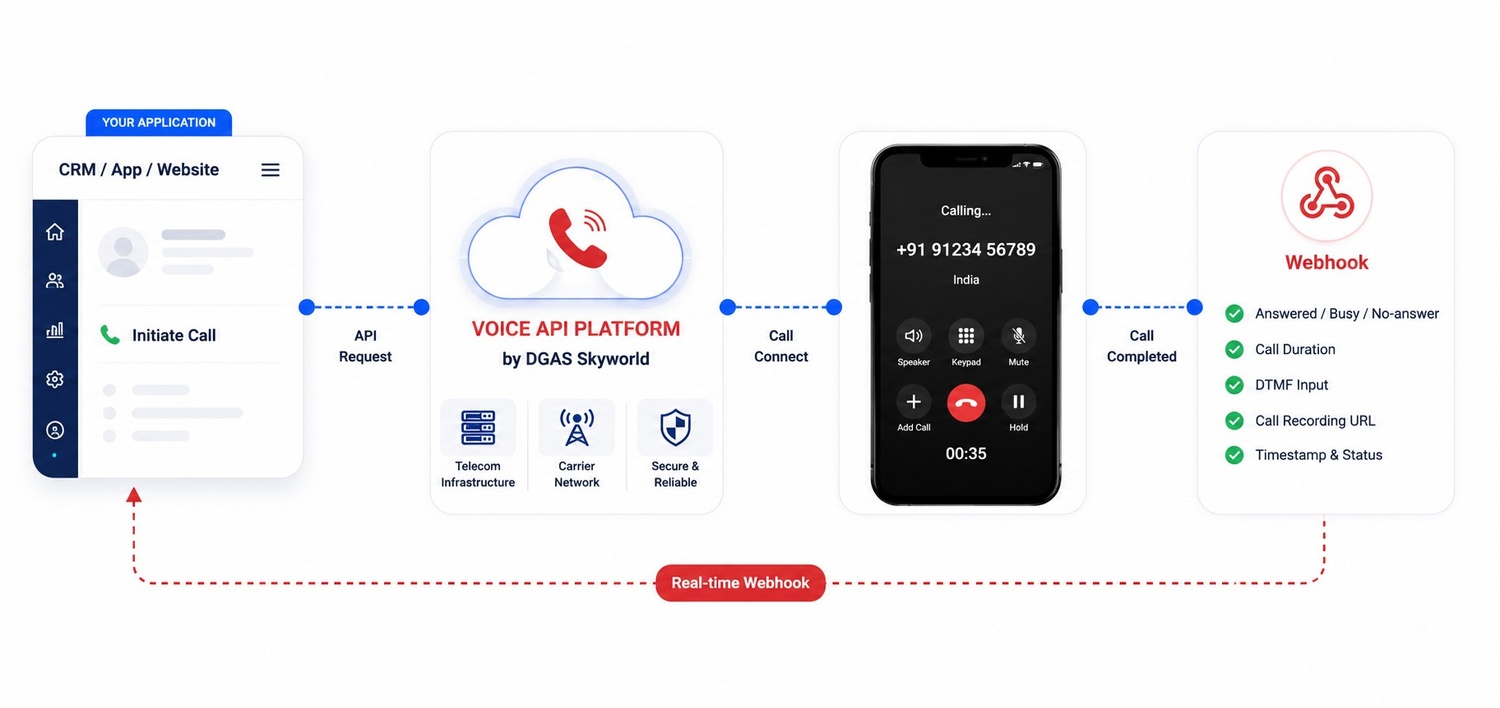
Behind the scenes, a voice call API bridges the internet and the traditional telecom network (PSTN). Here’s the simplified flow:
- Your app sends an API request with the caller ID, destination number, and call instructions (a TTS script, a pre-recorded audio file, or an IVR flow).
- The provider’s platform initiates the call through its telecom infrastructure and connects it to the recipient’s phone, whether they’re on a mobile network or a landline.
- The call executes your logic — playing a message, capturing keypad input (DTMF), routing to an agent, or triggering a recording.
- Your system receives a webhook with the outcome: answered, busy, no-answer, call duration, and any input the caller provided.
That last part — webhooks — is what makes voice APIs genuinely useful for automation. If a call goes unanswered, your system can automatically trigger a fallback SMS or WhatsApp message instead of leaving the customer without the information they needed.
For businesses already using SMS API or WhatsApp Business API for notifications, this fallback logic is often the single biggest reason to add voice — it catches the customers the other channels miss.
Why CPaaS Matters When You’re Choosing a Voice Call API
Here’s something most vendor pages won’t tell you upfront: buying voice calling from a single-channel vendor and buying it from a full CPaaS (Communications Platform as a Service) provider are two very different experiences operationally, even if the call quality looks similar on a demo.
When your voice call API sits inside a broader CPaaS platform alongside SMS, WhatsApp, RCS, and email, you get a few practical advantages that matter more once you’re running this at scale:
- One dashboard, one API key, one bill. Instead of separate contracts and separate documentation for every channel, your development and finance teams deal with a single relationship.
- Automatic cross-channel fallback. If a voice call isn’t answered, your system can trigger an SMS or WhatsApp message using the same platform — no need to stitch together two different vendors’ APIs.
- Consistent sender identity. Your business’s registered caller ID, SMS header, and WhatsApp display name stay aligned across channels, which builds more trust with the customer than a random 10-digit number calling from nowhere.
- Faster support resolution. When something breaks, you’re not being bounced between two support teams trying to figure out whose system dropped the ball.
- Easier compliance management. Since India’s telecom regulations increasingly treat SMS and voice under the same TCCCPR framework (more on this below), managing registration and consent through one provider reduces the paperwork significantly.
This is the exact gap a lot of standalone international voice API providers leave open — they’re built for global scale, not for the specific mechanics of Indian telecom compliance or the reality that most Indian businesses need voice, SMS, and WhatsApp working together, not as three separate vendor relationships.
DGAS Skyworld has been building CPaaS infrastructure for Indian businesses since 2017, and Enterprise Voice Solutions sit alongside SMS API, WhatsApp Business API, RCS Messaging, Truecaller Messaging, AI Chatbot, and Email API on a single platform — so a missed call can automatically fall back to a WhatsApp message without you writing extra integration code.
Key Features to Look for in a Voice Call API
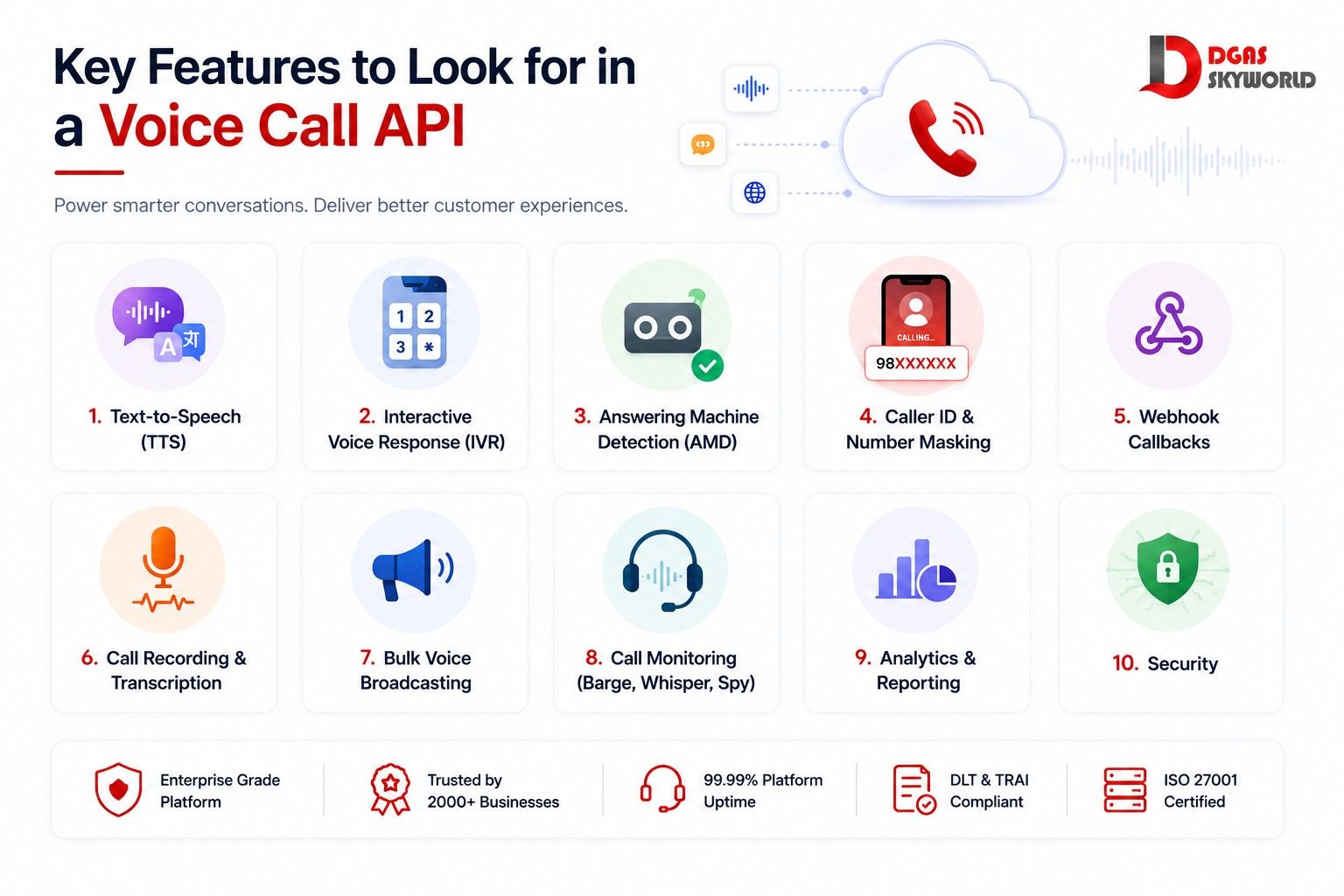
Not every provider’s feature list is built the same way. Here’s what actually moves the needle for Indian businesses:
Text-to-Speech (TTS) with Indian Language Support
A robotic-sounding TTS engine kills call completion rates fast. Look for natural-sounding voices in Hindi, Tamil, Telugu, Marathi, Bengali, Kannada, and Malayalam — not just English. Ask any shortlisted voice API India provider for audio samples before you commit; quality varies enormously between vendors.
Interactive Voice Response (IVR)
Basic “press 1 for sales, press 2 for support” menus are table stakes now. What separates a good IVR API from a mediocre one is support for multi-level menus, CRM-linked dynamic routing, and the ability to update flows without redeploying code.
Read more about – Interactive Voice Response (IVR)
Answering Machine Detection (AMD)
AMD tells your system whether a human or a voicemail system picked up the call, so your agents or automation don’t waste time on unanswered outbound campaigns. This matters most for high-volume outbound use cases like collections or appointment reminders.
Custom Caller ID and Number Masking
In India, unknown numbers get ignored or declined far more often than in most markets. A registered, recognisable caller ID meaningfully increases answer rates. Number masking is equally important for two-sided marketplaces — think logistics apps connecting a delivery partner and a customer without either seeing the other’s real number.
Webhook Callbacks
Real-time status updates — answered, busy, failed, duration, DTMF input — are what let you build fallback logic. A provider with a slow or unreliable webhook delivery SLA quietly breaks every automation built on top of it.
Call Recording and Transcription
Essential for BFSI, healthcare, and any regulated sector that needs an audit trail. Ask specifically where recordings are stored and for how long — data residency matters for compliance.
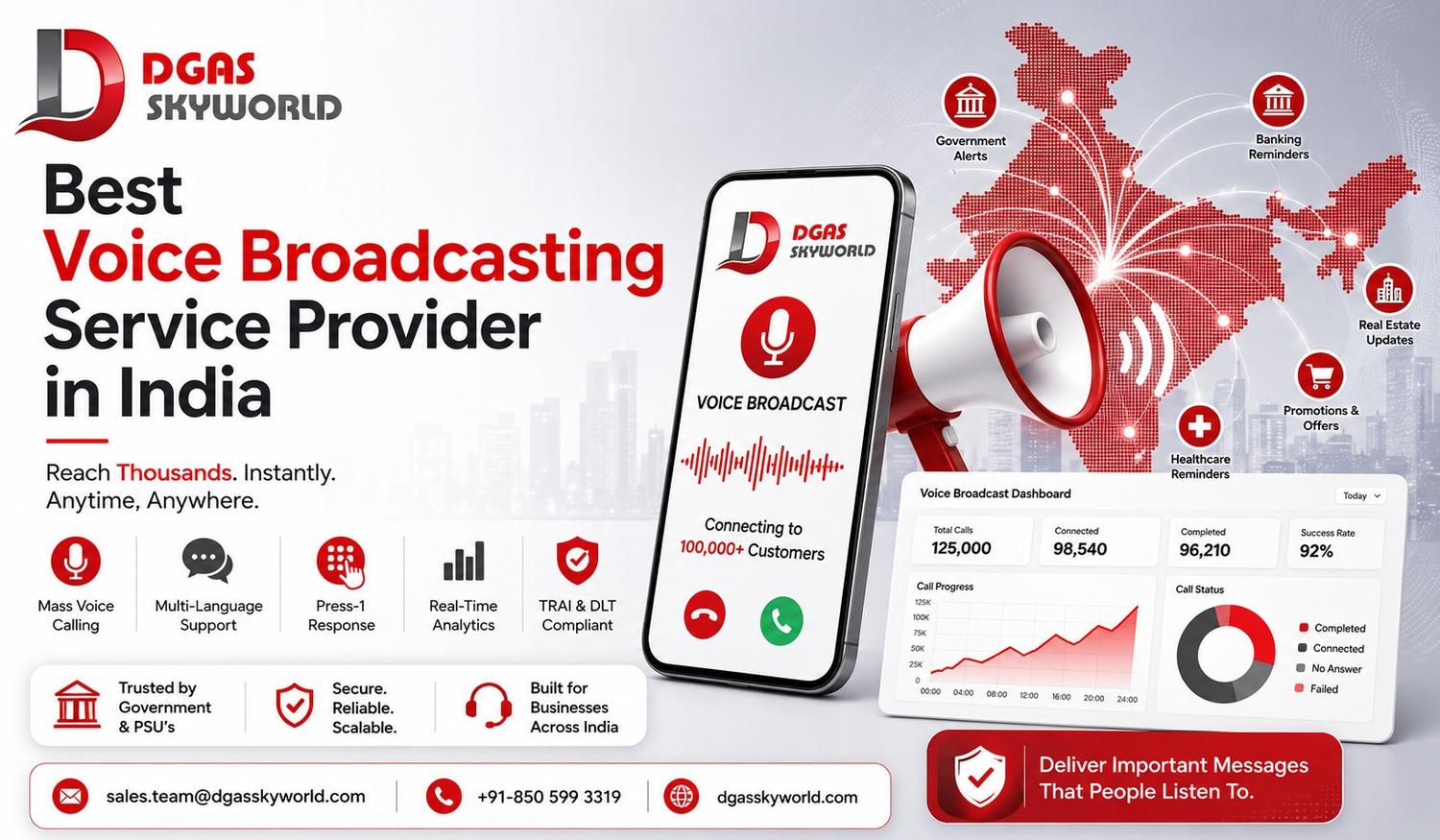
Bulk Voice Broadcasting
For announcements, reminders, or surveys sent to large lists in one go — useful for anything from festival greetings to loan due-date reminders.
Read more about – Bulk Voice Broadcasting
Call Monitoring (Barge, Whisper, Spy)
Useful for contact centres that need real-time quality control — a supervisor can listen in, coach an agent silently, or step into a live call when needed.
Analytics and Reporting
Call logs, duration, connect rate, and cost-per-call data help you actually optimise the channel instead of running it blind.
Security
End-to-end encryption of call data and recordings, plus authentication controls on your API keys, should be non-negotiable — phone conversations frequently touch sensitive information like payment details or health data.
Voice Call API Pricing in India: What Actually Affects Your Bill
Voice pricing in India almost always works on a per-minute, connected-call basis — you’re billed for actual talk time, not for every dial attempt. A call that goes unanswered, rings out, or hits a busy signal typically isn’t charged at all, which is part of why voice works well as a fallback channel rather than a primary one.
A few factors quietly decide what you’ll actually pay each month:
- Call answer rate. If only 60% of your outbound calls connect, you’re only billed for that 60% — but it also means your effective cost-per-successful-contact is higher than the headline per-minute rate suggests.
- Average call duration. A 15-second OTP confirmation costs a fraction of a 3-minute IVR support flow. Keep TTS scripts short and to the point wherever possible.
- Call volume. Most providers offer better per-minute rates as your monthly volume grows — worth negotiating once you have a few months of usage data.
- GST. An 18% tax applies on top of usage charges, same as other digital communication services in India.
A rough way to think about cost profiles:
| Use Case | Typical Duration | Cost Behaviour |
|---|---|---|
| Voice OTP fallback | 15–30 seconds | Very low cost per call, used when SMS/WhatsApp OTP fails |
| Delivery confirmation | 15–25 seconds | Low cost, high volume, useful for COD verification |
| Payment/EMI reminder | 30–45 seconds | Moderate cost, replaces manual collection calls |
| Appointment reminder | 20–30 seconds | Low cost, reduces no-shows in healthcare/services |
| IVR support flow | 2–5 minutes | Higher cost per call, but far cheaper than a live agent |
| Feedback survey | 2–3 minutes | Moderate cost, valuable post-transaction data |
The pattern that holds across almost every industry: short, high-volume notification calls are extremely cost-effective at scale, while longer IVR or support flows cost more per interaction but can replace far more expensive agent time.
Common Use Cases of Voice Call API in India
Voice automation looks different depending on the industry. Here’s where it earns its keep:
BFSI: Payment reminders, EMI due-date alerts, fraud verification calls, and collections outreach — all with detailed call logs for audit purposes.
Healthcare: Appointment confirmations, prescription refill reminders, and post-consultation follow-ups that reduce no-show rates without adding front-desk workload.
E-commerce and Logistics: Delivery confirmation calls, COD verification before dispatch, and delivery-partner-to-customer connections using number masking to protect both parties’ privacy.
Real Estate: Automated callback confirmation for site-visit bookings, project update calls to interested leads, and appointment reminders for sales team walk-throughs — a use case we work with directly across our real estate marketing engagements.
Customer Support and BPO: IVR-based query routing, escalation to live agents only when a query genuinely needs a human, and call monitoring for quality assurance.
EdTech: Admission deadline reminders, fee due-date alerts, and counsellor callback scheduling during high-volume admission seasons.
The common thread: voice calling works best for anything that’s high-volume, time-sensitive, and where a missed message has a real cost — a missed EMI, a missed appointment, an undelivered package.
Voice Call API vs Traditional Call Centre: Where Each One Wins
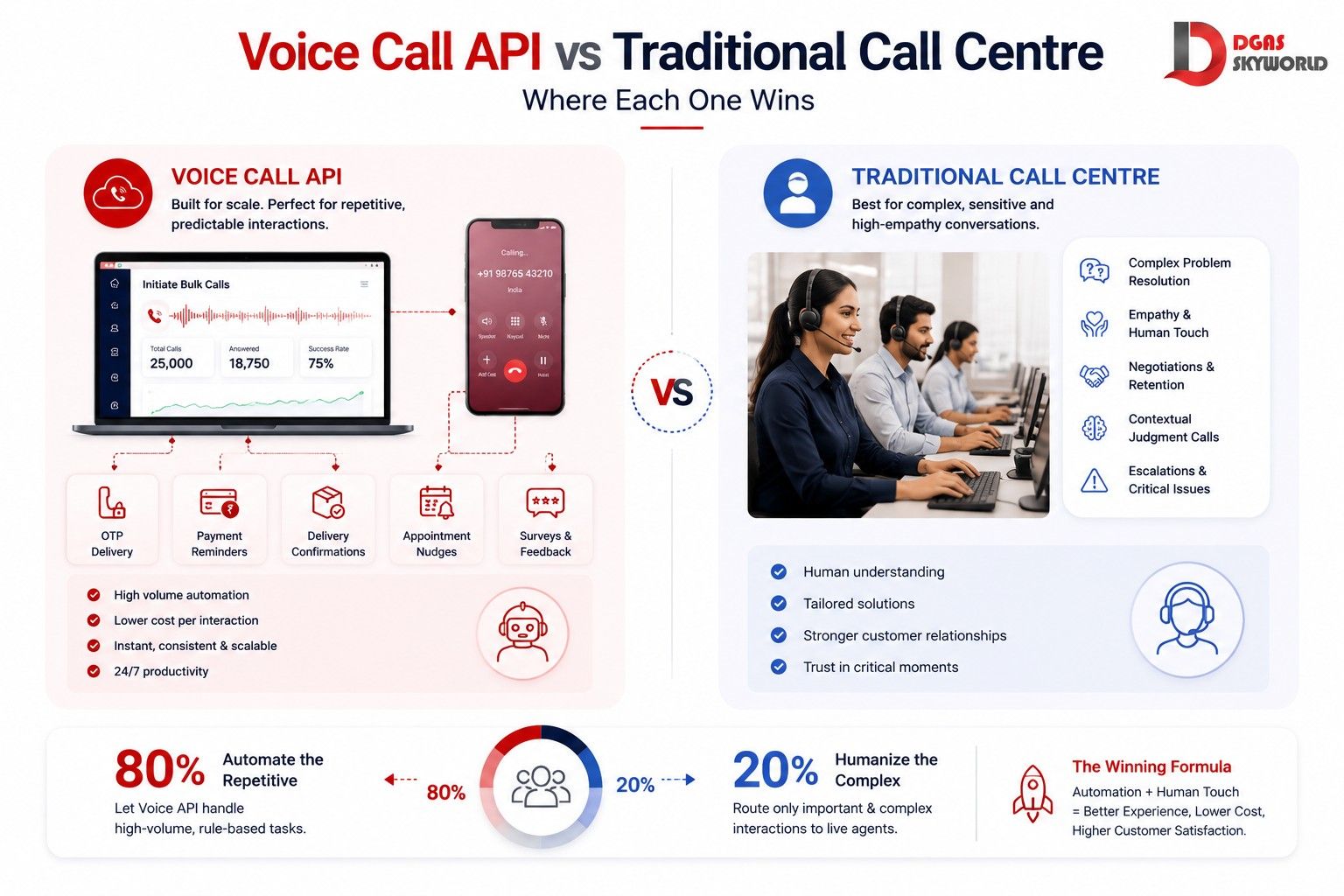
This isn’t really a competition — it’s a division of labour.
A voice call API handles high-volume, repetitive, predictable interactions extremely well: OTP delivery, payment reminders, delivery confirmations, appointment nudges, single-question feedback surveys. Anything with a fixed script and a predictable set of responses is a good fit for automation.
A human agent still wins for complexity, empathy, and judgment calls — a genuine complaint, a negotiation, a situation that needs context a script can’t anticipate. The businesses getting the most value from voice APIs aren’t replacing their support teams; they’re using automation for the repetitive 80% and routing the remaining 20% to a live agent who actually has time to handle it properly, because they’re not stuck dialling reminder calls all day.
DLT, TRAI Compliance and What Changed for Voice Calls in India
This is the part most voice API guides get outdated fastest, so it’s worth being precise here.
Voice calls in India are regulated under the same TCCCPR (Telecom Commercial Communications Customer Preference Regulations) framework that governs commercial SMS — and contrary to older advice still floating around online, voice calls do require DLT-linked registration, not just SMS. Businesses making commercial voice calls need to register as a Principal Entity on the DLT platform, register their headers, and use the correct numbering series for the type of call being made — broadly, one series for promotional calls and a separate one for service or transactional calls.
TRAI’s February 2025 amendment tightened this further, with staged enforcement running through March 2026: consent windows are now shorter and must be properly documented, DND scrubbing is required before any promotional call, and automated calling systems are held to the same rules as human-operated call centres — there’s no exemption for AI-generated or automated voice.
What this means practically for your business:
- Register your Principal Entity and headers before you start any commercial voice campaign, not after.
- Scrub your calling list against the DND registry at the time of dialling, not just when the list was first uploaded — preferences change daily.
- Keep documented consent records, especially for transactional or service calls where consent windows are time-limited.
- Maintain call logs and recordings if you’re in a regulated sector like BFSI or healthcare, with clear data residency and retention policies from your provider.
Because this space moves quickly and enforcement has become stricter through 2025 and 2026, it’s worth confirming your specific obligations with your compliance team or legal counsel rather than relying solely on a vendor’s marketing page — including this one. A good CPaaS provider should be able to walk you through registration rather than leaving you to figure it out alone. For the SMS side of this same framework, our guide on how DLT registration works in India covers the process in more depth.
How to Choose the Right Voice Call API Provider in India
Once you’ve shortlisted a few vendors, these are the questions worth asking before you sign anything:
1. What are your direct operator connections? Ask specifically about direct relationships with Jio, Airtel, Vodafone Idea, and BSNL — not a vague “yes, we cover India.” Direct connections affect call completion rates meaningfully.
2. Is pricing genuinely per-minute, or are there hidden setup fees? Get the full cost model in writing, including any per-call connection charges layered on top of the per-minute rate.
3. Can I hear TTS samples in the languages my customers actually speak? Don’t take a language list at face value — request live samples in Hindi and at least one regional language relevant to your user base.
4. How are no-answer and busy calls handled and billed? Confirm these aren’t charged, and ask about automatic retry logic and configurable retry intervals.
5. What’s the webhook delivery SLA? For any fallback automation — like triggering an SMS after a failed voice call — delayed webhooks mean delayed fallback and a frustrated customer.
6. Does this fit into a broader CPaaS stack, or am I locking into a single channel? This is where a platform like DGAS Skyworld makes the decision easier — since Voice, SMS API, WhatsApp Business API, RCS Messaging, Truecaller Messaging, AI Chatbot, and Email API all run through one platform, you’re not managing five vendor relationships or five separate compliance registrations for a single customer communication strategy. It’s worth exploring our Enterprise Voice Solutions page to see how this fits alongside your existing channels.
7. What’s their actual support responsiveness like? Ask for reference customers in your industry, and test their support response time before you’re relying on it during a production incident.
Frequently Asked Questions
What is a Voice Call API?
A voice call API is a cloud-based tool that lets businesses programmatically make, receive, and manage phone calls from within their own application or CRM, without needing dedicated telecom hardware.
Is DLT registration required for voice calls in India?
Yes. Under TRAI’s TCCCPR framework, commercial voice calls require Principal Entity and header registration on the DLT platform, similar to SMS, with correct numbering series depending on whether the call is promotional or transactional/service in nature.
How is voice call API pricing calculated?
Most providers in India bill per connected minute — unanswered, busy, or failed calls are typically not charged. Your actual bill depends on answer rate, average call duration, and monthly volume.
What’s the difference between a Voice API and an IVR system?
An IVR is a specific feature — an automated menu system — that a voice API can execute as part of a call. The voice API is the broader toolkit that also handles call initiation, recording, webhooks, and routing logic.
Can a Voice Call API work together with WhatsApp or SMS for fallback messaging?
Yes — this is one of the most valuable use cases. If a voice call isn’t answered, your system can automatically trigger a fallback message on WhatsApp or SMS, which is far easier to manage when all three channels run through a single CPaaS platform.
Is voice call API secure enough for OTPs and payment-related calls?
A properly built voice API supports encrypted call data, secure webhook delivery, and access-controlled API keys, making it suitable for sensitive use cases like OTP delivery and payment confirmations — provided the provider follows standard security practices.
Ready to Add Voice Calling to Your Business Stack?
Whether you’re looking to automate payment reminders, build a compliant IVR flow, or simply stop losing customers to missed calls, DGAS Skyworld’s Enterprise Voice Solutions are built specifically for Indian businesses — with the same platform also covering SMS API, WhatsApp Business API, and RCS Messaging, so your fallback logic actually works end to end.
Book a free demo and see how voice calling fits into your existing customer communication flow: Book Your Free Demo
Prefer to talk it through first? Contact our team — or use the WhatsApp and call buttons on this page to reach our sales team directly for a quick chat, or our support team if you’re already a customer with a question.
This article is for informational purposes and reflects TRAI regulations as understood at the time of writing. Please confirm current compliance requirements with your legal or compliance advisor before launching a voice calling campaign.



![Automated Voice Messaging System: What It Is, Benefits, Use Cases & How to Use It [2026 Guide]](https://dgasskyworld.com/wp-content/uploads/2026/09/automated-voice-messaging-system.jpeg)