WhatsApp Marketing for Real Estate in India: How Builders/Agents Are Closing Deals Faster (2026)
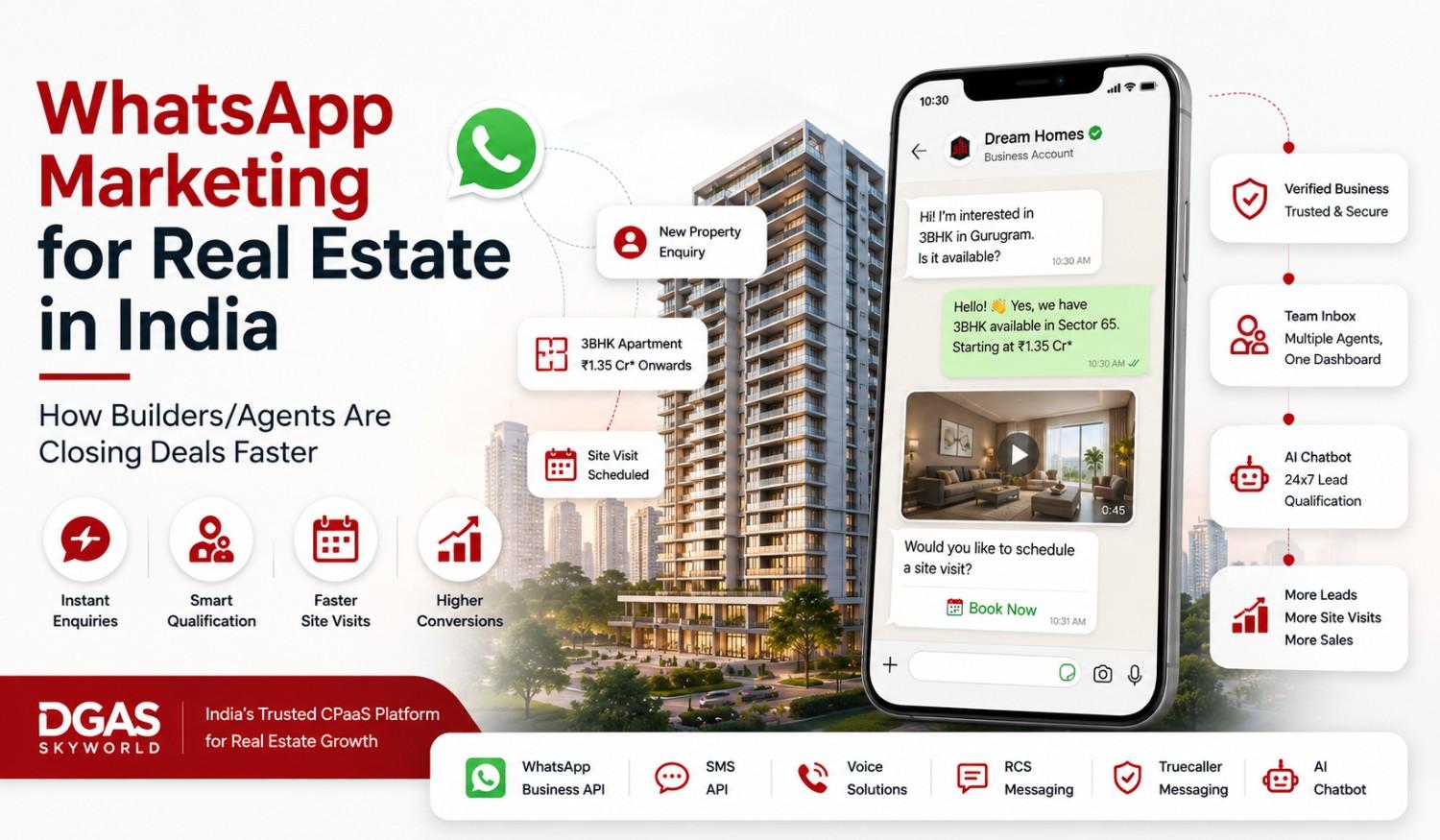
It’s 10:47 PM. A buyer in Gurugram is lying in bed, scrolling through 3BHK listings on her phone. She finds one she likes, taps “Message on WhatsApp,” and types: “Is this still available? What’s the price?”
Three other people do the exact same thing, on three different listings, in the next four minutes.
The agent who replies first — with the right price, a floor plan, and a slot for a site visit — gets the lead. The other two agents find out the next morning that the flat is already spoken for.
This is real estate in India right now. Not phone calls. Not email. WhatsApp. And if your business isn’t set up to respond the moment someone messages you, you’re not losing leads slowly — you’re losing them in minutes.
This guide breaks down exactly how WhatsApp marketing for real estate in India actually works in 2026: what to automate, what compliance actually requires, how to handle NRI buyers, and why the smartest builders and brokers are no longer treating WhatsApp as a standalone channel.
Why WhatsApp Marketing Matters for Real Estate in India
India is WhatsApp’s single largest market in the world, with several hundred million active users — more than any other country by a wide margin. For an Indian real estate business, that’s not a nice statistic. It’s the plain fact that your buyer is already on WhatsApp, all day, every day, in a way they simply aren’t on email or a phone line.
Property buying in India is also a trust-heavy, relationship-driven decision. Buyers want to see the floor plan before they call. They want to ask a follow-up question without waiting on hold. They want a human — or a fast, helpful bot — to answer at 11 PM on a Sunday, because that’s when they’re actually browsing.
WhatsApp marketing for real estate in India works because it meets three needs traditional channels can’t:
- Speed — replies land in seconds, not hours
- Trust — a verified business number feels safer than an unknown caller ID
- Richness — photos, floor plans, videos, and location pins, all in one thread
Traditional cold-calling and email blasts still have a place, but for the Indian buyer’s actual behaviour in 2026, WhatsApp is the front door.
WhatsApp Business App vs. WhatsApp Business API: Which Do You Actually Need?
This is the first fork in the road for any Indian real estate business, and it’s worth getting right before you build anything else.
| Criteria | WhatsApp Business App | WhatsApp Business API |
|---|---|---|
| Best for | Solo agents, small brokerages | Builders, developers, multi-project agencies |
| Broadcast limit | 256 contacts | Unlimited (opt-in required) |
| Multi-agent support | No (one device/number) | Yes — shared team inbox |
| Automation | Basic auto-replies, quick replies | Full chatbot flows, qualification, routing |
| CRM integration | None | Native integrations available |
| Message templates | Not applicable | Required for outbound marketing/utility messages |
| Cost | Free | Paid — per-conversation, provider-dependent |
Simple rule of thumb: if you’re a single agent handling a handful of leads a week, the free Business App with labels and catalogues will carry you a long way. If you’re a developer running paid campaigns across multiple projects, coordinating five or more sales executives, or trying to scale WhatsApp lead generation for real estate beyond what one person can manually reply to — you need the API.
Top Use Cases of WhatsApp Business API for Indian Real Estate
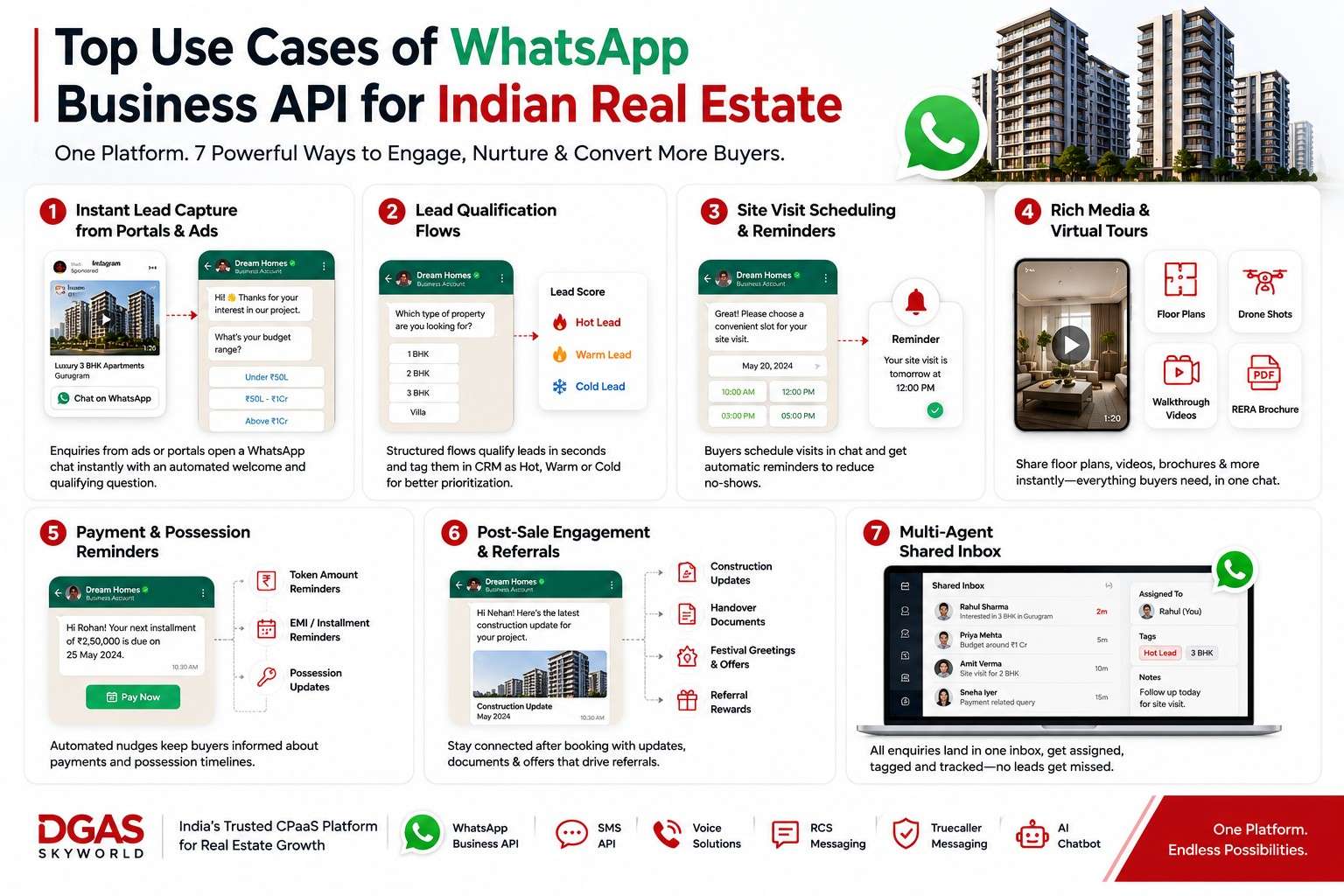
Once you’re on the API, here’s where it actually earns its cost.
1. Instant Lead Capture from Portals and Ads
A buyer clicks a Click-to-WhatsApp ad on Instagram, or taps “Enquire” on a listing from a property portal — the conversation opens instantly, with an automated first reply already acknowledging their interest and asking the qualifying question that matters most: budget, locality, or BHK preference.
2. Lead Qualification Flows
Instead of an agent manually asking “what’s your budget,” a structured flow does it in the first 30 seconds — and tags the lead in your CRM as hot, warm, or cold based on the answers, so your sales team spends time on the right conversations.
3. Site Visit Scheduling and Reminders
Buyers pick a slot directly inside the chat. A reminder goes out the evening before and again a couple of hours ahead, cutting down the no-shows that eat into every sales team’s week.
4. Rich Media and Virtual Tours
Floor plans, drone shots, walkthrough videos, RERA-registered project brochures — all shareable in a single tap, without anyone waiting on a slow email attachment.
5. Payment and Possession Reminders
For buyers already in the pipeline, automated nudges about token amounts, installment due dates, or possession timelines keep transactions moving without a sales executive having to track every date manually.
6. Post-Sale Engagement and Referrals
The relationship shouldn’t end at booking. Construction updates, handover documentation, and the occasional festive greeting keep a closed buyer warm for the referral that often matters more than the original sale.
7. Multi-Agent Shared Inbox
For larger builder sales teams, every enquiry lands in one shared inbox, gets tagged and assigned, and stays visible even if the original agent is on a site visit or off for the day.
RERA, DPDP, and Compliance: What Indian Real Estate Businesses Actually Need to Know
This is the part most WhatsApp marketing guides skip — and it matters more in real estate than almost any other sector, because you’re dealing with high-value transactions and disclosures that are legally regulated.
A few things to build into your WhatsApp strategy from day one:
- Consent first. Only message people who’ve opted in — through a website form, a Click-to-WhatsApp ad, a QR code at your sales office, or a similar clear action. Buying or scraping a contact list and broadcasting to it isn’t just against WhatsApp’s policies; it damages the trust the whole channel depends on.
- Accurate project disclosures. Any pricing, possession date, or project detail shared over chat should match what’s officially registered and disclosed for that project. Automating replies is fine — automating outdated or inconsistent information is not.
- Data handling. Buyer details collected through a chatbot — phone numbers, budgets, ID documents shared for KYC — should be stored and processed the way any personal data under India’s data protection framework should be: with a clear purpose, limited access, and no unnecessary retention.
- Template categorisation. WhatsApp requires pre-approved templates for outbound business-initiated messages, split into categories like utility and marketing. Mislabeling a promotional new-launch broadcast as a “utility” template is one of the fastest ways to get templates rejected or your business account flagged — get this right from the first submission.
- Rule-compliant automation. Meta has been tightening its policies around which kinds of AI and chatbot integrations are permitted on WhatsApp. Build your qualification and routing bots around approved, compliant automation rather than an unsupported third-party AI layer that could put your WhatsApp Business Account at risk.
None of this is complicated once it’s part of your setup — it just needs to be there from the start, not patched in after a template gets rejected or a lead complains.
Reaching NRI Buyers on WhatsApp
A meaningful share of demand for Indian real estate — especially in the premium and luxury segment — comes from NRI buyers in the UAE, UK, US, Canada, Australia, and Singapore. WhatsApp is often the only channel that works cleanly across that distance.
A few things that matter specifically for this audience:
- Time-zone-aware messaging. A drip sequence or reminder that fires at 9 AM IST lands in the middle of the night for a buyer in California. Segment your NRI leads and schedule accordingly.
- Virtual-tour-first funnels. An NRI buyer usually can’t walk into your sales office this week. Lead with a strong video walkthrough and 360° tour link before pushing for a site visit — the site visit becomes something they plan for their next trip home, not a blocker to the conversation continuing.
- Delivery isn’t guaranteed everywhere. International numbers occasionally have delivery or connectivity issues that a purely WhatsApp-only strategy can’t work around. This is exactly where having a fallback channel — voice or SMS — for high-intent NRI leads makes the difference between a lead going cold and a lead getting a callback.
Beyond WhatsApp: Why Real Estate Businesses Are Going Omnichannel
Here’s something almost no WhatsApp marketing guide for real estate tells you honestly: WhatsApp delivery isn’t 100%. Numbers get uninstalled, buyers opt out, and connectivity in Tier 2 and Tier 3 towns isn’t always consistent enough to rely on a single channel for a transaction worth crores.
The real estate businesses getting the best conversion numbers in 2026 aren’t running WhatsApp in isolation — they’re running it as the front door of a broader communication stack:
- WhatsApp Business API for the primary conversation — enquiries, qualification, media sharing, scheduling
- SMS API as a reliable fallback for lead acknowledgements and reminders when WhatsApp delivery or read status is uncertain
- Enterprise Voice Solutions for a fast callback the moment a lead shows high intent — some conversations, especially with a serious buyer weighing a multi-crore decision, still need a real voice
- RCS Messaging for rich, branded media where it’s supported, without asking the buyer to leave their default messaging app
- Truecaller Messaging so your calls and messages show up as a verified business identity instead of an unknown number a wary buyer is unlikely to pick up
This is exactly the stack DGAS Skyworld has built for Indian businesses since 2017 — as an official WhatsApp Business API provider (not a reseller or BSP layering fees on top of someone else’s setup), alongside SMS API, Enterprise Voice, RCS Messaging, Truecaller Messaging, and AI chatbot capability, all running under one platform, built specifically for the Indian market.
Real estate teams using this kind of combined setup aren’t choosing between WhatsApp and a fallback channel case by case — the fallback fires automatically when it’s needed, and every conversation, regardless of channel, lands in one place.
If your builder or brokerage is trying to stitch together three different vendors for messaging, voice, and SMS, it’s worth seeing what a single India-focused CPaaS platform looks like instead. Book a free demo with DGAS Skyworld to see the setup in action.
Why Get Your WhatsApp Business API Through a CPaaS Platform
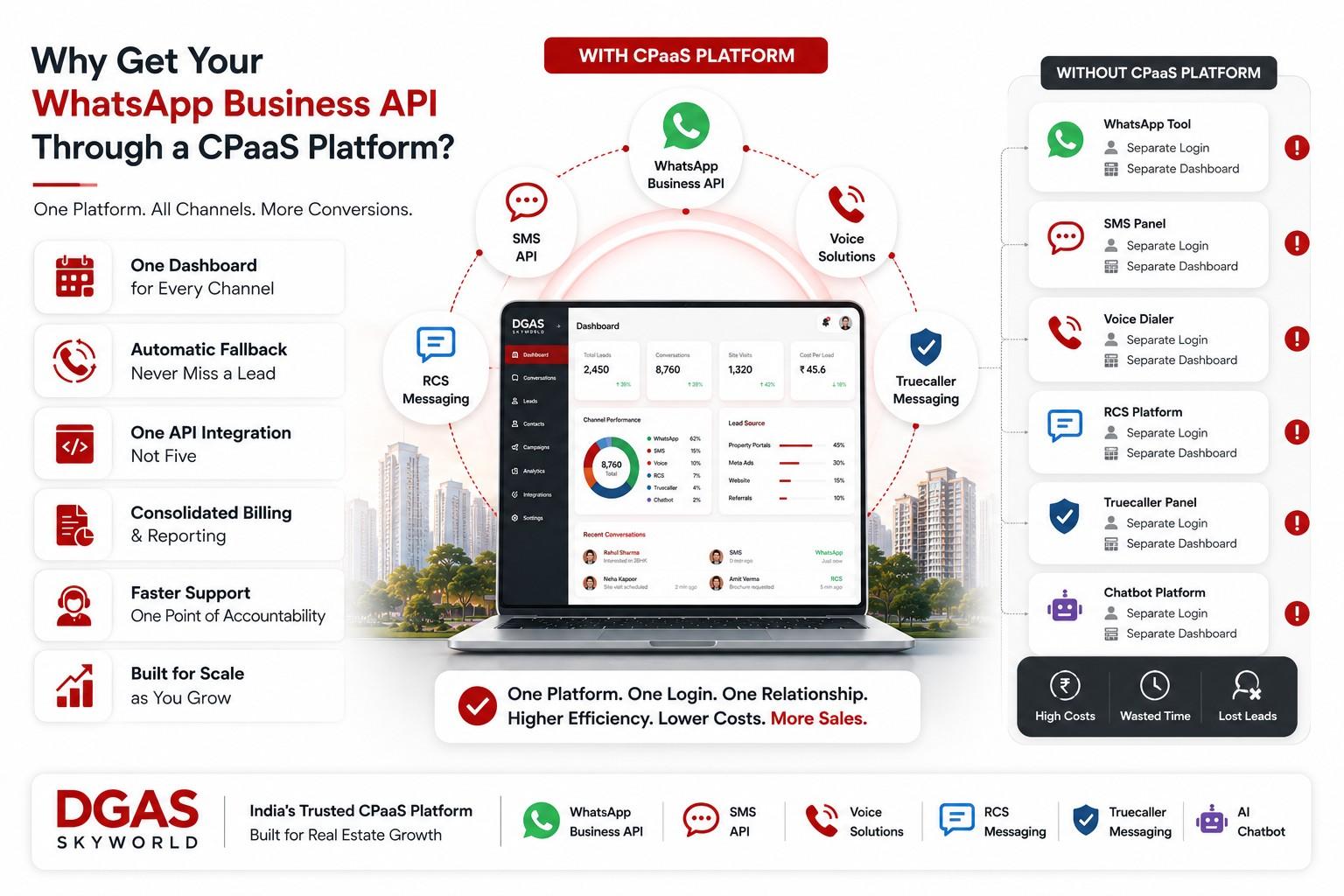
There’s a question a lot of real estate businesses skip over: should you get WhatsApp Business API directly, or through a CPaaS (Communications Platform as a Service) provider?
In practice, almost no one gets it “directly” — every business accesses WhatsApp Business API through some kind of provider. The real choice is between a provider that only does WhatsApp, and a CPaaS platform that gives you WhatsApp alongside every other channel your sales team actually needs. Here’s why the second option tends to work better for real estate specifically:
- One dashboard for every channel. Instead of logging into a separate WhatsApp tool, a separate SMS panel, and a separate voice dialer, your team manages WhatsApp, SMS, Voice, RCS, and Truecaller messaging from a single place — one login, one lead view, one conversation history.
- Automatic fallback when WhatsApp doesn’t land. A CPaaS platform can be configured to fall back to SMS or a voice call automatically when a WhatsApp message isn’t delivered or read — something a WhatsApp-only provider simply can’t offer, because it doesn’t have any other channel to fall back to.
- One API integration, not five. Your developers integrate once with a CPaaS platform’s API and get access to every channel it supports, instead of maintaining five separate integrations with five separate vendors, each with its own documentation, rate limits, and billing cycle.
- Consolidated billing and reporting. One invoice, one set of analytics, one place to see cost-per-lead across every channel — instead of piecing together spend and performance from multiple vendor dashboards at month-end.
- Faster support, one point of accountability. When something breaks — a template gets rejected, delivery drops, a webhook fails — you’re troubleshooting with one support team who understands your whole setup, not bouncing between vendors trying to figure out whose system is at fault.
- Built for scale as you grow. A CPaaS platform is designed to add channels and volume without a rebuild. As your project pipeline grows from one launch to five, you’re scaling within the same system rather than re-architecting your stack.
This is the model DGAS Skyworld runs on: you get official WhatsApp Business API access, but it comes bundled with SMS API, Enterprise Voice Solutions, RCS Messaging, Truecaller Messaging, and AI Chatbot — all through one CPaaS platform built for the Indian market since 2017. For a real estate business juggling portal leads, ad campaigns, and multiple sales executives, that’s the difference between managing five vendors and managing one relationship.
Regional Language and Tier 2/3 City Considerations
Real estate growth in India isn’t confined to the top eight metros anymore. Tier 2 and Tier 3 cities are seeing real buyer activity — and a chatbot flow that only speaks English is leaving a meaningful chunk of that audience underserved.
Hindi-first flows, and genuine regional-language support where your project footprint calls for it, aren’t a nice-to-have for this segment — they’re often the difference between a lead completing a qualification flow and dropping off after the first message.
How to Set Up WhatsApp Marketing for Your Real Estate Business
- Choose an official WhatsApp Business API provider — ideally one that isn’t just reselling someone else’s connection.
- Complete business verification to get your WhatsApp Business Account approved and, where applicable, green-tick verified.
- Get your message templates approved — categorised correctly as utility or marketing from the start.
- Integrate with your CRM or property management system so every lead, tag, and conversation syncs automatically.
- Build your qualification flow — budget, locality, BHK, and timeline, with a clear human hand-off for high-intent leads.
- Set up your entry points — Click-to-WhatsApp ads, a website widget, and QR codes on brochures and hoardings.
- Launch, track, and iterate — response time, qualification rate, and site-visit conversion are the numbers that matter most.
Best Practices for WhatsApp Marketing in Indian Real Estate
- Reply within minutes, not hours. In a market where a buyer is messaging three agents at once, speed alone often decides the lead.
- Segment before you broadcast. A budget-mismatched or location-irrelevant broadcast is the fastest way to get muted.
- Keep a human hand-off visible at all times. Automation should speed things up, not replace the option to talk to a real person.
- Refresh your content regularly. Outdated pricing or an old brochure sent by a bot erodes trust faster than a slow reply would have.
Common Mistakes to Avoid
- Treating WhatsApp as a spam channel. Frequent, irrelevant broadcasts lead to opt-outs and blocked numbers.
- Mislabeling templates to dodge marketing-message restrictions — this gets templates rejected and risks your account status.
- Running WhatsApp in isolation, with no fallback for the leads it can’t reach — especially costly for NRI buyers and Tier 2/3 markets with inconsistent connectivity.
- No qualification step, which floods your sales team with unfiltered enquiries instead of leads worth calling.
The Future of WhatsApp Marketing for Real Estate in India
The direction is clear: rule-compliant AI-assisted qualification, deeper two-way CRM integration, and — increasingly — a multi-channel approach where WhatsApp is the primary conversation but not the only one. Builders and brokerages that treat their communication stack as a single connected system, rather than a WhatsApp number bolted onto everything else, are the ones converting the fastest in 2026.
Final Thoughts
WhatsApp marketing for real estate in India isn’t a trend to test — it’s already how your buyers expect to reach you. The businesses winning the most leads right now aren’t necessarily the ones with the biggest ad budgets. They’re the ones who reply first, qualify fast, and have a real backup plan for the leads WhatsApp alone can’t reach.
If you’re building or scaling this for your real estate business, DGAS Skyworld brings WhatsApp Business API together with SMS, Enterprise Voice, RCS, Truecaller Messaging, and AI chatbots – one India-focused platform, built and supported locally since 2017. Book your free demo and see what a properly connected communication stack looks like for your next launch.
Frequently Asked Questions
1. Is WhatsApp Business API legal to use for real estate marketing in India?
Yes. As long as you’re messaging people who’ve opted in, using approved message templates, and handling buyer data responsibly, WhatsApp Business API is a fully compliant channel for Indian real estate marketing.
2. Do I need RERA approval before sharing project details on WhatsApp?
Any pricing, possession date, or project detail you share over WhatsApp should match what’s officially registered and disclosed for that project under RERA — the channel doesn’t change the underlying disclosure requirement.
3. What’s the real difference between the WhatsApp Business App and the API for a real estate agency?
The App works for a solo agent replying to a manageable number of chats. The API is built for scale — multi-agent inboxes, automation, unlimited broadcasts to opted-in contacts, and CRM integration — and is the right choice once you’re running paid campaigns or managing multiple projects.
4. Can I integrate WhatsApp with my existing real estate CRM?
Yes. A good WhatsApp Business API provider will connect directly with your CRM so leads, tags, and conversation history sync automatically instead of living in a separate system.
5. How do I reach NRI buyers effectively on WhatsApp?
Lead with virtual tours and video walkthroughs since an in-person visit usually isn’t immediate, schedule messages around their time zone rather than IST, and have a fallback channel like voice or SMS ready for numbers WhatsApp can’t reliably reach.
6. Does DGAS Skyworld provide WhatsApp API only, or a full communication stack?
DGAS Skyworld is an official WhatsApp Business API provider offering a complete India-focused CPaaS stack – WhatsApp Business API, SMS API, Enterprise Voice Solutions, RCS Messaging, Truecaller Messaging, and AI Chatbot — all under one platform, built for the Indian market since 2017.