A2P Messaging in 2026: What It Really Is, How It Works, and How to Pick a Provider Who Won’t Waste Your Money
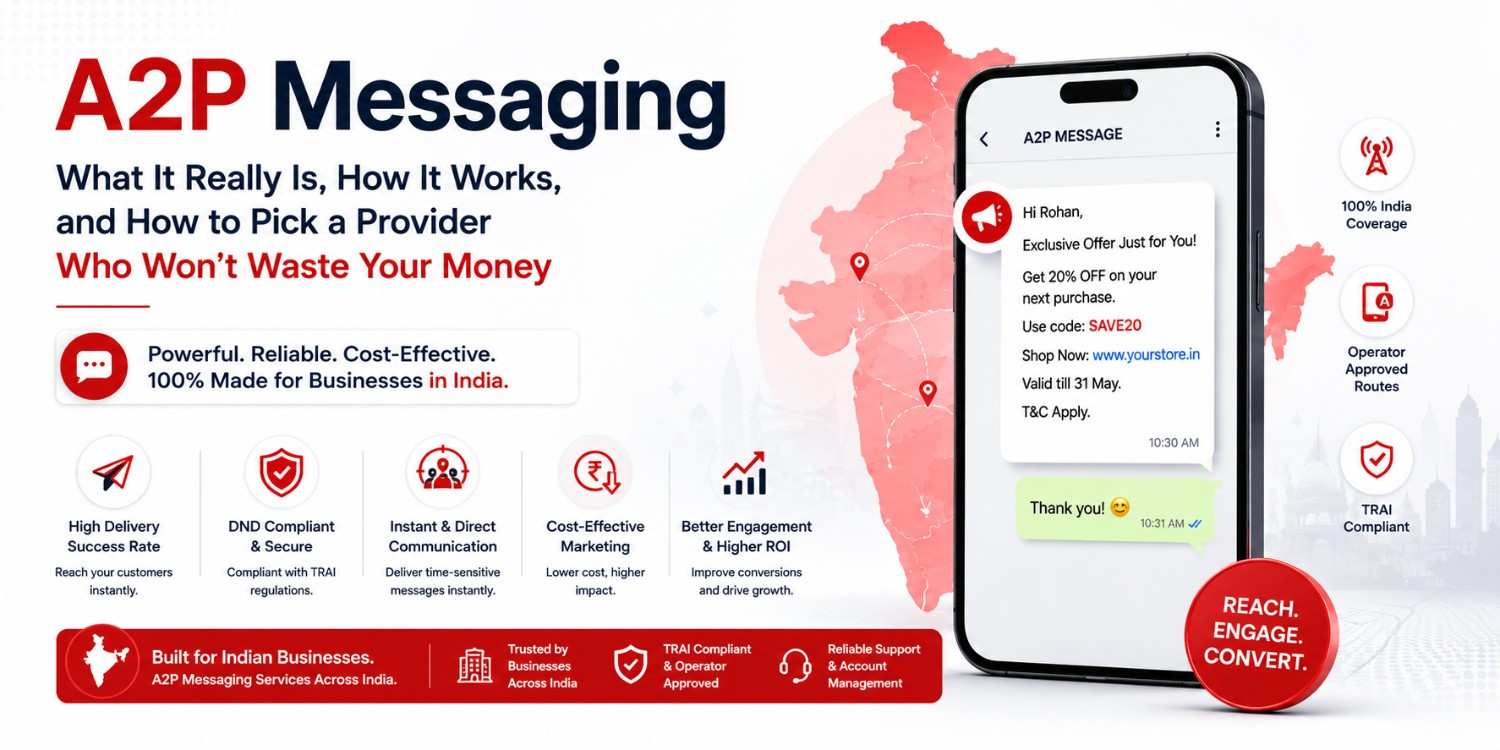
Think about the last time your phone buzzed with a “your OTP is 4821” text, or a “your order has shipped” update, or a reminder that your dentist appointment is tomorrow at 4 PM. None of those came from a person sitting at a desk typing your number in. They came from software — an app, a server, a marketing platform — talking directly to your phone.
That’s A2P messaging. And it’s a much bigger business than most people realize.
The global A2P SMS market is sitting at roughly USD 54.22 billion in 2026, according to Mordor Intelligence’s latest industry data, and it’s expected to keep climbing toward the mid-60-billion mark by 2031. Other research houses peg the number even higher when you fold in the broader A2P messaging category beyond pure SMS. Whichever estimate you trust, the takeaway is the same: this isn’t a niche communication channel anymore. It’s infrastructure.
If you’ve landed here because you’re trying to actually understand A2P messaging — not just the textbook definition, but how it works, what it costs, what the compliance headaches look like, and how to pick a provider that won’t leave you high and dry — this is that guide.
So, What Is A2P Messaging, Exactly?
A2P stands for application-to-person. It’s the umbrella term for any message that originates from a software system — not a human — and lands on someone’s phone. The word “application” is doing a lot of work here: it could mean your bank’s fraud detection system, an e-commerce platform’s order engine, a hospital’s scheduling software, or a marketing automation tool blasting out a flash sale.
The one thing all A2P SMS has in common is that the sender isn’t a person typing on a keyboard. It’s a machine, following rules, at scale.
Compare that to P2P messaging — the ordinary back-and-forth texting you do with friends and family. P2P is one person, one message, no automation, no volume. A2P is the opposite on every axis: automated, high-volume, and usually one-directional (though plenty of A2P setups now support replies too).
Here’s a quick way to think about the difference:
- Who’s sending? A2P: software. P2P: a human.
- How many messages at once? A2P: potentially millions in a campaign. P2P: a handful a day.
- Does the carrier care? A2P: yes, heavily — sender IDs, registration, consent tracking. P2P: barely regulated between consenting individuals.
- What’s it used for? A2P: OTPs, alerts, reminders, promotions. P2P: actual conversations.
There’s also a lesser-known cousin worth knowing: P2A messaging, or person-to-application. That’s when you text back — voting for a contestant on a reality show, replying “STOP” to unsubscribe, or asking a customer service chatbot a question. Most modern A2P setups are built to handle both directions, which is really what makes two-way business texting feel less robotic.
How Does A2P Messaging Actually Work?
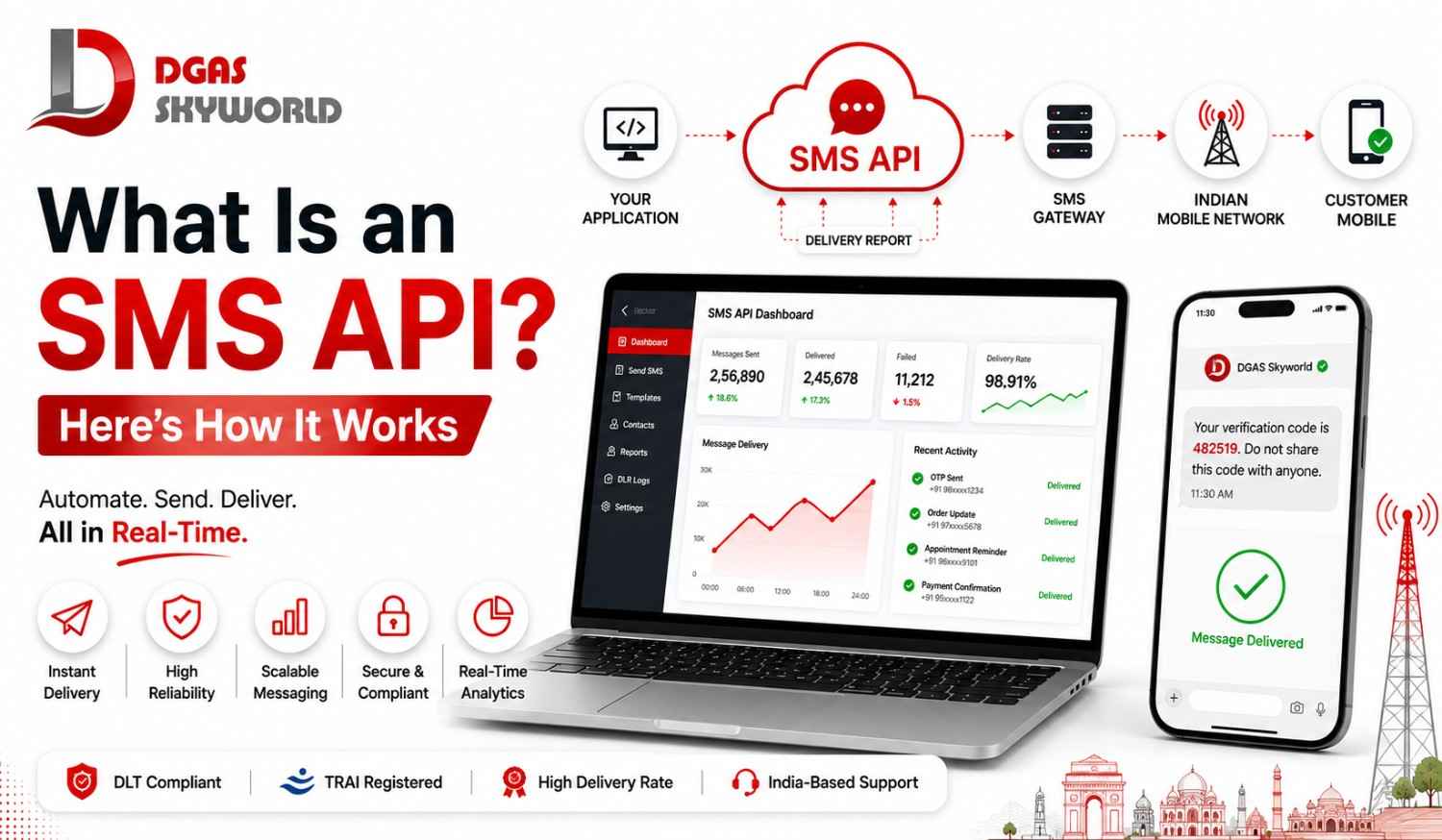
It’s easy to think of A2P messaging as a black box — you hit “send campaign” and a text just… appears on someone’s phone. In reality, there are four distinct stops along the way, and each one is a place where things can go right or badly wrong.
1. The message gets created. Somewhere in a CRM, an e-commerce backend, a hospital’s scheduling tool, or a dedicated A2P messaging platform, a trigger fires. Maybe it’s a purchase event, an appointment booking, or a scheduled campaign send. The system generates the message content — often pulling in personalization fields like the customer’s name or order number.
2. It hits a gateway. The message doesn’t go straight to a phone. It routes through an SMS or messaging gateway — think of this as a translator and traffic controller rolled into one. The gateway formats the message correctly and hands it off to carrier networks using protocols like SMPP or standard HTTP APIs.
3. The carrier checks it. This is the step most guides skip over, and it’s the one that actually determines whether your message gets delivered. Carriers check the message against registration records — in the US, that’s the A2P 10DLC system; in India, it’s TRAI’s DLT framework. They verify the sender isn’t spoofing a bank or a known brand, and they run spam and consent checks. A message that fails any of these gets silently dropped. Not bounced, not flagged — just gone.
4. It reaches the phone — and maybe talks back. Once cleared, the message lands on the recipient’s device. If the channel supports two-way messaging, the person can reply, confirm an appointment, or text “STOP,” and that reply routes back through the same pipeline in reverse.
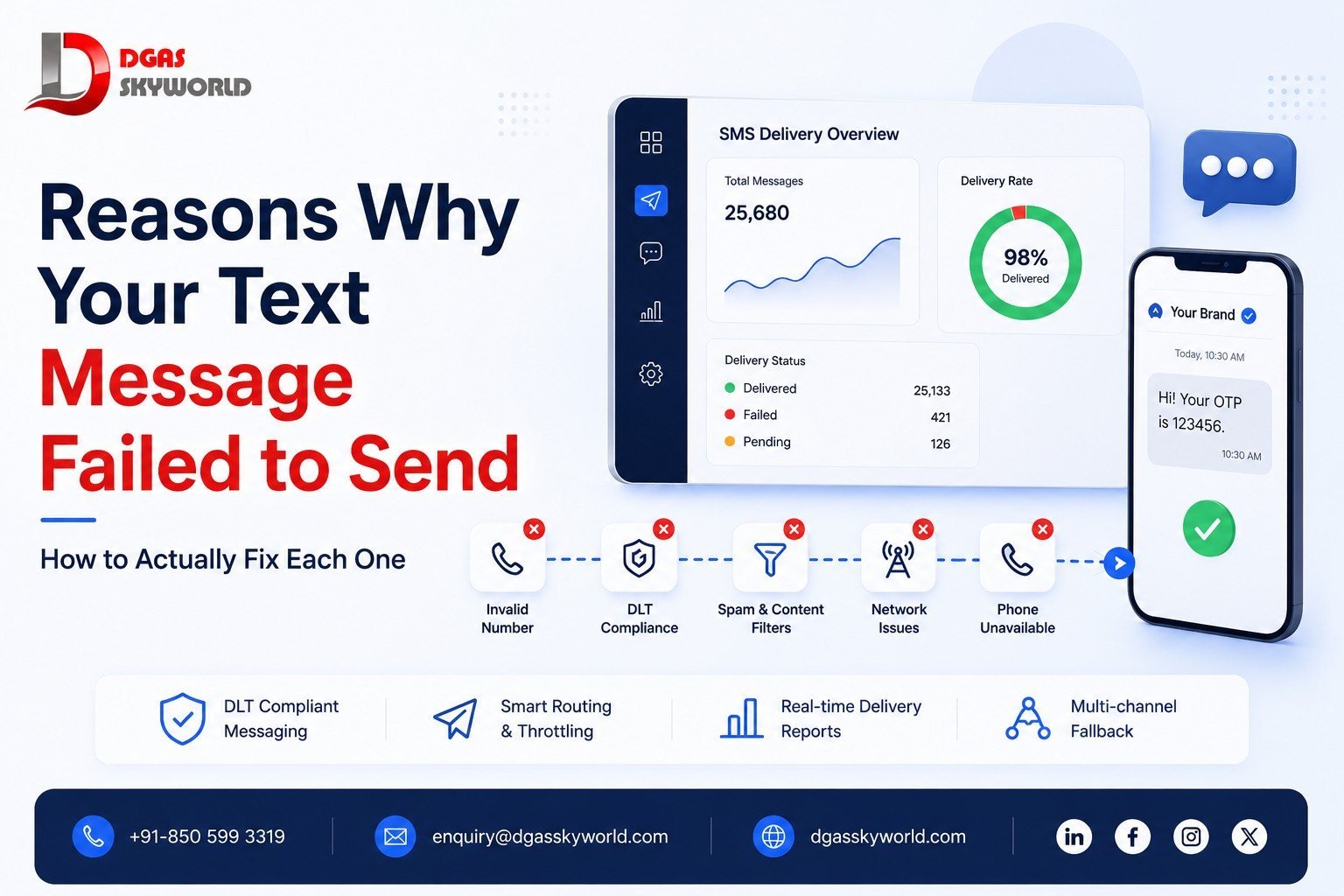
Read Also – 17 Reasons Why Text Message Failed to Send And How to Actually Fix Each One
The Part Most A2P Guides Leave Out: It’s Not Just SMS Anymore
Here’s where a lot of the content you’ll find online about A2P messaging starts to feel dated. It treats “A2P” and “SMS” as interchangeable, and in 2026, they’re not.
WhatsApp Business API and RCS Business Messaging are now core parts of the A2P stack, not side experiments. They carry the exact same use cases — OTPs, order updates, appointment reminders, marketing — but with things plain SMS simply can’t do: images, buttons, carousels, quick-reply chips. RCS does something similar natively inside the default messaging app on Android phones, so recipients don’t need to install anything extra.
The smart move in 2026 isn’t picking one channel and ignoring the rest. It’s orchestration — sending on the richest channel a recipient’s device supports, and falling back to plain SMS automatically when it doesn’t. A hotel booking confirmation might go out on WhatsApp with a map link and a check-in button for most recipients, but fall back to a plain-text SMS the moment WhatsApp delivery fails.
One thing worth flagging if you’re budgeting a WhatsApp-inclusive A2P strategy: Meta has been moving away from its old per-conversation pricing model toward per-message billing for template messages. If your cost projections are based on older per-conversation math, it’s worth revisiting those numbers before you commit to a campaign budget.
Where A2P Messaging Actually Gets Used (By Industry)
The theory is useful, but A2P messaging earns its keep in very specific, very practical ways depending on the industry. Here’s where it shows up most.
Healthcare. Appointment reminders, prescription refill nudges, lab result notifications, vaccination scheduling. Missed appointments cost hospitals real money, and A2P reminders are one of the cheapest levers available to reduce no-shows — which is part of why healthcare keeps showing up as one of the fastest-growing verticals in A2P SMS market forecasts.
E-commerce and retail. This is probably the use case you interact with most without noticing — order confirmations, shipping updates, OTPs at checkout, cart abandonment nudges, flash-sale blasts. Delivery-stage messages in particular have near-universal open rates because people are actively waiting for that information.
BFSI — banking, financial services, insurance. This is the single largest vertical by A2P SMS market share, holding somewhere around 28–29% of the global market depending on which research firm you ask. Mandated transaction alerts, fraud detection pings, and OTP-based two-factor authentication are the backbone of it. One frequently cited 2024 industry estimate puts the share of financial institutions worldwide relying on A2P SMS for two-factor authentication above 85%.
Travel and hospitality. Flight delays, gate changes, hotel confirmations, check-in reminders — anything where the value of the message drops sharply if it’s even twenty minutes late.
Real estate. This one doesn’t get enough attention in most A2P explainers, but it’s increasingly significant — site visit reminders, project update broadcasts to a buyer list, and lead nurturing sequences for high-intent inquiries. For premium and luxury residential projects especially, WhatsApp-based A2P messaging tends to outperform plain SMS, simply because you can share floor plans, pricing sheets, and walkthrough video links directly inside the conversation instead of a bare link.
Internal, employee-facing communication. Not every A2P message is customer-facing. Shift changes, safety alerts, and internal policy updates increasingly move through A2P channels for distributed teams who don’t check email on the floor.
Why Businesses Keep Investing in A2P Messaging
The pitch for A2P messaging isn’t complicated, but the numbers behind it are genuinely strong:
- It gets opened. A2P SMS open rates routinely clear 90%, which isn’t a marketing claim — it’s a structural fact about how people treat text messages versus email. Engagement rates on well-targeted campaigns commonly land above 40%.
- It’s fast. Delivery typically happens within seconds, which matters enormously for anything time-sensitive — a fraud alert that arrives ten minutes late is close to useless.
- It doesn’t need an app or a data connection. Plain SMS works on virtually any phone, anywhere, which still matters more than people assume in markets with patchy data coverage.
- It scales personalization. A single campaign can merge customer data into thousands of individually relevant messages without anyone manually customizing a thing.
- It’s genuinely two-way when you want it to be. Recipients can confirm, reschedule, or opt out right inside the thread.
- It’s cheap relative to the alternatives. Compared to outbound calling or physical mail, the cost per message at volume is hard to beat.
The Compliance Part Nobody Wants to Read (But Actually Determines If Your Messages Land)
Here’s an uncomfortable truth: you can write a perfect A2P campaign, target the perfect audience, and still watch it vanish into nothing — because carriers now actively filter unregistered or non-compliant traffic before it ever reaches a phone. Compliance isn’t a legal footnote anymore. It’s a delivery mechanism.
In the United States: A2P 10DLC and the TCPA
US carriers require businesses to register both their brand and each individual messaging campaign under the A2P 10DLC system before sending business SMS through standard long-code numbers. That means submitting your legal business details and a description of what your campaign actually contains and why. On top of that, the Telephone Consumer Protection Act (TCPA), enforced by the FCC, requires explicit opt-in consent before any marketing text goes out, and it requires you to honor the national Do Not Call registry. Unregistered 10DLC traffic gets throttled — sometimes blocked outright — by carriers who’ve gotten a lot less patient about grey-route messaging in recent years.
In India: TRAI’s DLT Framework
If you’re sending commercial SMS to Indian phone numbers, this is the section to actually read carefully, because it’s more elaborate than most businesses expect — and it’s non-negotiable.
Under the Telecom Commercial Communications Customer Preference Regulations (TCCCPR), 2018, every business must register on a TRAI-approved DLT (Distributed Ledger Technology) platform — a blockchain-based system, which sounds unusual for a telecom regulation but is exactly what it is. Registration covers three layers:
- Your Principal Entity registration, which gets you a Unique Entity ID (there’s a commonly cited one-time registration fee around ₹5,900, and registering with one telecom operator’s DLT platform is recognized across all the others).
- Your sender ID, or “header” — a six-character alphanumeric code that identifies your brand on every message.
- Pre-approved content templates — every unique message variant you plan to send needs individual approval before it can go out.
As of recent industry figures, India’s DLT ecosystem has more than 250,000 registered entities and over 600,000 registered headers on file. And the rules keep tightening: since October 2024, every URL inside an SMS template has to be a full link from a domain you own, whitelisted in advance — public shorteners like bit.ly get blocked automatically during DLT scrubbing. Miss any piece of this, and even a legitimate OTP gets silently dropped by the carrier before it reaches the subscriber. There’s no bounce notification. It just doesn’t arrive.
For any business running SMS campaigns into India, DLT registration isn’t paperwork you can push off — it’s the actual mechanism deciding whether your messages exist on the other end.
Most other major markets enforce their own version of sender ID registration and anti-spam rules, generally built around documented opt-in consent and a mandatory, easy opt-out path. The specifics shift more often than most businesses track, so it’s worth confirming current requirements with your carrier or provider before a launch rather than assuming last year’s rules still apply.
SMS vs WhatsApp API vs RCS: Which A2P Channel Should You Actually Use?
This is less “pick one” and more “know which one to reach for, when.”
SMS Service wins on raw reach — it works on literally any phone, no app required — which makes it the right default for OTPs and anything where guaranteed delivery matters more than presentation. WhatsApp Business API wins on engagement and richness — images, buttons, carousels — but requires the recipient to have WhatsApp installed, and pricing is shifting toward per-message billing for template sends. RCS Business Messaging sits in between: rich media similar to WhatsApp, but built natively into the default messaging app on supported Android devices, so there’s no install step, though device and carrier support still varies.
Most businesses that get this right aren’t choosing one and abandoning the others. They’re layering them — sending the richest version a recipient’s device supports, with SMS as the fallback that guarantees the message lands somewhere.
How to Actually Choose an A2P Messaging Service Provider
There are dozens of A2P messaging service providers out there, and honestly, most of their marketing pages sound identical. The differences that actually matter rarely show up in a sales pitch. Here’s what to dig into instead:
- Direct carrier connectivity. Providers with direct routes to carriers — rather than reselling through two or three middlemen — tend to deliver more consistently, especially during high-volume sends.
- Compliance handled for you. A provider worth paying for manages your 10DLC registration or your TRAI DLT onboarding directly, rather than pointing you at a carrier portal and wishing you luck.
- Pricing you can actually see. Ask for per-message costs broken down by destination corridor. A flat “average” quote can hide real cost spikes in whichever countries you actually send to most.
- One platform, multiple channels. Look for an A2P messaging platform that handles SMS, WhatsApp Business API, and RCS together — juggling three separate vendors and three separate invoices for what should be one messaging strategy is a headache you don’t need.
- Documentation that doesn’t waste your engineers’ time. Clean APIs and reliable delivery-status webhooks save real implementation weeks.
- Support that shows up when a campaign breaks. Ask directly what happens when a template gets rejected mid-campaign or a send gets blocked. The answer tells you more than any feature list will.
Worth noting plainly: DGAS Skyworld operates as an official WhatsApp Business API provider — not a BSP and not a reseller — serving businesses across India, That distinction matters because it means Meta business verification, template approvals, and compliance run through us directly, without an extra layer sitting between your campaign and delivery.
We also run this as part of a broader CPaaS (Communications Platform as a Service) offering — so if you’re evaluating A2P messaging alongside voice, verification, or other programmable communication needs, WhatsApp API and RCS Messaging are available under the same CPaaS platform across all our markets, with SMS service currently offered under this platform for India specifically.
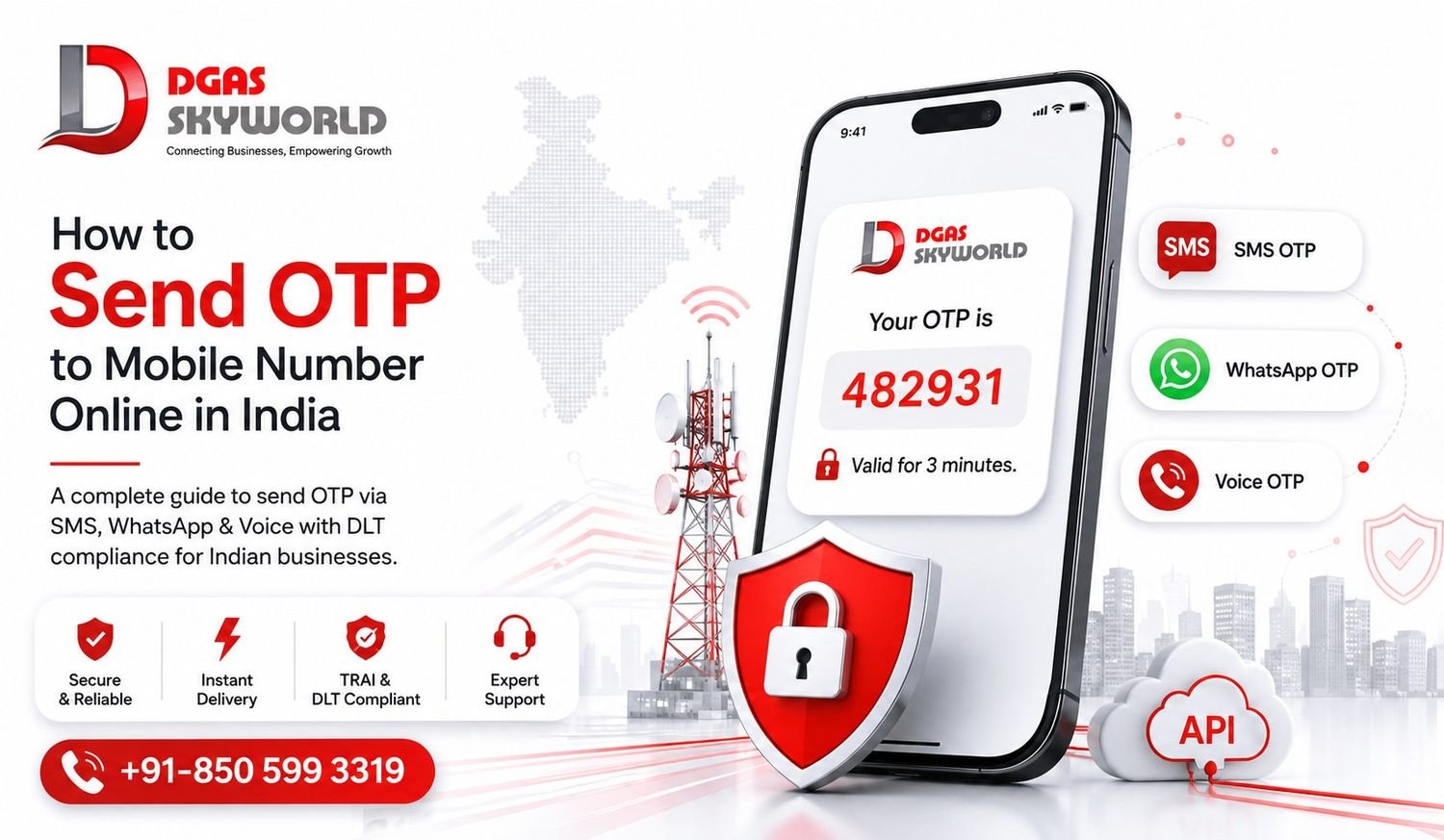
Read Also – SMS Verification: What It Is, How It Works, and How to Send Verification Codes
Frequently Asked Questions
What is A2P messaging in simple terms?
It’s any message sent from a software application or business system to someone’s phone, rather than from one person to another — OTPs, order confirmations, appointment reminders, and promotional texts all fall under A2P messaging.
What’s the actual difference between A2P and P2P SMS?
P2P is a private, human-to-human conversation. A2P is automated, sent at volume by a business system through registered channels, which is exactly why carriers apply different rules — sender ID formats, registration, consent tracking — to A2P traffic that they’d never apply to a regular text between friends.
Does WhatsApp Business API count as A2P messaging?
Yes. It’s simply a richer channel carrying the same kinds of A2P use cases SMS always has — notifications, OTPs, marketing — just with images, buttons, and interactive elements SMS can’t support.
Do I need A2P 10DLC registration?
If you’re sending business SMS to US phone numbers, yes. Without it, your messages risk being filtered or blocked outright by US carriers.
What exactly is TRAI DLT registration?
It’s India’s blockchain-based compliance system under the TCCCPR 2018 regulation. Every business sending commercial SMS to Indian numbers has to register its entity, sender ID, and message templates on a DLT platform — unregistered messages get blocked by carriers before delivery, no exceptions.
How much does A2P messaging actually cost?
It depends heavily on destination. International termination rates averaged around USD 0.10 per message globally in early 2025, though several corridors across Africa and Asia run noticeably higher. WhatsApp and RCS pricing is generally structured per message or per conversation and varies by use case and region.
What should I actually look for in an A2P messaging service provider?
Direct carrier connections, built-in compliance support for frameworks like 10DLC and DLT, transparent per-corridor pricing, solid API documentation, responsive support, and ideally, one CPaaS platform that covers SMS, WhatsApp, RCS, and other programmable communication needs together rather than juggling separate vendors.
Can A2P messages include photos or rich content?
Plain SMS is text-only, with limited media support through MMS. For real rich media — images, buttons, carousels — you’d use WhatsApp Business API or RCS Business Messaging instead.
The Bottom Line
The core idea behind A2P messaging hasn’t really changed since the first appointment reminder ever went out — automated, timely communication that actually gets opened. What’s changed is everything around it. SMS is no longer the whole story; WhatsApp and RCS are now standard parts of a serious A2P messaging platform. And compliance — 10DLC in the US, DLT in India — has stopped being a legal checkbox and become the literal mechanism deciding whether your messages exist on the other end.
Businesses that treat channel mix and compliance as one connected system, rather than an afterthought bolted onto a marketing campaign, are the ones actually seeing A2P messaging convert — not just send.
Need an A2P messaging strategy that’s built to actually deliver? DGAS Skyworld is an official WhatsApp Business API provider and CPaaS platform running compliant WhatsApp and RCS messaging automation for businesses across India, with SMS services available on our CPaaS platform for India. Schedule a consultation to talk through your setup.
This article is for informational purposes and does not constitute legal or compliance advice. Verify current TRAI, FCC, and Meta requirements directly before launching campaigns.