What Is an SMS API? Here’s How It Works
Picture this: it’s 11 PM, an order just shipped from a warehouse in Delhi, an OTP is waiting to be sent to a customer in Mumbai, and a hospital in Bengaluru needs to remind 400 patients about tomorrow’s appointments. None of this happens because someone is manually typing out messages on a phone. It happens because a piece of software called an SMS API is quietly doing the work — instantly, accurately, and at a scale no human team could match.
SMS still holds one of the highest open rates of any communication channel, with most messages read within minutes of arriving — which is exactly why banks, e-commerce platforms, hospitals, and real estate brands haven’t abandoned it, even in a world full of app notifications and chat platforms. But sending SMS at business scale isn’t something you do from a phone’s messaging app. That’s where an SMS API comes in.
In this guide, we’ll break down what an SMS API actually is, how it works behind the scenes, the compliance rules every Indian business needs to know (DLT registration — more on that below), and how choosing the right platform can save you both money and messaging headaches.
What Is an SMS API?
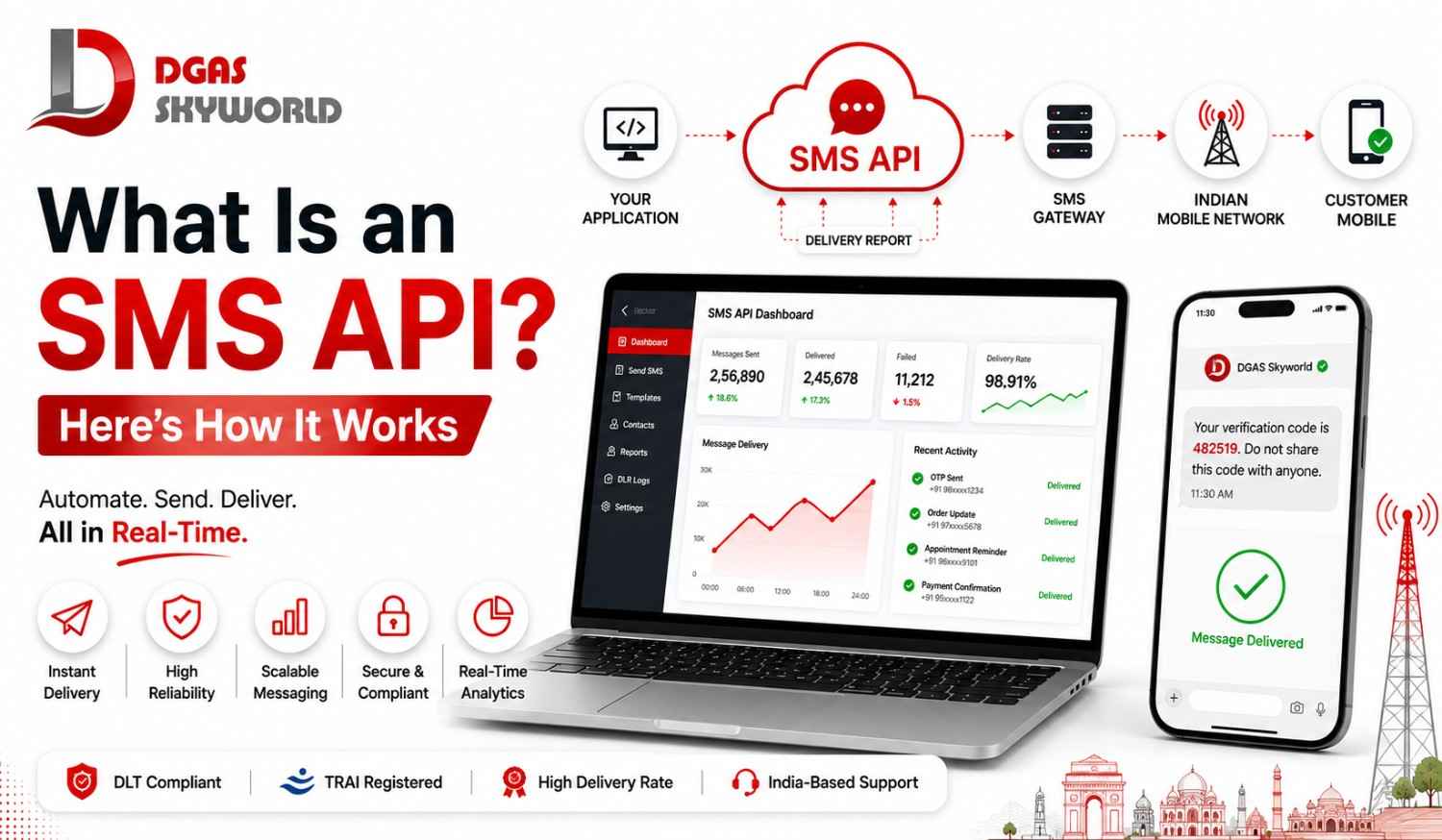
An SMS API (Application Programming Interface) is a software interface that lets your application, website, or CRM send and receive text messages automatically — without a human ever opening a messaging app.
Think of it as a digital courier. Your business system hands over a message, a recipient’s number, and a few instructions to the SMS API. The API then routes everything through an SMS gateway to the telecom network, and the message lands on the customer’s phone — usually within seconds.
Instead of your support team manually texting hundreds of customers, an SMS API integration lets your software trigger messages automatically — a payment confirmation the moment a transaction completes, an OTP the instant someone logs in, a delivery update the second a courier scans a package.
This is why SMS APIs are also commonly referred to as a text message API, bulk SMS API, or SMS gateway API — different names, same core function: connecting your application to the telecom network programmatically.
How Does an SMS API Work? (Step-by-Step)
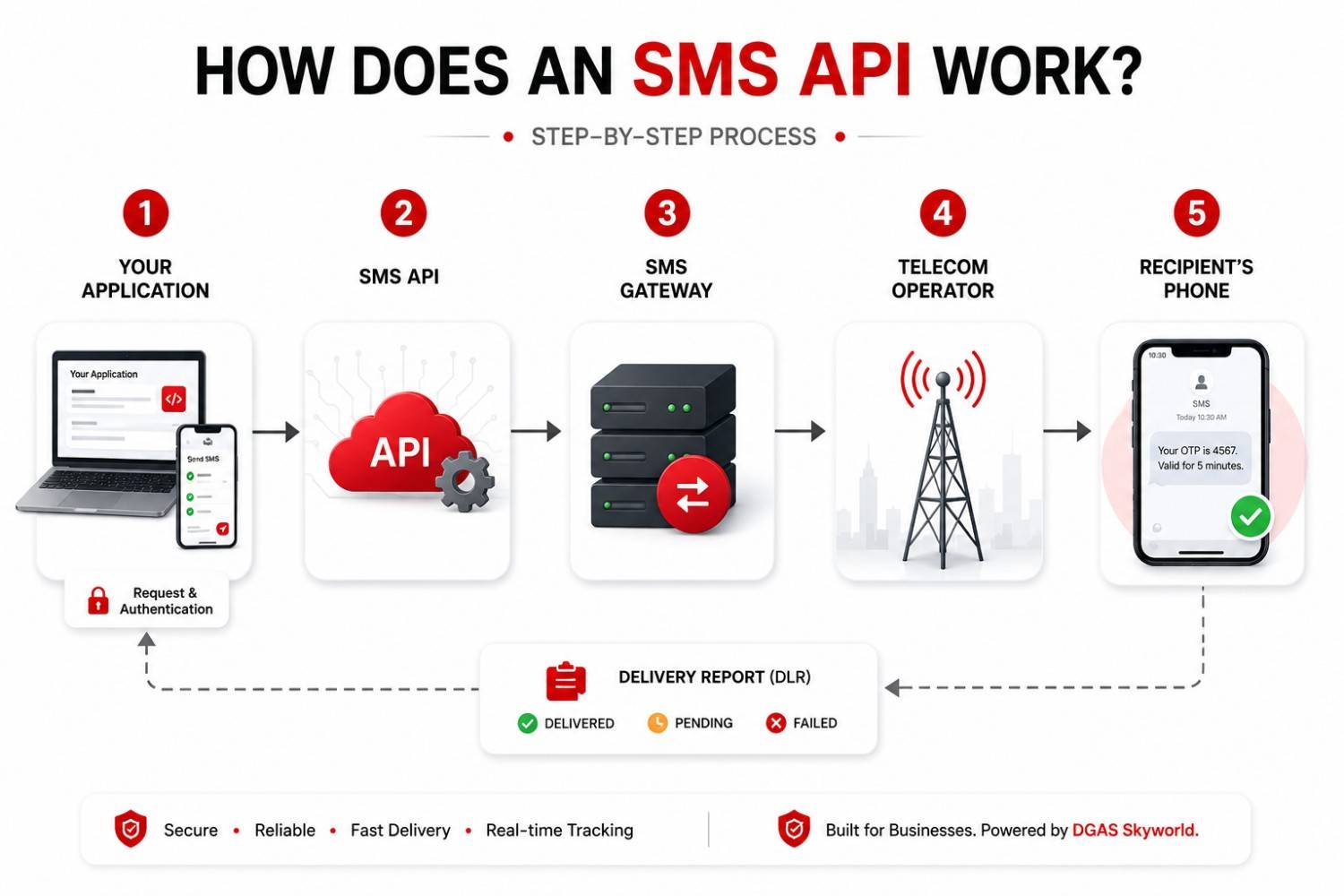
Here’s what actually happens between the moment your system triggers a message and the moment it appears on someone’s phone:
Step 1: Request & Authentication
Your application sends a request to the SMS API containing the message content, the recipient’s phone number, and your authentication credentials (an API key or access token). This confirms you’re an authorized sender, not a random script pinging the network.
Step 2: Message Routing via the SMS Gateway
The SMS gateway — the actual bridge between the internet and telecom infrastructure — receives this request. It identifies which mobile network the recipient’s number belongs to and routes the message accordingly.
Step 3: Delivery to the Recipient’s Device
The mobile operator delivers the message to the recipient’s handset. This entire journey — from your server to the customer’s phone — typically takes just a few seconds, even when you’re sending thousands of messages in parallel.
Step 4: Delivery Report (DLR) and Status Feedback
Once delivered (or if it fails), the API sends back a Delivery Report (DLR) — telling your system exactly what happened: delivered, pending, or failed, along with an error code if something went wrong. This is what lets you track campaign performance and troubleshoot delivery issues in real time.
(Flow: Your Application → SMS API → SMS Gateway → Telecom Operator → Recipient’s Phone → Delivery Report back to you)
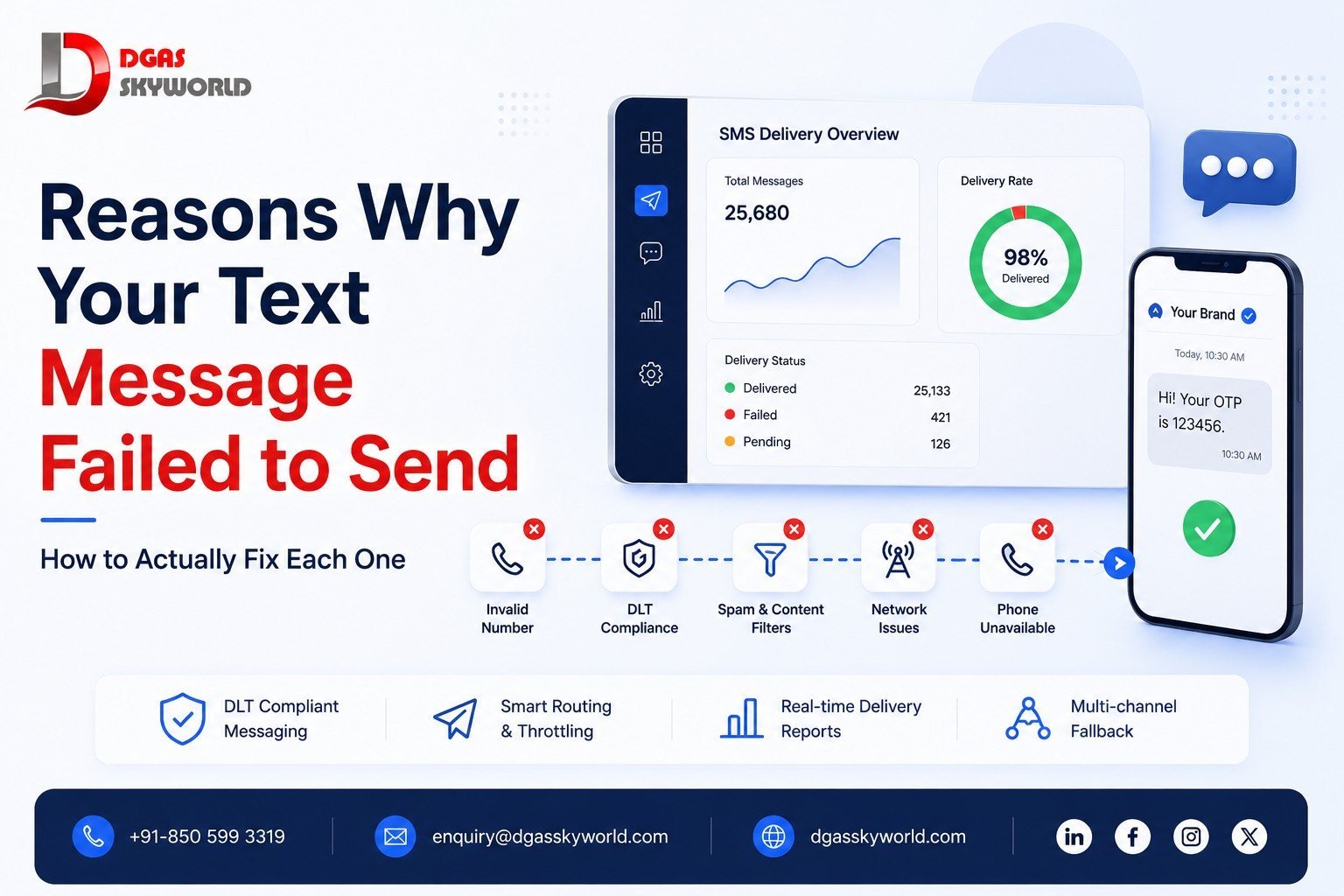
Read Also – 17 Reasons Why Text Message Failed to Send And How to Actually Fix Each One
Types of SMS API You Should Know About
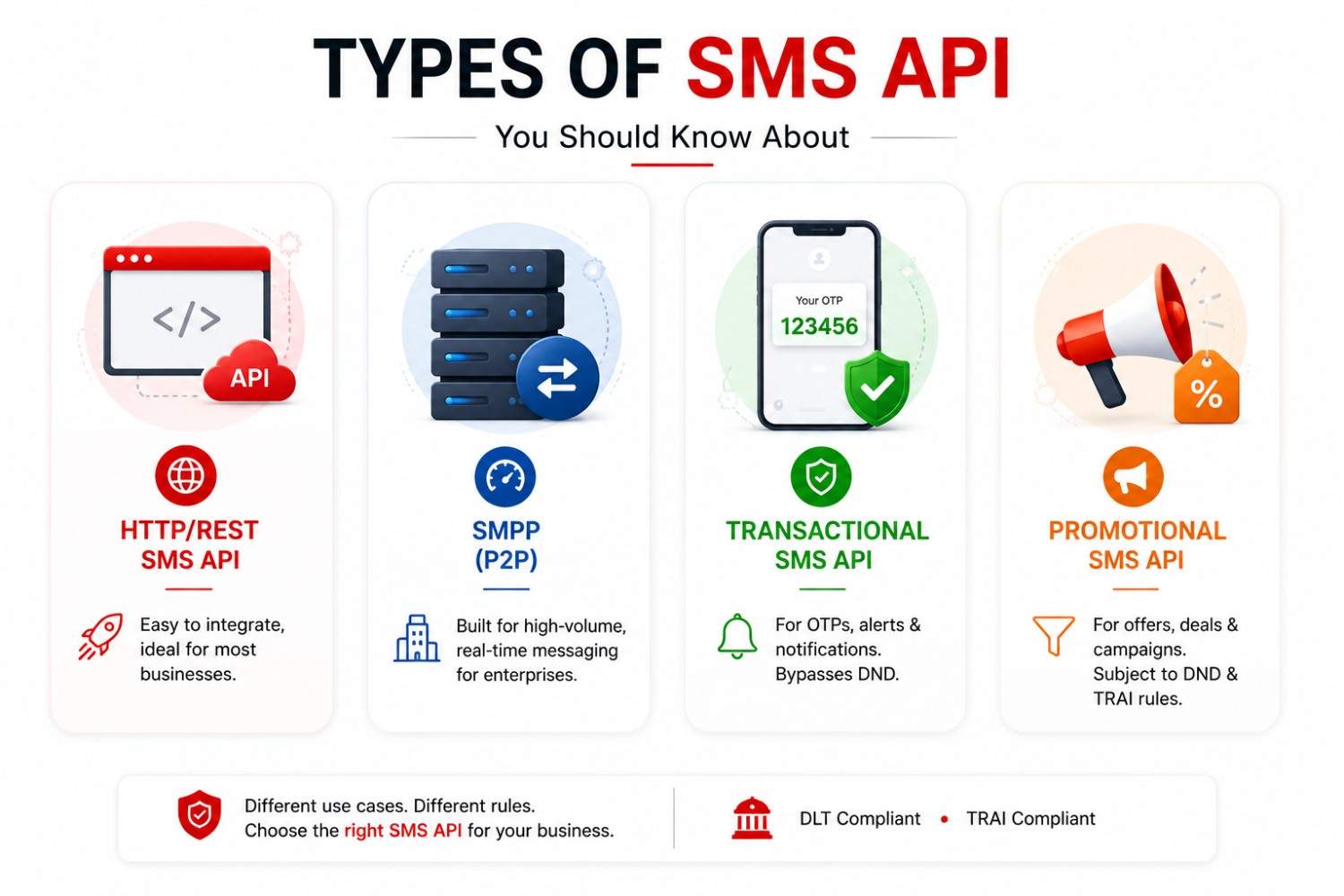
Not all SMS APIs are built the same way, and picking the wrong type can cost you money or cause compliance headaches.
- HTTP/REST-based SMS API – The most common type; lightweight, easy to integrate, ideal for most businesses regardless of size.
- SMPP (Short Message Peer-to-Peer) – A protocol built for extremely high-volume, real-time messaging, typically used by large enterprises and telecom-grade senders.
- Transactional SMS API – Used for OTPs, alerts, and account notifications. These bypass DND (Do Not Disturb) restrictions in India because they’re not promotional.
- Promotional SMS API – Used for offers, discounts, and marketing campaigns. These are subject to DND filtering and time-window restrictions under TRAI regulations.
Knowing this difference matters more in India than almost anywhere else, because our regulatory framework treats these two categories very differently — which brings us to the part most global guides on this topic completely skip.
Important SMS API Terms You Should Know
A quick glossary to help you navigate provider documentation and pricing sheets:
| Term | What It Means |
|---|---|
| Sender ID | The name or number displayed as the sender (e.g., “DGASKW” instead of a random number) |
| API Key | A unique authentication credential that identifies your account |
| Latency | Time taken for a message to reach the recipient after the request is sent |
| Throughput (TPS) | Number of messages the API can send per second |
| DLR (Delivery Report) | Confirmation of whether a message was delivered, pending, or failed |
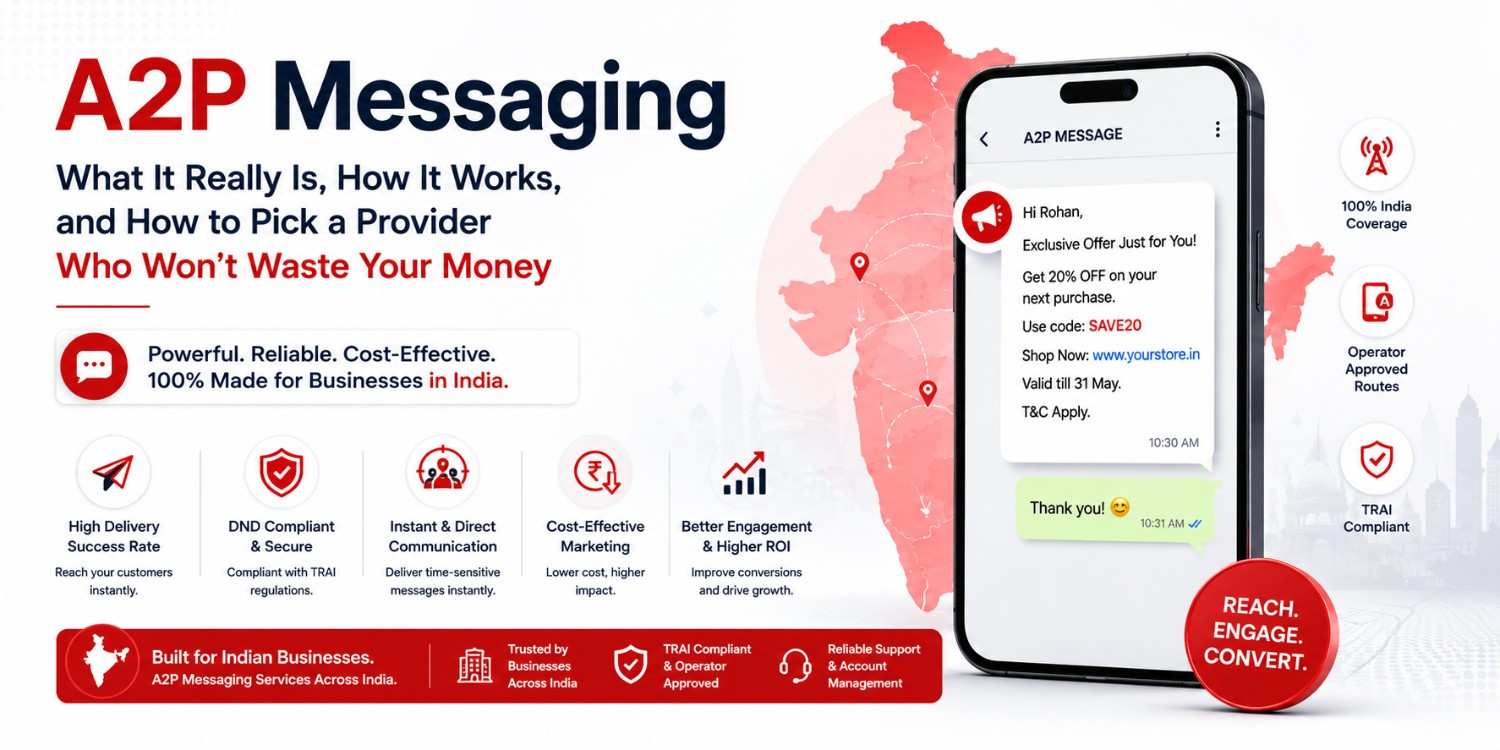
| A2P Messaging | Application-to-Person messaging — automated messages sent from software to a phone |
| GSM-7 Encoding | Standard character set allowing up to 160 characters per SMS segment |
| Long Code vs Short Code | Long code = regular 10-digit number; short code = shorter dedicated number for high-volume sending |
| DLT | Distributed Ledger Technology — the TRAI-mandated registration system for all commercial SMS senders in India |
DLT Registration & TRAI Compliance for SMS API in India
This is the part almost every global SMS API guide leaves out entirely — and it’s the single biggest reason Indian businesses get their messages blocked.
Under TRAI’s regulations, every business sending commercial SMS in India must complete DLT (Distributed Ledger Technology) registration, which involves three things:
- Entity ID registration – registering your business as a verified sender
- Header/Sender ID registration – registering the name that appears as your SMS sender (e.g., “DGASKW”)
- Template registration – pre-approving the exact wording of every message you intend to send
If any of these three aren’t properly registered, your messages get filtered or blocked by telecom operators — no exceptions, regardless of how good your SMS API provider is on the technical side.
This is where the provider you choose matters as much as the API itself. A good CPaaS partner doesn’t just hand you an API key and leave you to figure out DLT compliance on your own — they guide you through entity registration, template approval, and ongoing compliance monitoring so your delivery rates stay high and your campaigns never get stuck in a compliance loop.
(For a deeper look at how A2P messaging and DLT interact, see our detailed guide on A2P Messaging in India.)
Why Do Businesses Need an SMS API?
- 24/7 Automation – messages go out the moment an event triggers them, day or night, no manual intervention
- Scalability – send 10 messages or 10 lakh messages through the same system
- High Engagement – SMS remains one of the fastest-read communication channels, with most messages opened within minutes
- Two-Way Messaging – customers can reply, enabling support and confirmation workflows, not just one-way broadcasts
- Real-Time Tracking – delivery reports and analytics help you measure and improve campaign performance
- Cost-Efficiency – far cheaper than building and maintaining your own telecom infrastructure in-house
What’s the Benefit of Getting Bulk SMS From a CPaaS Platform?
We’ve covered how an SMS API works. But here’s an important question: should you get your bulk SMS from a standalone SMS gateway, or from a CPaaS platform? This distinction has a much bigger impact on business outcomes than most people realize.
A standalone SMS gateway does exactly one thing — send SMS. A CPaaS (Communication Platform as a Service) platform, on the other hand, gives you access to multiple channels — SMS, WhatsApp, RCS, Voice, Truecaller messaging, AI Chatbot and Email — through a single dashboard and a single API integration.
Here are the real business benefits of this approach:
- Single Integration, Multiple Channels – Integrate the API once, and you can use SMS alongside WhatsApp and RCS without dealing with separate vendors for each channel.
- Smart Fallback – If an SMS gets blocked due to DND restrictions, a CPaaS platform can automatically fall back to WhatsApp or RCS — ensuring the message still reaches the customer.
- Unified Analytics – Delivery data from every channel sits on one dashboard, so you don’t have to track separate reports for each provider.
- Cost Optimization – With smart routing, the system automatically picks the most cost-effective channel for each message.
- One Vendor, One Support Team – No more juggling multiple providers as you scale — everything is handled by a single team.
This is exactly why larger brands move away from standalone SMS gateways and choose a full CPaaS platform instead — because as a business grows, SMS alone isn’t enough. You need a unified communication infrastructure that can grow with you.
DGAS Skyworld works exactly this way — giving businesses SMS API, WhatsApp Business API, RCS Messaging, Enterprise Voice, Truecaller Messaging, AI Chatbot, and Email API, all from a single platform, without the need for multiple vendors.
Real-World Use Cases of SMS API
- E-Commerce – order confirmations, shipping updates, delivery alerts
- BFSI (Banking, Financial Services, Insurance) – OTPs, transaction alerts, EMI due reminders
- Healthcare – appointment reminders, test result notifications, prescription refill alerts
- Education – exam date notifications, fee due reminders, class schedule changes
- Real Estate – site visit confirmations, project launch alerts, offer notifications
- Travel & Hospitality – booking confirmations, check-in reminders, delay updates
SMS API Best Practices — Do’s and Don’ts
Do:
- Get explicit customer opt-in before sending promotional messages
- Use only DLT-approved templates for every message
- Personalize content wherever possible to improve engagement
- Monitor delivery reports regularly to catch failures early
Don’t:
- Send promotional messages without checking DND status
- Ignore customer opt-out requests
- Use unregistered sender IDs or templates
- Over-message your subscriber base — value over volume, always
How to Choose the Right SMS API Provider in India
Before signing up with any provider, check for:
- DLT compliance support – do they help with entity and template registration, or leave you to figure it out?
- Delivery rate and uptime SLA – what guarantees do they offer?
- Throughput capacity – can they handle your peak sending volume?
- Transparent INR pricing – no hidden charges, clear per-message costs
- Multi-channel (CPaaS) capability – can they scale with you into WhatsApp, RCS, or Voice later?
- Local support team – someone who understands Indian telecom regulations, not a generic overseas helpdesk
Why Choose DGAS Skyworld for SMS API in India
DGAS Skyworld has been building CPaaS communication infrastructure for Indian businesses since 2017. We’re built specifically for the Indian market — our services are available exclusively within India, which means our infrastructure, compliance support, and delivery routes are optimized for Indian telecom networks rather than spread thin across global markets.
Through a single platform, DGAS Skyworld gives businesses access to:
- SMS API – transactional and promotional bulk messaging with DLT compliance support
- WhatsApp Business API – official, verified business messaging (see our guide on What Is WhatsApp API)
- RCS Messaging – rich, interactive next-gen messaging
- Enterprise Voice Solutions – automated and programmable voice calling
- Truecaller Messaging – verified business identity on calls and messages
- AI Chatbot – automated conversational support across channels
- Email API – transactional and bulk email delivery
We handle the DLT registration process, monitor delivery performance, and provide dedicated support — so your team can focus on messaging strategy instead of chasing telecom compliance paperwork.
Want to see how an SMS API fits into your communication stack? Talk to our team and get started with a platform built for Indian businesses.
Book Your Free Demo for Bulk SMS API
Frequently Asked Questions
1. What is an SMS API used for?
An SMS API is used to automate sending and receiving of text messages — including OTPs, order updates, appointment reminders, and marketing promotions — directly from a business’s software or application.
2. Is DLT registration mandatory for sending SMS in India?
Yes. TRAI mandates DLT registration (Entity ID, Sender ID, and message templates) for every business sending commercial SMS in India. Without it, messages get blocked by telecom operators.
3. What’s the difference between an SMS API and an SMS Gateway?
An SMS gateway is the infrastructure that routes messages to telecom networks. An SMS API is the software interface businesses use to send instructions (message, recipient, schedule) to that gateway.
4. How much does an SMS API cost in India?
Pricing depends on message volume, message type (transactional vs promotional), and the provider you choose. Most Indian providers charge per SMS segment, with volume-based discounts available.
5. What’s the difference between transactional and promotional SMS API?
Transactional SMS (OTPs, alerts) bypasses DND restrictions since it’s not marketing content. Promotional SMS (offers, discounts) is subject to DND filtering and can only be sent during permitted hours under TRAI rules.
6. How do I get started with DGAS Skyworld’s SMS API?
Simply reach out to our team for a free consultation. We’ll guide you through DLT registration, API integration, and help you choose the right plan based on your messaging volume.
Conclusion
An SMS API isn’t just a technical tool — it’s the infrastructure that lets your business communicate instantly, reliably, and at scale, without adding headcount or building your own telecom backend. But in India, doing it right means getting DLT compliance sorted from day one, and choosing a provider who understands both the technology and the regulatory landscape.
If you’re evaluating SMS API providers, look beyond just “does it send messages” — ask whether it can grow with you into WhatsApp, RCS, and Voice through a single CPaaS platform. That’s exactly what DGAS Skyworld has been building for Indian businesses since 2017.
Related reading: What Is WhatsApp API? | Bulk SMS Marketing Guide | A2P Messaging Explained | How to Send Automated Messages on WhatsApp