Best Voice Broadcasting Service Provider in India – Send 10,000+ Calls in Minutes
Picture this: it’s the last week of the month, and a municipal body needs to inform two lakh residents about a water supply shutdown by tomorrow morning. Emails won’t reach half of them. An app notification assumes they’ve even installed the app. But a phone call? A phone call reaches almost anyone, on almost any device, in a language they understand.
That’s the quiet power behind voice broadcasting — and it’s exactly why, according to TRAI’s May 2026 subscriber data, India’s telephone base has crossed 134.3 crore connections, with wireless tele-density now over 93% nationally. Nearly every citizen, customer, and employee you need to reach already has a phone in their pocket. Voice broadcasting is simply the fastest way to talk to all of them at once.
But here’s what most businesses get wrong when they go shopping for a voice broadcasting service provider: they treat it as a single, isolated purchase — one more vendor, one more login, one more dashboard. The businesses (and government bodies) that actually get the most value out of bulk voice broadcasting are the ones who source it through a CPaaS platform that already connects their SMS, WhatsApp, RCS, and voice channels — and, just as importantly, who partner with a provider whose reliability has already been tested at scale by demanding, compliance-heavy customers like government departments and PSUs.
In this guide, we’ll unpack what voice broadcasting actually is, back up its benefits with real data, and show you exactly what to look for in a provider — including why DGAS Skyworld, trusted by government organizations, universities, and enterprises across India since 2017, is a name worth putting on your shortlist.
What Is Voice Broadcasting Service?
Voice broadcasting (also called bulk voice broadcasting, mass voice calling, or automated voice calling) is a technology that lets businesses send a pre-recorded or text-to-speech voice message to hundreds or thousands of phone numbers simultaneously. Instead of an agent dialling one number at a time, voice broadcasting software automates the entire outbound calling process — from dialling and message delivery to retries and reporting.
A typical voice broadcast can include:
- A simple informational message (an alert, reminder, or announcement)
- An interactive IVR-based message where the recipient presses a key to respond (a press-1 campaign)
- A personalized message using dynamic fields like customer name, due amount, or appointment date
You can dive deeper into how the underlying technology is structured in our guide on voice call APIs in India, which covers the programmable side of enterprise voice.
How Does Voice Broadcasting Work?
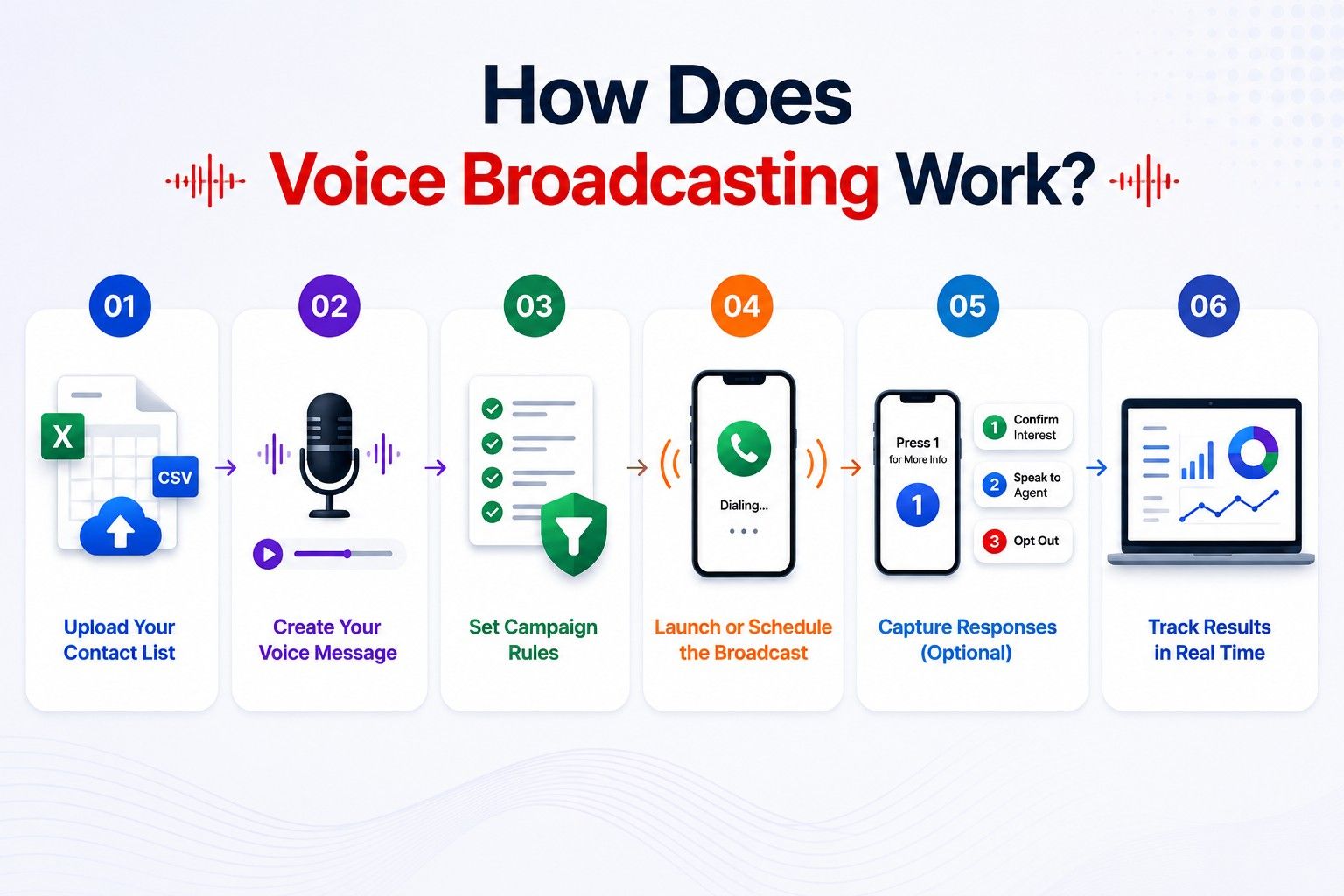
A standard voice broadcasting campaign follows a simple, repeatable workflow:
- Upload your contact list — via Excel, CSV, or a direct API/CRM integration.
- Create your voice message — record it yourself, upload an audio file, or generate it instantly using text-to-speech in multiple Indian languages.
- Set campaign rules — apply DND/DNC filtering, choose calling hours, and define retry logic for unanswered calls.
- Launch or schedule the broadcast — the system dials numbers automatically and plays your message to each recipient.
- Capture responses (optional) — recipients can press keys to confirm interest, get transferred to a live agent, or opt out.
- Track results in real time — monitor call connectivity, keypress responses, drop-offs, and overall campaign performance from a web dashboard.
Why Voice Still Wins: The Data Behind Bulk Voice Broadcasting
Numbers tell the story better than opinions do:
- 1.343 billion phone connections. TRAI’s May 2026 report puts India’s total telephone subscriber base at 134.3 crore, with wireless tele-density crossing 93% nationally. Unlike WhatsApp or RCS, which need a smartphone and a data connection, a voice broadcast reaches feature phones, landlines, and smartphones alike — a genuinely universal channel in a country where rural tele-density still trails urban tele-density significantly.
- 92% answer rates when channels work together. Industry research on outbound engagement (Verse.ai’s Texting Insights Report) found that combining a text message with a follow-up call pushed answer rates as high as 92% — nearly 3.7x higher than cold calling alone. That single data point is the strongest argument for pairing voice broadcasting with SMS or WhatsApp rather than running it as a standalone channel.
- A voice message carries what text can’t. Tone, urgency, and warmth don’t translate well into 160 characters. For payment reminders, emergency alerts, and appointment confirmations — situations where trust and clarity matter — a spoken message consistently outperforms plain text in comprehension and recall.
The takeaway: voice broadcasting isn’t outdated — it’s under-leveraged, especially by businesses running it in isolation instead of as part of a connected communication strategy.
Why a CPaaS Provider Is the Smarter Way to Get Voice Broadcasting Service
This is the single biggest differentiator most businesses overlook while shopping for a voice broadcasting service provider: should you buy voice broadcasting as a standalone tool, or get it through a CPaaS (Communication Platform as a Service) that already powers your SMS, WhatsApp, and other channels?
Here’s why sourcing bulk voice broadcasting through a CPaaS provider is almost always the better decision:
1. One API, every channel. A CPaaS platform gives you a single integration point for voice broadcasting, SMS API, WhatsApp Business API, RCS messaging, and email — instead of managing five different vendor logins, APIs, and support teams. If you’re new to the concept, our complete guide to CPaaS platforms breaks down exactly how this works.
2. Smarter fallback logic. With a CPaaS-native voice broadcasting service, an unanswered call can automatically trigger a follow-up SMS or WhatsApp message to the same customer — the exact “text + call” combination that data shows nearly doubles answer rates. A standalone voice-only vendor simply cannot do this, because it has no visibility into your other channels.
3. Unified reporting and customer view. Instead of tracking voice call reports in one dashboard and SMS delivery reports in another, a CPaaS platform consolidates every channel’s performance in one place, giving you a true 360-degree view of a customer’s communication journey.
4. Built-in compliance across channels. A CPaaS provider operating in India already maintains DLT registration and TRAI/TCCCPR-compliant workflows as standard infrastructure — your voice broadcasts inherit the same compliance rigor that governs your SMS marketing and A2P messaging campaigns.
5. Better economics at scale. Bundling voice, SMS, WhatsApp, and other channels with one provider is typically more cost-effective than paying separate platform fees and support contracts to multiple vendors.
6. Faster scaling for growing businesses. As your outreach needs grow, a CPaaS platform lets you turn on new channels instantly instead of onboarding a new vendor from scratch.
Want to see this in action? Book a free demo with DGAS Skyworld and see how voice, SMS, and WhatsApp can run from a single dashboard for your business.
Key Benefits of Voice Broadcasting for Your Business
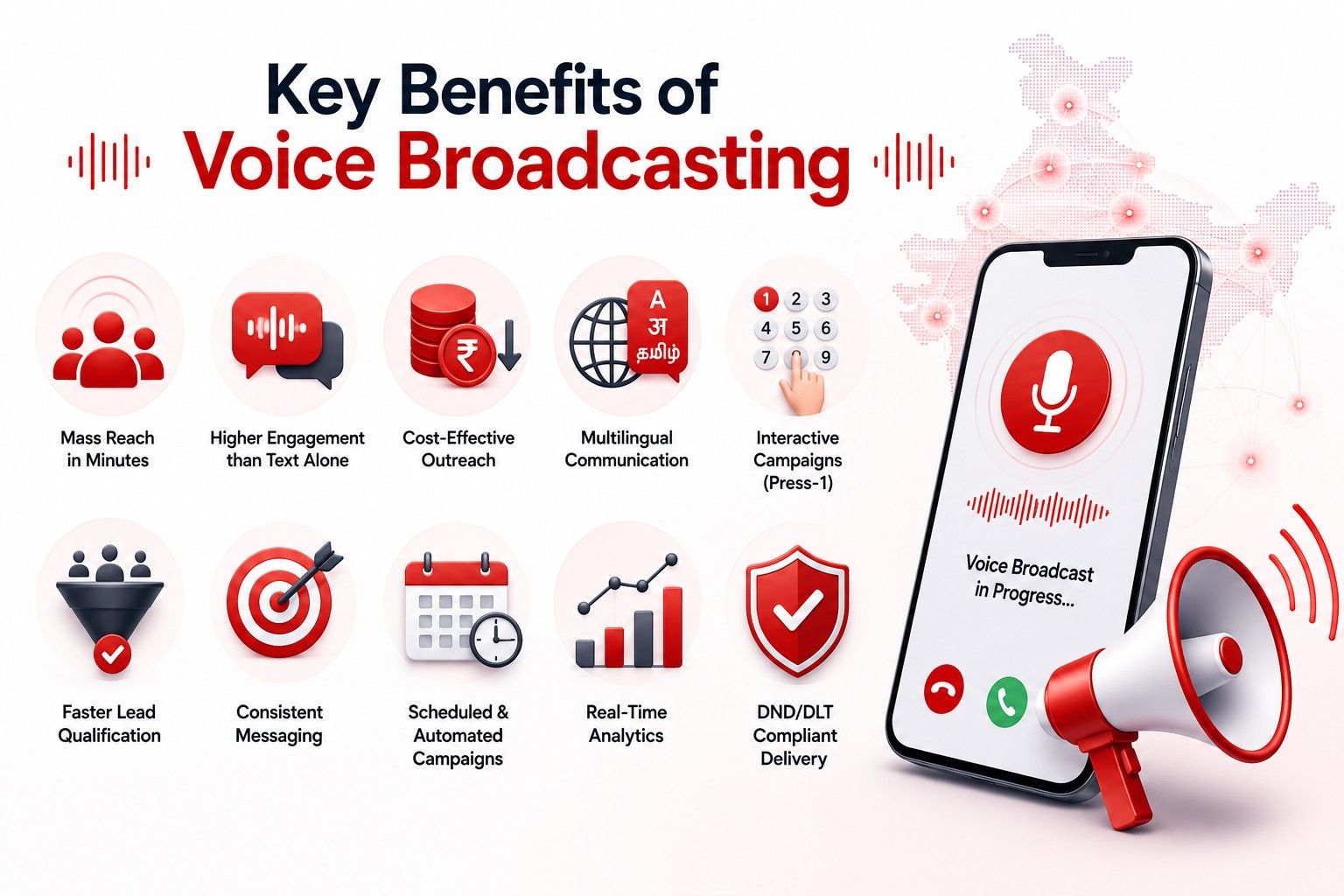
- Mass Reach in Minutes — Deliver a single voice message to thousands of contacts across India almost instantly.
- Higher Engagement Than Text Alone — A spoken message carries urgency and tone that a plain SMS often can’t, especially for time-sensitive alerts.
- Cost-Effective Outreach — Automated bulk voice calls dramatically cut the cost-per-contact compared to manual calling.
- Multilingual Communication — Record or generate messages in Hindi, English, and regional Indian languages to connect with diverse audiences.
- Interactive Campaigns (Press-1) — Let recipients respond in real time — press 1 to connect with an agent, press 2 to opt out, or answer a quick survey.
- Faster Lead Qualification — Filter out uninterested contacts automatically and route only genuine responders to your sales team.
- Consistent Messaging — Every recipient hears the exact same message, eliminating the inconsistency of manual, agent-led calling.
- Scheduled and Automated Campaigns — Plan sends for optimal hours based on audience behaviour and past response data.
- Real-Time Analytics — Track connectivity rate, call duration, keypress responses, and drop-offs to continuously refine your campaigns.
- DND/DLT Compliant Delivery — A responsible voice broadcasting service filters DND-registered numbers and follows TRAI’s TCCCPR 2018 framework, protecting your brand from compliance risk.
Top Use Cases of Bulk Voice Broadcasting
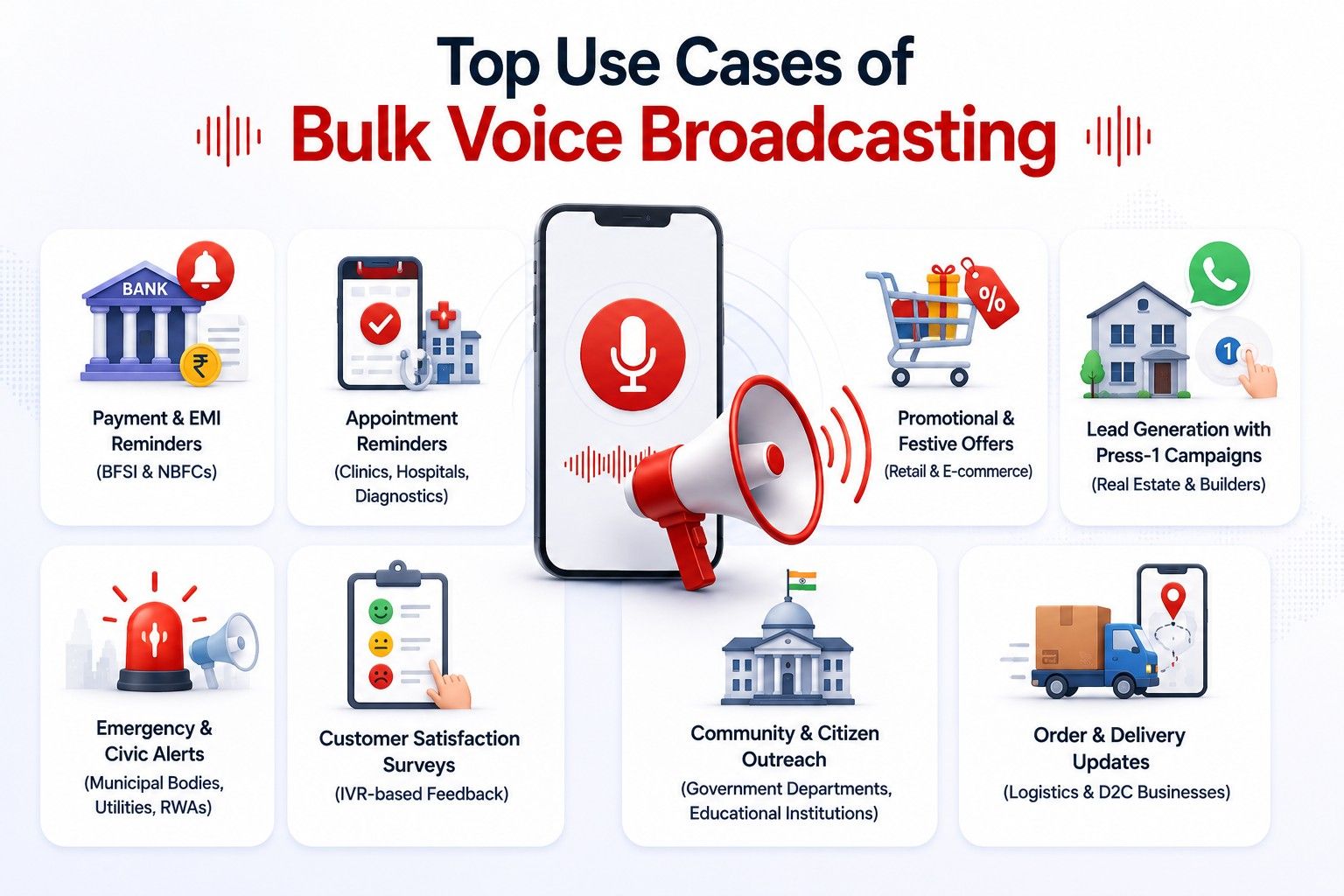
- Payment and EMI reminders for BFSI and NBFCs
- Appointment reminders for clinics, hospitals, and diagnostic centres
- Promotional and festive offers for retail and e-commerce brands
- Lead generation through press-1 interactive campaigns — see how this plays out in WhatsApp marketing for real estate in India, a channel that pairs naturally with voice follow-ups for builders and agents
- Emergency and civic alerts for municipal bodies, utilities, and RWAs
- Customer satisfaction surveys using simple IVR-based feedback
- Community and citizen outreach for government departments and educational institutions
- Order and delivery updates for logistics and D2C businesses
Features to Look For in a Voice Broadcasting Service Provider
Before choosing a bulk voice broadcasting partner, check whether the platform offers:
- Bulk contact upload with easy segmentation
- Text-to-speech in multiple Indian languages
- DND/DNC filtering and TRAI-compliant delivery
- Campaign scheduling and automatic retry for unanswered calls
- Press-1 IVR and live-agent transfer
- Real-time dashboard with detailed call reports
- API and CRM integration for automated workflows
- The ability to combine voice with SMS, WhatsApp, or RCS as fallback channels
TRAI, DND, and DLT Compliance for Voice Broadcasting in India
India regulates commercial voice and messaging communication strictly under TRAI’s TCCCPR (Telecom Commercial Communications Customer Preference Regulation) 2018, along with DLT (Distributed Ledger Technology) registration for commercial senders. A trustworthy voice broadcasting service provider in India will automatically scrub DND-registered numbers, maintain verified sender identities, and keep your campaigns within regulatory limits — protecting your business from penalties and protecting your customers from unwanted communication. This is especially non-negotiable when your recipient list includes government departments, students, or account holders, where compliance failures carry real reputational cost.
Trusted by Government Bodies, PSUs & Leading Enterprises
Anyone can claim to be “the best voice broadcasting service provider.” What’s harder to claim — and far more meaningful — is a track record of government bodies and public sector organizations choosing to work with you, project after project, where compliance, reliability, and data security aren’t negotiable.
DGAS Skyworld has been the preferred communication partner for a range of government and public sector organizations across India, including:
- Agra Nagar Nigam — civic alerts and citizen communication
- Gujarat Council on Science and Technology — institutional and academic outreach
- Punjabi University, Patiala — student and administrative communication
- Indian Institute of Foreign Trade — institutional messaging and notifications
- …and several more government bodies, municipal corporations, and PSUs across India
In total, DGAS Skyworld has delivered 10+ government and PSU projects successfully — a distinction that speaks louder than any marketing claim, because government procurement and compliance checks are simply harder to pass than a typical enterprise sales cycle.
That same reliability extends to private organizations across:
- Healthcare
- Banking
- E-commerce
- Real Estate
- Education
- Logistics
- Retail
If a platform is trusted to send civic alerts on behalf of a municipal corporation or handle institutional communication for a university, it’s a reasonable bet that it can handle your business’s payment reminders, promotional campaigns, or lead-generation calls without missing a beat.
Why DGAS Skyworld Is a Trusted Voice Broadcasting Service Provider in India
DGAS Skyworld has been building CPaaS communication infrastructure for Indian businesses since 2017, and enterprise voice solutions — including bulk voice broadcasting — sit right alongside its SMS API, WhatsApp Business API, RCS messaging, Truecaller messaging, AI chatbot, and email API offerings — all explained in more detail on our Enterprise Voice Solutions page.
What makes DGAS Skyworld a dependable choice for businesses and institutions in India:
- India-focused infrastructure — DGAS Skyworld operates exclusively within India, which means its voice broadcasting and messaging infrastructure is built and optimized specifically for Indian telecom networks, DLT requirements, and TRAI compliance — not adapted from a global, one-size-fits-all system.
- Proven at government scale — with 10+ successfully delivered government and PSU projects, DGAS Skyworld has already cleared the compliance, security, and reliability bar that public sector procurement demands.
- One CPaaS platform, every channel — because voice broadcasting is part of the same platform as SMS, WhatsApp, RCS, and email, businesses can run a payment reminder as a voice call first and automatically fall back to SMS or WhatsApp if the call goes unanswered — all from one dashboard.
- Nearly a decade of CPaaS experience — since 2017, DGAS Skyworld has worked with businesses across BFSI, real estate, healthcare, e-commerce, education, logistics, and retail, building the operational experience a newer vendor simply hasn’t had time to accumulate.
- Compliance-first delivery — DND filtering and DLT-aligned workflows are built into the platform, so businesses don’t have to manage compliance separately for each channel.
How to Choose the Right Voice Broadcasting Partner
Ask these questions before signing up with any provider:
- Can the platform handle your expected calling volume reliably?
- Does it support DND/DNC filtering and DLT-compliant delivery for India?
- Can messages be personalized with customer-specific details?
- Does it support press-1 IVR and live-agent transfer for lead generation?
- Are real-time reports and analytics available?
- Can it integrate with your CRM or internal systems via API?
- Is voice broadcasting available alongside other channels — SMS, WhatsApp, RCS — on one platform?
- Has the provider been trusted by demanding customers such as government bodies or PSUs?
- Does the provider offer dedicated support during setup and campaign execution?
Conclusion
Voice broadcasting remains one of the fastest, most direct ways to reach the 1.34 billion phone connections active across India today — whether for reminders, promotions, alerts, or civic communication. But the real value multiplies when voice broadcasting isn’t a standalone tool, but part of a connected CPaaS platform that also runs your SMS, WhatsApp, RCS, and email communication — backed by a provider whose reliability has already been tested by government bodies, PSUs, and enterprises across every major industry.
Ready to see what a unified, India-first voice broadcasting solution looks like for your business? Book a free demo with DGAS Skyworld or talk to our team to get started.
Frequently Asked Questions
1. What is voice broadcasting service?
Voice broadcasting is an automated technology that sends pre-recorded or text-to-speech voice messages to a large number of phone numbers simultaneously, commonly used for alerts, reminders, promotions, and lead generation.
2. Is voice broadcasting legal in India?
Yes, when it follows TRAI’s TCCCPR regulations, including DND filtering and DLT-registered sender workflows for commercial communication.
3. What is the difference between voice broadcasting and IVR?
Voice broadcasting sends an outbound message to many recipients at once; IVR (Interactive Voice Response) is often used within a broadcast to let recipients respond by pressing keys, or to handle inbound calls.
4. Why should I choose a CPaaS provider for voice broadcasting instead of a standalone vendor?
A CPaaS provider lets you run voice broadcasting alongside SMS, WhatsApp, and RCS on one platform, with unified reporting, shared compliance infrastructure, and automatic fallback between channels — something a single-channel voice vendor cannot offer.
5. Has DGAS Skyworld worked with government organizations?
Yes. DGAS Skyworld has delivered 10+ government and PSU projects, including work with Agra Nagar Nigam, Gujarat Council on Science and Technology, Punjabi University Patiala, and the Indian Institute of Foreign Trade, alongside private enterprises across healthcare, banking, e-commerce, real estate, education, logistics, and retail.
6. Can voice broadcasting messages be personalized?
Yes. Most voice broadcasting software supports dynamic fields such as customer name, due amount, or appointment date using text-to-speech.
7. Does DGAS Skyworld provide voice broadcasting outside India?
No. DGAS Skyworld’s CPaaS services, including voice broadcasting, SMS API, and related solutions, are available exclusively within India.